

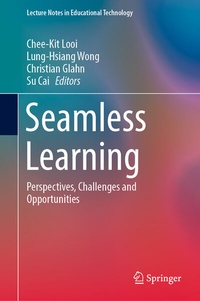
Seamless Learning
Description

This book introduces readers to the latest state of research and development in seamless learning. It consolidates various approaches to and practices in seamless learning from a range of techno-pedagogical, socio-situated and socio-cultural perspectives. Further, it details our current understanding of learning in both formal and informal settings, crossover learning, incidental learning, and context-based learning approaches, together with these aspects' linkages to the notion of seamlessness.
The book is divided into sections addressing the theorization of seamless learning, understanding informal learning, research methodological issues, technology-enabled seamless learning and real-world applications of seamless learning.More details
Other editions
Additional editions
Persons
Lung-Hsiang Wong is a Senior Research Scientist in the National Institute of Education, Nanyang Technological University, Singapore. His research interests include mobile and seamless learning, computer-assisted language learning, computer-supported collaborative learning and teachers' professional development. He is an Associate Editor of the IEEE Transactions on Learning Technologies . He was the lead editor of the scholarly book Seamless Learning in the Age of Mobile Connectivity , published by Springer, and the first author of the Chinese scholarly book Move, Language Learning! - Exploring Seamless and Mobile Language Learning , published by Nanjing University Press.
Christian Glahn is the director of the Blended Learning Center and professor for educational technologies at the HTW Chur, Switzerland. He has studied and researched the fields of computer and educational sciences in Germany, Austria, The Netherlands, and Switzerland and is an active in the technology enhanced learning domain. Glahn co-developed and operationalized the concept of micro learning. He is experienced in bridging innovative personalized and context-aware technologies to formal training, non-formal learning, and performance support in universities, public services, and industries. His research focuses on integrating smart technologies into existing technology-enhanced learning environments and practices in higher education institutions and organizations.
Su Cai is the vice director of Joint Laboratory for Mobile Learning, Ministry of Education-China Mobile Communications Corporation and associate professor at School of Educational Technology, Beijing Normal University. He was the Principal Investigator of many research projects such as National Natural Science Foundation of China, Beijing Education Science "Thirteen Five" Plan, Beijing Higher Education Young Elite Teacher Project, Fundamental Research Funds for the Central Universities and Beijing Natural Science Foundation. His research interests include Virtual Reality/Augmented Reality in Education, 3D Virtual LearningEnvironment and STEM Education.
Content
Part 1 Theoretical Niches and Frameworks for Seamless Learning.- 1. The Conceptual Niche of Seamless Learning: An Invitation to Dialogue.- 2. The Learning Problems behind the Seams in Seamless Learning.- 3. External Representations and the Design of Seamless Learning Systems.- 4. An Inspiration from Border Crossing: Principle of Boundary Activity for Integrating Learning in the Formal and Informal Spaces.- Part 2 Architectures and Technologies for Supporting Seamless Learning.- 5. Towards an Architectural Approach to Supporting Collaborative Seamless Learning Experiences.- 6. Crossing Over Settings, Practices and Experiences: Connecting Learning in Museums and Classrooms.- Part 3 Expositions and Experimentations of Seamless Learning.- 7. Sensors for Seamless Learning.- 8. Designing Seamless Learning Activities for School Visitors in the Context of Fab Lab Oulu.- 9. Supporting Seamless Learning with a Learning Analytics Approach.- 10. Seamless Writing: how the Digitalization of Writing transforms Thinking, Communication and Student Learning.
