

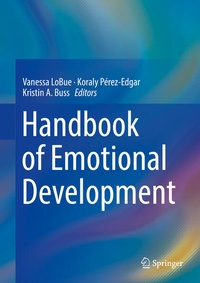
Handbook of Emotional Development
Description

This handbook offers a comprehensive review of the research on emotional development. It examines research on individual emotions, including happiness, anger, sadness, fear, and disgust, as well as self-conscious and pro-social emotions. Chapters describe theoretical and biological foundations and address the roles of cognition and context on emotional development. In addition, chapters discuss issues concerning atypical emotional development, such as anxiety, depression, developmental disorders, maltreatment, and deprivation. The handbook concludes with important directions for the future research of emotional development.
Topics featured in this handbook include:
-
The physiology and neuroscience of emotions.
-
Perception and expression of emotional faces.
-
Prosocial and moral emotions.
-
The interplay of emotion and cognition.
-
The effects of maltreatment on children's emotional development.
-
Potentialemotional problems that result from early deprivation.
The Handbook of Emotional Development is an essential resource for researchers, clinicians/professionals, and graduate students in child and school psychology, social work, public health, child and adolescent psychiatry, pediatrics, and related disciplines.
More details
Other editions
Additional editions
Persons
Koraly Pérez-Edgar, Ph.D., is an Associate Professor of Psychology at the Pennsylvania State University. She received her A.B. from Dartmouth College and her M.A. and Ph.D. from Harvard University. Dr. Perez-Edgar's training was under the mentorship of Dr. Jerome Kagan at Harvard University, Dr. Nathan A. Fox at the University of Maryland, and Dr. Daniel S. Pine at the NIMH. Dr. Perez-Edgar's research focuses on the relations between temperament and psychopathology. In particular, she examines how individual differences in attention can work to ameliorate or exacerbate early temperament traits.
Kristin A. Buss, Ph.D., is a Professor of Psychology at the Pennsylvania State University. She received her B.S. in Child Development at the University of Minnesota and her M.S. and Ph.D. in psychology from University of Wisconsin. She is interested in emotional development and temperamental variation from birth through early adolescence. Her work spans multiple areas of research within social development, psychobiology, and neuroscience. Her current work is focused on the development of risk for adjustment problems, such as anxiety symptoms in toddlers with fearful temperaments. This work has demonstrated significant effects for types of situations where children show fear as well as how biomarkers, such as physiological stress reactivity, increase risk for maladaptive outcomes for these children.
