

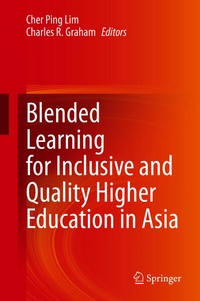
Blended Learning for Inclusive and Quality Higher Education in Asia
Description

This book demonstrates how blended learning improves access to and enhances the quality of higher education teaching and learning in Asian universities. It first discusses how leading universities in the region drive and support blended learning at the institutional level to enhance student learning engagement and outcomes. It then examines 10 effective implementations and lessons learned of blended learning practices across different disciplinary courses and programmes (humanities and language, science and engineering, social science and education, and others) in the region. The chapters in this book provide an overview of the opportunities and challenges of blended learning for improved access and enhanced quality of higher education, and offer insights into the promising blended learning policies and practices in Asian universities.
Reviews / Votes
"The book would inspire and encourage policy makers, administrators, and practitioners to tackle the issues arising from the implementation of BL overnight. . The content of this book is socially, culturally, economically and politically diverse .. . Readers and BL practitioners from other parts of the world will easily identify the contexts that are similar to their own and apply related practices used and lessons learnt from this book to empower their BL implementation." (Liwei Liu, Innovations in Education and Teaching International, January 3, 2022)More details
Other editions
Additional editions
Persons
Lim Cher Ping is the Chair Professor of Learning Technologies and Innovation at The Education University of Hong Kong and the Editor-in-Chief of The Internet and Higher Education. He was the Director of the Centre for Learning, Teaching and Technology until 2014 and has been leading and supporting various quality enhancement initiatives in the university. Over the last two decades, he has engaged major education stakeholders at the national and international levels, including Asian Development Bank, Inter-American Development Bank, UNESCO, and the World Bank, as his research and development partners.
Charles R. Graham is a Professor of Instructional Psychology and Technology at Brigham Young University with interest in technology-mediated teaching and learning. Charles studies the design and evaluation of online and blended learning environments and the use of technology to enhance teaching and learning. Charles has authored 50+ articles in over two-dozen journals and 20+ chapters related to online and blended learning in edited books. In 2015, Charles became a Fellow of the Online Learning Consortium "For outstanding achievement in advancing theory, research and effective practice in online and blended learning." He is also a Fellow with the Michigan Virtual Learning Research Institute for his work to develop a K-12 Blended Teaching Readiness instrument.
