

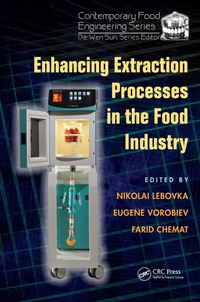
Enhancing Extraction Processes in the Food Industry
1st Edition
Published on 19. April 2016
570 pages
978-1-4398-4595-0 (ISBN)
Description

Extraction is an important operation in food engineering, enabling the recovery of valuable soluble components from raw materials. With increasing energy costs and environmental concerns, industry specialists are looking for improved techniques requiring less solvents and energy consumption. Enhancing Extraction Processes in the Food Industry is a comprehensive resource providing clear descriptions of the latest extraction methods and instruments used in food laboratories.
The book begins with an overview of solvent extraction technology. It examines pulsed electric fields and their effect on food engineering, and the potential and limitations of microwave-assisted extraction. It explores diffusion processes and reviews what is known about electrical discharge processes in the extraction of biocompounds.
Next, the book summarizes current knowledge on conventional and innovative techniques for the intensification of extractions from food and natural products, focusing on environmental impacts. It reviews recent developments in supercritical CO2 extraction of food and food products, describes the pressurized hot water extraction (PHWE) process, and examines future trends for PHWE. The book also examines essential oil extraction, and the tools and techniques of high pressure-assisted extraction. The authors demonstrate its application using litchi and longan fruits as examples.
The final chapters focus on extrusion-assisted extraction, gas-assisted mechanical expression, mechanochemically assisted extraction, reverse micellar extraction, and aqueous two-phase extraction. The book concludes with a chapter on the treatment of soybeans through enzyme-assisted aqueous processing, examining the economics involved as well as the development of the process.
A solid review of modern approaches that enhance extraction processes, this volume is destined to pave the way for future research and development in the field.
The book begins with an overview of solvent extraction technology. It examines pulsed electric fields and their effect on food engineering, and the potential and limitations of microwave-assisted extraction. It explores diffusion processes and reviews what is known about electrical discharge processes in the extraction of biocompounds.
Next, the book summarizes current knowledge on conventional and innovative techniques for the intensification of extractions from food and natural products, focusing on environmental impacts. It reviews recent developments in supercritical CO2 extraction of food and food products, describes the pressurized hot water extraction (PHWE) process, and examines future trends for PHWE. The book also examines essential oil extraction, and the tools and techniques of high pressure-assisted extraction. The authors demonstrate its application using litchi and longan fruits as examples.
The final chapters focus on extrusion-assisted extraction, gas-assisted mechanical expression, mechanochemically assisted extraction, reverse micellar extraction, and aqueous two-phase extraction. The book concludes with a chapter on the treatment of soybeans through enzyme-assisted aqueous processing, examining the economics involved as well as the development of the process.
A solid review of modern approaches that enhance extraction processes, this volume is destined to pave the way for future research and development in the field.
More details
Series
Edition
1. Auflage
Language
English
Place of publication
Baton Rouge
United States
Publishing group
Taylor & Francis Inc
Target group
College/higher education
Food engineers in food ingredient, food flavoring, functional food, and nutraceutical processing and manufacturing facilities; food chemists, food microbioloigists, and other food scientists in food product development.
Illustrations
150 s/w Abbildungen, 45 s/w Tabellen
150 b/w images and 45 tables
ISBN-13
978-1-4398-4595-0 (9781439845950)
Copyright in bibliographic data and cover images is held by Nielsen Book Services Limited or by the publishers or by their respective licensors: all rights reserved.
Schweitzer Classification
Other editions
Additional editions
Nikolai Lebovka | Eugene Vorobiev | Farid Chemat
Enhancing Extraction Processes in the Food Industry
Book
11/2016
CRC Press
€100.00
Shipment within 10-20 days
Nikolai Lebovka | Eugene Vorobiev | Farid Chemat
Enhancing Extraction Processes in the Food Industry
Book
09/2011
1st Edition
CRC Press
€234.00
Shipment within 15-20 days
Persons
Nikolai I. Lebovka is currently head of the Physical Chemistry Department of the Biocolloid Chemistry Institute and professor of physics at Taras Shevchenko National University of Kiev. He studies electric field-induced effects in biological and food materials and is also active in the fields of colloids and biocolloids, theory and applications of nanocomposites, computation physics, and theory and practice of percolation phenomena. He has published more than 230 papers in peer-reviewed journals and several chapters in books, and was a member of the organizing committee of several international conferences.
Eugene Vorobiev
is a full professor at the Chemical Engineering Department and head of Laboratory for Agro-Industrial Technologies at the Universite de Technologie de Compiegne (UTC), France. His main research interests are focused on mass transfer phenomena, theory and practice of solid-liquid separation, and innovative food technologies (especially electrotechnologies). He has published more than 200 peer-reviewed papers and is the author of 18 patents. He was awarded the Gold Medal of the Filtration Society (2001) and is a Laureate of the Price for the innovative technique for the environment (Ademe, 2008). He acted as a chairman of several international conferences.
Farid Chemat
is a full professor of chemistry and director of the Laboratory for Green Extraction Techniques of Natural Products (GREEN) at the Universite d'Avignon et des Pays de Vaucluse, France. His main research interests are focused on innovative and sustainable extraction techniques (especially microwave, ultrasound, and green solvents) for food, pharmaceutical, and cosmetic applications. His research activities are documented by more than 100 scientific peer-reviewed papers and six patents. He is the coordinator of "France Eco-Extraction," a group that deals with international dissemination of research a
Eugene Vorobiev
is a full professor at the Chemical Engineering Department and head of Laboratory for Agro-Industrial Technologies at the Universite de Technologie de Compiegne (UTC), France. His main research interests are focused on mass transfer phenomena, theory and practice of solid-liquid separation, and innovative food technologies (especially electrotechnologies). He has published more than 200 peer-reviewed papers and is the author of 18 patents. He was awarded the Gold Medal of the Filtration Society (2001) and is a Laureate of the Price for the innovative technique for the environment (Ademe, 2008). He acted as a chairman of several international conferences.
Farid Chemat
is a full professor of chemistry and director of the Laboratory for Green Extraction Techniques of Natural Products (GREEN) at the Universite d'Avignon et des Pays de Vaucluse, France. His main research interests are focused on innovative and sustainable extraction techniques (especially microwave, ultrasound, and green solvents) for food, pharmaceutical, and cosmetic applications. His research activities are documented by more than 100 scientific peer-reviewed papers and six patents. He is the coordinator of "France Eco-Extraction," a group that deals with international dissemination of research a
Content
Introduction to Extraction in Food Processing.Pulse Electric Field-Assisted Extraction. Microwave-Assisted Extraction.Ultrasonically Assisted Diffusion Processes.Pulsed Electrical Discharges: Principles and Application to Extraction of Biocompounds. Combined Extraction Techniques. Supercritical Fluid Extraction in Food Processing. Pressurized Hot Water Extraction and Processing. Instant Controlled Pressure Drop Technology in Plant Extraction Processes.High Pressure-Assisted Extraction: Method, Technique, and Application. Extrusion-Assisted Extraction: Alginate Extraction from Macroalgae by Extrusion Process. Gas-Assisted Mechanical Expression of Oilseeds. Mechanochemically Assisted Extraction. Reverse Micellar Extraction of Bioactive Compounds for Food Products. Aqueous Two-Phase Extraction of Enzymes for Food Processing. Enzyme-Assisted Aqueous Extraction of Oilseeds. Index
