

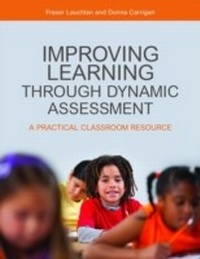
Improving Learning through Dynamic Assessment
A Practical Classroom Resource
1st Edition
Published on 28. March 2013
176 pages
978-0-85700-731-5 (ISBN)
Description

Improving Learning Through Dynamic Assessment is a practical tool for helping to assess and support children aged 4+ with learning challenges based on an innovative approach.
Contrasting with traditional 'static' assessment methods, this resource enables educational psychologists and related professionals to involve the child actively in the process of assessment - allowing them to measure not just what the child has learnt, but also how the child learns, how responsive they are to attempts to intevene, and what is holding them back from learning. It outlines the relevant theory and offers a staged assessment process to follow, with strategies for assessing cognitive and affective capacity. The resource contains all you need to carry out dynamic assessment, featuring photocopiable activities, checklists, handouts for teachers/parents to use with children and training materials which explain the approach in terms understandable to all participating adults.
The first practical resource on how to carry out this popular and innovative form of assessment, Improving Learning through Dynamic Assessment is an important resource for educational psychologists, speech and language therapists, special educational needs coordinators (SENCOs), specialist support teachers and other professionals working with children with learning challenges.
Contrasting with traditional 'static' assessment methods, this resource enables educational psychologists and related professionals to involve the child actively in the process of assessment - allowing them to measure not just what the child has learnt, but also how the child learns, how responsive they are to attempts to intevene, and what is holding them back from learning. It outlines the relevant theory and offers a staged assessment process to follow, with strategies for assessing cognitive and affective capacity. The resource contains all you need to carry out dynamic assessment, featuring photocopiable activities, checklists, handouts for teachers/parents to use with children and training materials which explain the approach in terms understandable to all participating adults.
The first practical resource on how to carry out this popular and innovative form of assessment, Improving Learning through Dynamic Assessment is an important resource for educational psychologists, speech and language therapists, special educational needs coordinators (SENCOs), specialist support teachers and other professionals working with children with learning challenges.
Reviews / Votes
Dynamic assessment sounds an interesting concept and should be practical to implement within the classroom. The materials contained in the book and on the website look as though they could add another layer of assessment input regarding the pupil. This resource would complement the toolkit of many professionals. -- Special Children This will be an excellent resource for educational psychologists and fellow professionals for carrying out the sometimes complex ideas underpinning the dynamic assessment approach. Highly recommended. -- Dr Simon Gibbs, Reader in Educational Psychology, Programme Director for Initial Training in Educational Psychology (DAppEdPsy), Newcastle University, UK Lauchlan and Carrigan have managed to do something that many attempt, and fail. They have produced a very usable book which bridges the gap between theory and practice in applied psychology. For too long dynamic assessment remained in the hands of academics and it always sounded like a good idea but in practice there was little guidance for practitioners to make the move from the more traditional forms of cognitive assessment to a dynamic approach. I cannot recommend this book highly enough and it should be in the hands of all practising educational (school) psychologists. -- Dr Chris Boyle, Senior Lecturer in Psychology and Inclusive Education, Monash University, AustraliaMore details
Language
English
Place of publication
London
United Kingdom
Target group
College/higher education
Professional and scholarly
ISBN-13
978-0-85700-731-5 (9780857007315)
Copyright in bibliographic data and cover images is held by Nielsen Book Services Limited or by the publishers or by their respective licensors: all rights reserved.
Schweitzer Classification
Other editions
Additional editions
Fraser Lauchlan | Donna Carrigan
Improving Learning through Dynamic Assessment
A Practical Classroom Resource
Book
03/2013
Jessica Kingsley Publishers
€75.71
Shipment within 15-20 days
Persons
Fraser Lauchlan is an experienced educational psychologist and owner of Fraser Lauchlan Associates, which offers training and consultancy work relating to educational psychology. He is honorary lecturer at the School of Psychological Sciences and Health, University of Strathclyde, Scotland, and is Visiting Professor at the University of Cagliari, Sardinia. He divides his time between the UK and Italy. Donna Carrigan is a Senior Educational Psychologist based in South Lanarkshire, Scotland and co-author of the Framework of Assessment and Intervention for Resilience (FAIR).
Content
Section 1. Introduction. Section 2. Theory and Rationale. Section 3. Staged Process. Section 4. Intervention. Section 5. Materials. Appendix 1. Case study. Appendix 2. References.
