

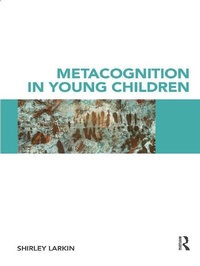
Metacognition in Young Children
Published on 10. September 2009
208 pages
978-1-135-22045-7 (ISBN)
Description

Metacognition is known to be an important factor in academic achievement; however it is also important in a wider life context. The ability to reflect upon how we are thinking can help us to make wiser decisions in all aspects of our life.
This book addresses how metacognition might be fostered in young children. Examining theories of particular relevance to primary school age children the author combines her empirical work over the last 8 years with the work of other researchers to show that children of all ages display metacognitive processing, given the right kind of environment. Drawing on evidence from psychology and education, Metacognition in Young Children brings together international research from different curriculum areas. As well as the traditional areas of science, mathematics and literacy, the author considers metacognition in physical education, art, drama and music. The book argues for a development of metacognition theory, which takes account of wider contextual and political factors. This book includes:
Real classroom examples, taking account of the whole child, socio-cultural context and the curriculum
Practical examples of developing metacognition across the curriculum
Advice on building metacognitive environments in the classroom
Development of metacognition theory
Essential reading for educational psychology and research students, this book will appeal to trainee and practising teachers with an interest in facilitating young children's development into wise and thoughtful adults. It offers practical advice supported by theory and evidence.
This book addresses how metacognition might be fostered in young children. Examining theories of particular relevance to primary school age children the author combines her empirical work over the last 8 years with the work of other researchers to show that children of all ages display metacognitive processing, given the right kind of environment. Drawing on evidence from psychology and education, Metacognition in Young Children brings together international research from different curriculum areas. As well as the traditional areas of science, mathematics and literacy, the author considers metacognition in physical education, art, drama and music. The book argues for a development of metacognition theory, which takes account of wider contextual and political factors. This book includes:
Real classroom examples, taking account of the whole child, socio-cultural context and the curriculum
Practical examples of developing metacognition across the curriculum
Advice on building metacognitive environments in the classroom
Development of metacognition theory
Essential reading for educational psychology and research students, this book will appeal to trainee and practising teachers with an interest in facilitating young children's development into wise and thoughtful adults. It offers practical advice supported by theory and evidence.
More details
Language
English
Place of publication
London
United Kingdom
Publishing group
Taylor & Francis Ltd
Target group
College/higher education
Professional and scholarly
Illustrations
3 s/w Abbildungen, 3 s/w Tabellen
3 Tables, black and white; 3 Illustrations, black and white
File size
1,15 MB
ISBN-13
978-1-135-22045-7 (9781135220457)
Copyright in bibliographic data and cover images is held by Nielsen Book Services Limited or by the publishers or by their respective licensors: all rights reserved.
Schweitzer Classification
Other editions
Additional editions
Shirley Larkin
Metacognition in Young Children
Book
07/2009
1st Edition
Routledge
€69.00
Shipment within 15-20 days
Shirley Larkin
Metacognition in Young Children
Book
07/2009
1st Edition
Routledge
€206.10
Shipment within 15-20 days
Person
Content
Part 1: Metacognition in Children and Adults 1. What is Metacognition? 2. Why Develop Metacognition? 3. Ages and Stages Part 2: Metacognition Across Subject Domains 4. Science and Mathematics 5. Reading and Writing 6. Metacognition in Other Subjects Part 3: Facilitating Metacognition 7. Teachers and Metacognition 8. Context and Metacognition 9. Policy and Metacognition Part 4: New Thinking 10. Developments in Metacognition Research 11. Possible Futures References
