

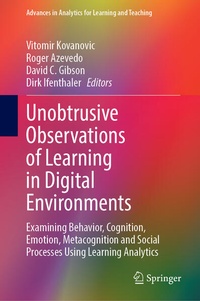
Unobtrusive Observations of Learning in Digital Environments
Description

This book integrates foundational ideas from psychology, immersive digital learning environments supported by theories and methods of the learning sciences, particularly in pursuit of questions of cognition, behavior and emotion factors in digital learning experiences. New and emerging foundations of theory and analysis based on observation of digital traces are enhanced by data science, particularly machine learning, with extensions to deep learning, natural language processing and artificial intelligence brought into service to better understand higher-order thinking capacities such as self-regulation, collaborative problem-solving and social construction of knowledge. As a result, this edited volume presents a collection of indicators or measurements focusing on learning processes and related behavior, (meta-)cognition, emotion and motivation, as well as social processes. In addition, each section of the book includes an invited commentary from a related field, such as educational psychology, cognitive science, learning science, etc.
More details
Other editions
Additional editions
Persons
Vitomir Kovanovic is the Senior Lecturer in Learning Analytics at the Centre for Change and Complexity in Learning (C3L), Education Futures, University of South Australia, Australia. His research focuses on learning analytics within high school and university settings, looking at student self-regulation and study strategies. Vitomir is an associated editor for the Higher Education Research & Development Journal (Taylor and Francis) and Academic Editor for PLoS ONE Journal (Public Library of Science). He was also Program Chair for the 2020 Learning Analytics & Knowledge Conference (LAK'20).
Roger Azevedo is a Professor in the School of Modeling Simulation and Training at the University of Central Florida (UCF). He is the Lead Scientist for UCF's Learning Sciences Faculty Cluster Initiative. His main research area includes examining the role of cognitive, metacognitive, affective, and motivational self-regulatory processes during learningwith advanced learning technologies. He is the former editor of the Metacognition and Learning journal, a fellow of the American Psychological Association, and the recipient of the prestigious Early Faculty Career Award from the National Science Foundation.
David Gibson is Professor and UNESCO Chair on Data Science in Higher Education Learning and Teaching at Curtin University, Australia. His foundational research demonstrated the feasibility of bridging from qualitative information to quantifiable dynamic relationships in complex models that verify trajectories of organizational change. He provides thought leadership as a researcher, professor, learning scientist and innovator. He is the creator of simSchool, a classroom flight simulator for preparing educators, and eFolio an online performance-based assessment system, and provides vision and sponsorship for Curtin University's Challenge, a mobile, game-based learning platform.
Dirk Ifenthaler is Professor and Chair of Economic and Business Education - Learning, Design and Technology at University of Mannheim, Germany and UNESCO Deputy Chair on Data Science in Higher Education Learning and Teaching at Curtin University, Australia. His research outcomes include numerous co-authored books, book series, book chapters, journal articles, and international conference papers, as well as successful grant funding in Australia, Germany, and USA. He is the Editor-in-Chief of the Technology, Knowledge and Learning and Senior Editor of Journal of Applied Research in Higher Education.
