

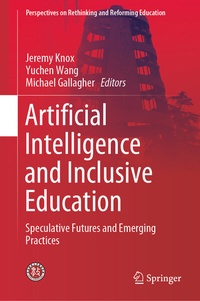
Artificial Intelligence and Inclusive Education
Speculative Futures and Emerging Practices
1st Edition
Published on 13. June 2019
XIII, 206 pages
978-981-13-8161-4 (ISBN)
Description

This book brings together the fields of artificial intelligence (often known as A.I.) and inclusive education in order to speculate on the future of teaching and learning in increasingly diverse social, cultural, emotional, and linguistic educational contexts. This book addresses a pressing need to understand how future educational practices can promote equity and equality, while at the same time adopting A.I. systems that are oriented towards automation, standardisation and efficiency. The contributions in this edited volume appeal to scholars and students with an interest in forming a critical understanding of the development of A.I. for education, as well as an interest in how the processes of inclusive education might be shaped by future technologies. Grounded in theoretical engagement, establishing key challenges for future practice, and outlining the latest research, this book offers a comprehensive overview of the complex issues arising from the convergence of A.I. technologiesand the necessity of developing inclusive teaching and learning.
To date, there has been little in the way of direct association between research and practice in these domains: A.I. has been a predominantly technical field of research and development, and while intelligent computer systems and 'smart' software are being increasingly applied in many areas of industry, economics, social life, and education itself, a specific engagement with the agenda of inclusion appears lacking. Although such technology offers exciting possibilities for education, including software that is designed to 'personalise' learning or adapt to learner behaviours, these developments are accompanied by growing concerns about the in-built biases involved in machine learning techniques driven by 'big data'.
To date, there has been little in the way of direct association between research and practice in these domains: A.I. has been a predominantly technical field of research and development, and while intelligent computer systems and 'smart' software are being increasingly applied in many areas of industry, economics, social life, and education itself, a specific engagement with the agenda of inclusion appears lacking. Although such technology offers exciting possibilities for education, including software that is designed to 'personalise' learning or adapt to learner behaviours, these developments are accompanied by growing concerns about the in-built biases involved in machine learning techniques driven by 'big data'.
Reviews / Votes
"The book would be of great significance to researchers working in the fields of education, AI, and other branches of the social sciences." (C K Raju, Computing Reviews, August 28, 2020)
More details
Series
Language
English
Place of publication
Singapore
Singapore
Publishing group
Springer Singapore
Target group
Professional and scholarly
Product notice
Reflowable
Illustrations
XIII, 206 p. 18 illus., 13 illus. in color.
File size
3,00 MB
ISBN-13
978-981-13-8161-4 (9789811381614)
DOI
10.1007/978-981-13-8161-4
Schweitzer Classification
Other editions
Additional editions
Jeremy Knox | Yuchen Wang | Michael Gallagher
Artificial Intelligence and Inclusive Education
Speculative Futures and Emerging Practices
Book
06/2019
Springer
€171.19
Shipment within 15-20 days
Persons
Jeremy Knox is a Lecturer in Digital Education at the University of Edinburgh, UK, and Co-Director of the Centre for Research in Digital Education. His research interests include critical posthumanism, open education, and data-intensive technologies in teaching and learning. His published work includes critical perspectives on open educational resources, massive open online courses, and learning analytics.
Yuchen Wang is a Research Associate & Tutor at the Institute for Education, Community and Society at the University of Edinburgh, UK. Her research focuses on inclusive education development, and in particular, the implications of student voice for transforming practice.
Michael Gallagher is a Research Associate at the Centre for Research in Digital Education at the University of Edinburgh, UK, and Director and Co-Founder of a digital education and ICT4D consultancy. His research interests include teacher training, digital education, open learning, mobile learning, critical theory, cultural heritage, and ethical design.
Yuchen Wang is a Research Associate & Tutor at the Institute for Education, Community and Society at the University of Edinburgh, UK. Her research focuses on inclusive education development, and in particular, the implications of student voice for transforming practice.
Michael Gallagher is a Research Associate at the Centre for Research in Digital Education at the University of Edinburgh, UK, and Director and Co-Founder of a digital education and ICT4D consultancy. His research interests include teacher training, digital education, open learning, mobile learning, critical theory, cultural heritage, and ethical design.
Content
1. Introduction.- Part 1: Theorising A.I. for Inclusive Education.- 2. AI, Human Evolution, and the Speed of Learning.- 3. (Post)Humanisim and Technological In/Exclusions.- 4. We Shape Our Algorithms; Thereafter They Shape Us.- Part 2: Challenges for A.I. and Inclusion.- 5. Towards Inclusive Education in the Age of Artificial Intelligence: Perspectives, Challenges and Opportunities.- 6. The Curriculum of Artificial Intelligence and the Curriculum of (Human) Tradition: Accumulated Advantages, 5G Networks, and Inclusion.- 7. A Solution for Inclusion? Chinese Teachers' Perceptions of Artificial Intelligence.- 8. Inclusive Education for Students with Chronic Illness - Technological Challenges and Opportunities.- Part 3: ('Artificial') Pedagogical Relationships.- 9. AI and Education: The Importance of Teacher and Student Relations.- 10. A Communication Model of Human-Robot Trust Development for Inclusive Education.- 11. The Consequences of Breakdowns in Children's Interactions with a Robotic Tutor.- Part 4: Emerging Practices.- 12. An Evaluation of the Effectiveness of Using Pedagogical Agents and Life Coaches for Teaching in Inclusive Ways.- 13. AIED Meets Inclusive Educational Technology - the Technical State-of-Art and Possible Directions.- 14. Inclusive Vocational Education Supported by A.I..- 15. A.I. Influences on Practical Pretending, Escapism and Role Playing through Simulations in the Classroom.
