

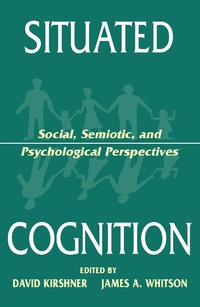
Situated Cognition
Social, Semiotic, and Psychological Perspectives
1st Edition
Published on 16. December 2021
336 pages
978-1-000-14925-8 (ISBN)
Description

This book is a result of a symposium at a recent annual meeting of the American Educational Research Association that explored foundational issues relative to situated cognition theory. Its chapters contribute to discourse about repositioning situated cognition theory within the broader supporting disciplines and to resolving the problematics addressed within the book.
There is a cumulative vision to the book -- its theme is that the notion of the individual in situated cognition theory needs to be fundamentally reformulated. No theoretical reconfiguration of the social world or of social practices can overcome an individual cast in the dualist tradition. This reformulation probes the physiological, psychoanalytic, and semiotic constitution of persons. Chapters authors cover a wide range of topics including:
* transfer of training -- arguing that traditional cognitive psychology has found precious little evidence of people's ability to apply knowledge gained in one context to the problems encountered in another;
* ecosocial systems -- a new object of inquiry for situated cognition theory in which the primary units of analysis are not things or people, but processes and practices;
* how linkages between discursive practices are manifested as semiotic chaining of signifiers for individuals engaged in everyday activities at home or at school;
* how the ability to function in ways that are consistent with logic emerges not through reflective abstraction on actions, but through an enhanced sense of agency as more responsible roles are adopted in daily life practices;
* the mutual constitution of social and individual knowledge -- familiar terms and concepts normally available through linguistic labels are cultural models, to be distinguished from the variegated and hidden mid-level meanings that reflect their situated uses in social activity;
* the material (neurological) substrate through which cultural models and mid-level meanings emerge; and
* how learning environments can be structured to take advantage of the perceptual underpinnings of cognition.
There is a cumulative vision to the book -- its theme is that the notion of the individual in situated cognition theory needs to be fundamentally reformulated. No theoretical reconfiguration of the social world or of social practices can overcome an individual cast in the dualist tradition. This reformulation probes the physiological, psychoanalytic, and semiotic constitution of persons. Chapters authors cover a wide range of topics including:
* transfer of training -- arguing that traditional cognitive psychology has found precious little evidence of people's ability to apply knowledge gained in one context to the problems encountered in another;
* ecosocial systems -- a new object of inquiry for situated cognition theory in which the primary units of analysis are not things or people, but processes and practices;
* how linkages between discursive practices are manifested as semiotic chaining of signifiers for individuals engaged in everyday activities at home or at school;
* how the ability to function in ways that are consistent with logic emerges not through reflective abstraction on actions, but through an enhanced sense of agency as more responsible roles are adopted in daily life practices;
* the mutual constitution of social and individual knowledge -- familiar terms and concepts normally available through linguistic labels are cultural models, to be distinguished from the variegated and hidden mid-level meanings that reflect their situated uses in social activity;
* the material (neurological) substrate through which cultural models and mid-level meanings emerge; and
* how learning environments can be structured to take advantage of the perceptual underpinnings of cognition.
More details
Edition
1. Auflage
Language
English
Place of publication
London
United Kingdom
Publishing group
Taylor & Francis Ltd
Target group
College/higher education
Product notice
Reflowable
ISBN-13
978-1-000-14925-8 (9781000149258)
Copyright in bibliographic data and cover images is held by Nielsen Book Services Limited or by the publishers or by their respective licensors: all rights reserved.
Schweitzer Classification
Other editions
Additional editions

David Kirshner | James A. Whitson
Situated Cognition
Social, Semiotic, and Psychological Perspectives
Book
05/1997
Lawrence Erlbaum Associates Inc
€63.39
Article exhausted; check different version
David Kirshner | James A. Whitson
Situated Cognition
Social, Semiotic, and Psychological Perspectives
Book
05/1997
Routledge
€207.00
Shipment within 10-20 days
Persons
David Kirshner (Edited by) , James A. Whitson (Edited by)
Content
Contents: Preface. Acknowledgements. D. Kirshner, J.A. Whitson, Editors' Introduction. J. Lave, The Culture of Acquisition and the Practice of Understanding. J. Lemke, Cognition, Context, and Learning: A Social Semiotic Perspective. V. Walkerdine, Redefining the Subject in Situated Cognition Theory. P. Agre, Living Math: Lave and Walkerdine on the Meaning of Everday Arithmetic. D. Kirshner, The Development of Logic in Infancy: A Case Study. J.A. Whitson, Cognition as a Semiotic Process: From Situated Mediation to Critical Reflective Transcendence. P. Cobb, K. Gravemeijer, E. Yackel, K. McClain, J. Whitenack, Mathematizing and Symbolizing: The Emergence of Chains of Signification in One First-Grade Classroom. J.P. Gee, Thinking, Learning, and Reading: The Situated Sociocultural Mind. J. St. Julien, Explaining Learning: The Research Trajectory of Situated Cognition and the Implications of Connectionism. C. Bereiter, Situated Cognition and How to Overcome It. Y. Engestroem, M. Cole, Afterword: Situated Cognition in Search of an Agenda.
