

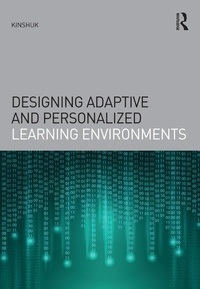
Designing Adaptive and Personalized Learning Environments
Published on 31. March 2016
190 pages
978-1-317-74771-0 (ISBN)
Description

Designing Adaptive and Personalized Learning Environments provides a theoretically-based yet practical guide to systematic design processes for learning environments that provide automatic customization of learning and instruction.
The book consists of four main sections: In "Introduction and Overview," the concepts of adaptivity and personalization are introduced and explored in detail. In "Theoretical Perspectives with Example Applications," various theoretical concepts underlying adaptive and personalized learning are discussed, including cognitive profiling, content-based adaptivity, exploration-based adaptivity, and mobile and ubiquitous settings. In "Practical Perspectives with Example Applications," the implementation process for adaptive and personalized learning environments is described, followed by application in various contexts. In "Validation and Future Trends," various evaluation techniques for validating the efficiency and efficacy of adaptive and personalized learning systems are discussed. This final section concludes with a discussion of emerging trends in adaptive and personalized learning research.
Based on cutting-edge research, Designing Adaptive and Personalized Learning Environments is appropriate as a primary textbook for both undergraduate and graduate courses focused on the design of learning systems, and as a secondary textbook for a variety of courses in programs such as educational technology, instructional design, learning sciences, digital literacy, computer based systems, and STEM content fields.
The book consists of four main sections: In "Introduction and Overview," the concepts of adaptivity and personalization are introduced and explored in detail. In "Theoretical Perspectives with Example Applications," various theoretical concepts underlying adaptive and personalized learning are discussed, including cognitive profiling, content-based adaptivity, exploration-based adaptivity, and mobile and ubiquitous settings. In "Practical Perspectives with Example Applications," the implementation process for adaptive and personalized learning environments is described, followed by application in various contexts. In "Validation and Future Trends," various evaluation techniques for validating the efficiency and efficacy of adaptive and personalized learning systems are discussed. This final section concludes with a discussion of emerging trends in adaptive and personalized learning research.
Based on cutting-edge research, Designing Adaptive and Personalized Learning Environments is appropriate as a primary textbook for both undergraduate and graduate courses focused on the design of learning systems, and as a secondary textbook for a variety of courses in programs such as educational technology, instructional design, learning sciences, digital literacy, computer based systems, and STEM content fields.
Reviews / Votes
"Kinshuk takes the complex subjects of personalization and adaptive learning and makes them accessible to students of learning and educational technology. In so doing, he also introduces the reader to some of the dominant themes in the field over the last decade, from reusable learning objects to cognitive load theory to personal profiling. This book is a valuable starting point for any reader studying contemporary educational technology."--Stephen Downes, Program Leader in Learning and Performance Support Systems at the National Research Council Canada
"The technologies of adaptivity and personalization have the potential to change learning environments and to provide students with individual supports fitting their unique characteristics. This book will help readers understand the general concepts, theoretical and practical applications, and future trends of adaptive and personalized learning environments."
--Ronghuai Huang, Professor and Co-Director at the Smart Learning Institute of Beijing Normal University, China
More details
Series
Language
English
Place of publication
London
United Kingdom
Publishing group
Taylor & Francis Ltd
Target group
College/higher education
Illustrations
1 s/w Tabelle, 13 s/w Abbildungen
1 Tables, black and white; 13 Illustrations, black and white
File size
0,93 MB
ISBN-13
978-1-317-74771-0 (9781317747710)
Copyright in bibliographic data and cover images is held by Nielsen Book Services Limited or by the publishers or by their respective licensors: all rights reserved.
Schweitzer Classification
Other editions
Additional editions
Book
04/2016
1st Edition
Routledge
€241.90
Shipment within 10-20 days
Book
04/2016
1st Edition
Routledge
€67.80
Shipment within 10-20 days
Person
Kinshuk is Associate Dean of Faculty of Science and Technology and Full Professor in the School of Computing and Information Systems at Athabasca University, Canada. He also holds the NSERC/CNRL/Xerox/McGraw Hill Industrial Research Chair for Adaptivity and Personalization in Informatics. He is founding chair of IEEE Technical Committee on Learning Technologies, and founding editor of the Journal of Educational Technology and Society and the Smart Learning Environments journal.
Content
Acknowledgements
Section 1: Introduction and Overview
Chapter 1: Defining Adaptivity and Personalization
Chapter 2: Adaptivity and Personalization in Life-Long Learning
Chapter 3: Contexts
Section 2: Theoretical Perspectives with Example Applications
Chapter 4: Cognitive Profiling
Chapter 5: Content-Based Adaptivity and Personalization
Chapter 6: Adaptivity and Personalization in Exploration-Based Learning
Chapter 7: Adaptivity and Personalization in Mobile and Ubiquitous Settings
Section 3: Practical Perspectives with Example Applications
Chapter 8: Implementation Process of Adaptive and Personalized Learning Environments
Chapter 9: Adaptivity and Personalization of Learning in Various Contexts
Chapter 10: Reusability in Adaptive and Personalized Learning
Section 4: Validation and Future Trends
Chapter 11: Evaluation of Adaptive and Personalized Systems
Chapter 12: Future Development and Research Issues
Index
Section 1: Introduction and Overview
Chapter 1: Defining Adaptivity and Personalization
Chapter 2: Adaptivity and Personalization in Life-Long Learning
Chapter 3: Contexts
Section 2: Theoretical Perspectives with Example Applications
Chapter 4: Cognitive Profiling
Chapter 5: Content-Based Adaptivity and Personalization
Chapter 6: Adaptivity and Personalization in Exploration-Based Learning
Chapter 7: Adaptivity and Personalization in Mobile and Ubiquitous Settings
Section 3: Practical Perspectives with Example Applications
Chapter 8: Implementation Process of Adaptive and Personalized Learning Environments
Chapter 9: Adaptivity and Personalization of Learning in Various Contexts
Chapter 10: Reusability in Adaptive and Personalized Learning
Section 4: Validation and Future Trends
Chapter 11: Evaluation of Adaptive and Personalized Systems
Chapter 12: Future Development and Research Issues
Index
