

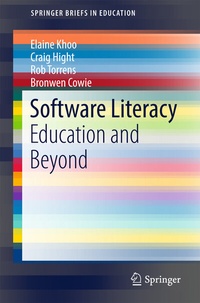
Software Literacy
Description

This book explores the notion of software literacy, a key part of digital literacy which all contemporary students and citizens need to understand. Software literacy involves a critical understanding of how the affordances and conceptual approaches of everything from operating systems, creative apps and media editors, to software-based platforms and infrastructures work to inform and shape the ways we think and act. As a cultural artefact, programing code plays a role in reproducing, reinforcing, and augmenting existing cultural practices, as well as generating completely new coded practices. A proposed three-tier framework for software literacy is the focus for a two-year empirical investigation into how tertiary students become more literate about the nature and implications of software they encounter as part of their tertiary studies. Two case studies of software learning and use in university-level engineering and screen & media studies courses are presented, investigating the mapping of students' trajectory of the learning of desktop applications against this framework for software literacy.
Though the book's focus is primarily educational, its content also has implications for any field that makes use of software and information & communication technology systems and applications. As such, the book will be of interest to all readers whose work involves the challenges and opportunities presented by software-based teaching and learning; and to those interested in how software impacts the workplace and leisure activities that make up our day-to-day lives.
More details
Other editions
Additional editions
Persons
Dr Craig Hight is an Associate Professor of Creative Industries at the University of Newcastle, Australia. His current research focuses on the relationships between digital media technologies and documentary practice, especially the variety of factors shaping online documentary cultures. He has published broadly on audience research, digital media and documentary theory. More details at: https://www.newcastle.edu.au/profile/craig-hight
Dr Rob Torrens is a lecturer at the University of Waikato. His engineering education interests focus on the transition from high school; the first-year experience; and improving student engagement and performance. More details at: http://sci.waikato.ac.nz/about-us/people/torrens
Professor Bronwen Cowie is Director of the Wilf Malcolm Institute of Educational Research at the University of Waikato. Her research interests include assessment for learning, student voice, the role of ICTs in teaching and learning, and curriculum implementation. She has published extensively on a number of national evaluation projects, as well as research projects that have investigated the nuances of classroom interactions. More details at: http://www.waikato.ac.nz/wmier/about-us/people/bronwen-cowie
