

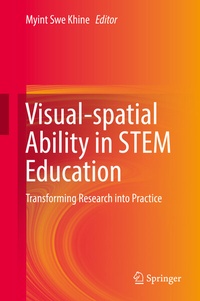
Visual-spatial Ability in STEM Education
Description

Each chapter in this book makes a unique contribution to the body of the literature and enhances the understanding of spatial ability and its influence on learning in the STEM disciplines. It addresses spatial abilities, ways to measure them as well as their impact and how they can affect learning subjects in scientific, technology and engineering domains. The volume deliberately covers a wide range perspectives from cognitive psychology, educational psychology, science, technology, engineering and mathematics, computer science, information technology disciplines to human development. Taking a broad view on the topic, chapters in the book discuss how to define spatial ability and its factors, the measurement of spatial ability and psychometric analyses, and educational strategies to improve spatial skills and their implications for science and technology education. The book thus provides an overview of current thinking about visual-spatial ability, spatial reasoning, and spatial skills.
Reviews / Votes
"The eleven entries are divided in two sections, the first focusing on measurement and development of spatial ability, and the second on research and practice. . Visual-spatial Ability in STEM Education: Transforming Research into Practice is a good read for those interested in spatial reasoning research, for mathematics educators wanting to make an impact on children's development of spatial reasoning, and for all who work with STEM students and programs." (Cindia Davis Stewart, MAA Reviews, maa.org, July, 2017)More details
Other editions
Additional editions
Person
Dr. Myint Swe Khine is a Professor and Chair of Assessment and Evaluation Centre, Emirates College for Advanced Education, United Arab Emirates and Adjunct Professor at the Science and Mathematics Education Centre, Curtin University, Perth, Australia. He obtained Master degrees from the University of Southern California, Los Angeles, USA and University of Surrey, Guildford, UK, and Doctor of Science Education from Curtin University, Australia. Before joining ECAE, he worked at the National Institute of Education, Nanyang Technological University in Singapore. He has published widely and edited books on science education. Recent book Science Education in East Asia: Pedagogical Innovations and Research-informed Practices is published by Springer in 2015.
Content
PART I Introduction.- Chapter 1 Spatial Cognition: Key to STEM Success, Myint Swe Khine.- PART II Measurement and Development of Spatial Ability.- Chapter 2 Validity of Spatial Ability Tests for Selection into STEM (Science, Technology, Engineering, and Mathematics) Career Fields, Laura G. Barron, Mark R. Rose, & James Johnson, Thomas R. Carretta.- Chapter 3 Spatial Ability: Measurement and Development, Rita Nagy-Kondor.- Chapter 4 Measuring Spatial Visualization: Test Development Study, Nazan Sezen Yuksel.- Chapter 5 Investigating Individual Differences in Visuo-Spatial Ability: Research Paradigms and Methodologies, Lu Wang.- PART II Research and Practices in Spatial Ability.- Chapter 6 What Innovations Have We Already Lost? : The Importance of Identifying and Developing Spatial Talent, Jonathan Wai, Harrison J. Kell.- Chapter 7Empowering Visuo-spatial Abilities among Italian Primary School Children: From Theory to Practice, Chiara Fastame.- Chapter 8 The Improvement of Spatial Ability: Do We Measure What We Intend to Measure? Yi-Ling Cheng.- Chapter 9 Mediator role of Information and Communication Technologies (ICTs) in Spatial Thinking, Melih Turgut.- Chapter 10 Visuospatial Working Memory as a Part of Information-Processing System - A Modifiable Resource behind Academic Learning? Minna Kyttälä.- Chapter 11 Gender Differences in Visual-spatial Ability and Their Implications for STEM-fields, David Reilly & David Neumann, Glenda Andrews.- Chapter 12 Ranking and Predicting Results for Different Training Activities to Develop Spatial Abilities, Jorge Martín-Gutierrez.- Index.
