

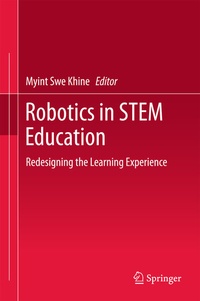
Robotics in STEM Education
Description

This book describes recent approaches in advancing STEM education with the use of robotics, innovative methods in integrating robotics in school subjects, engaging and stimulating students with robotics in classroom-based and out-of-school activities, and new ways of using robotics as an educational tool to provide diverse learning experiences. It addresses issues and challenges in generating enthusiasm among students and revamping curricula to provide application focused and hands-on approaches in learning . The book also provides effective strategies and emerging trends in using robotics, designing learning activities and how robotics impacts the students' interests and achievements in STEM related subjects.
The frontiers of education are progressing very rapidly. This volume brought together a collection of projects and ideas which help us keep track of where the frontiers are moving. This book ticks lots of contemporary boxes: STEM, robotics, coding, and computational thinking among them. Most educators interested in the STEM phenomena will find many ideas in this book which challenge, provide evidence and suggest solutions related to both pedagogy and content. Regular reference to 21st Century skills, achieved through active collaborative learning in authentic contexts, ensures the enduring usefulness of this volume.
John Williams
Professor of Education and Director of the STEM Education Research Group
Curtin University, Perth, Australia
More details
Other editions
Additional editions
Person
Content
Bringing Robotics in Classrooms, Amy Eguchi.- Meeting 21st Century Robotics and Automation Workforce Needs, Alex Sergeyev.- The Open Academic Robot Kit, Raymond Sheh.- Robotics Festival and Competitions Designed for STEM+C Education, ChanJin Chung, Christopher Cartwright, and Joe DeRose.- Systems Thinking Approach to Robotics Curriculum in Schools, Christina Chalmers.- How have Robots supported STEM Teaching? Fabiane Barreto, Vavassori Benitti, Newton Spolaôr.- Combating the War Against Machines through an Innovative, Hands-on Approach to Coding, Jacqui Chetty.- The Impact of Learning through Educational Robotics inK-8 School Subjects, Park Jungho.- Dancing, Drawing, and Dramatic Robots: Integrating Robotics and the Arts to Teach Foundational STEAM Concepts to Young Children, Amanda Sullivan, Amanda Strawhacker, Marina Umaschi Bers.-STEM Education by Exploring Robotics, Francis Tuluri.- Robotics as Educational Tool: Enhancing STEM Education, Myint Swe Khine.
