

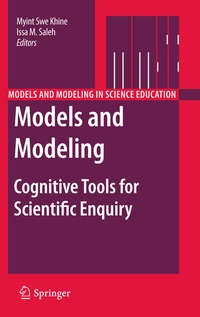
Models and Modeling
Description

More details
Other editions
Additional editions
Content
PART I - Theory Formation and Modeling in Science Education.- Chapter 1. Modeling and the Future of Science Learning, Richard K. Coll, Denis Laijum.- Chapter 2. A Study of Expert Theory Formation: The Role of Different Model Types and Domain Frameworks, Allan Collins.-Chapter 3. The Nature of Scientific Meta-Knowledge, Barbara Y. White, Allan Collins, John R. Frederiksen.- Chapter 4. From Modeling Schemata to the Profiling Schema: Modeling across the Curricula for Profile Shaping Education, Ibrahim A. Halloun. - PART II - Modeling and Student Learning in Science Education.- Chapter 5. Helping Students Construct Robust Conceptual Models, Colleen Megowan-Romanowicz.- Chapter 6. The Molecular Workbench Software: An Innovative Dynamic Modeling Tool for Nanoscience Education, Charles Xie, Amy Pallant .- Chapter 7. Lowering the Learning Threshold: Multi-Agent-Based Models and Learning Electricity, Pratim Sengupta, Uri Wilensky.- Chapter 8. Engineering-based Modeling Experiences in the Elementary and Middle Classroom, Lyn D. English, Nicholas G. Mousoulides.- Chapter 9. Engaging Elementary Students in Scientific Modeling: The MoDeLS 5th Grade Approach and Findings, Hamin Baek, Christina Schwarz, Jing Chen, Hayat Hokayem, Li Zhan.- PART III - Modeling and Teachers' Knowledge.- Chapter 10. Relationships between Elementary Teachers' Conceptions of Scientific Modeling and the Nature of Science, Valarie L. Akerson, Orvil White, Huseyin Colak,Khemmawaddee Pongsanon.- Chapter 11. Science teachers' knowledge about learning and teaching models and modeling in Public Understanding of Science, Ineke Henze, Jan H. van Driel.- Chapter 12. Teaching Pre-serviceElementary Teachers to Teach Science with Computer Models, Nicos Valanides, Charoula Angeli.- Subject Index.
