

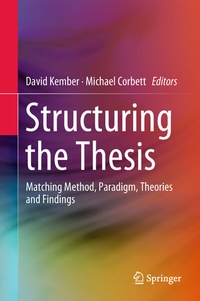
Structuring the Thesis
Description

The book is a collective investigation of the structuring of theses in education, the social sciences and other disciplines that commonly do not follow the standard procedures of the scientific method. To help research students design a structure for their own thesis and liberate their investigations from the constraints associated with the use of the conventional structure, it explains how the structures adopted were designed to suit the topic, methodology and paradigm. It also provides a wide range of examples to draw upon, which suit a broad spectrum of theory, methodological approaches, research methods and paradigms. Additionally, by analyzing the methodologies and paradigms, and reviewing the methodological and paradigmatic spectrum, it offers a significant contribution to the way research is conceptualized.
The book addresses a number of key questions faced by students, supervisors and examiners:
Why do examiners often find it difficult to read work in non-scientific disciplines when theses are structured in accordance with the conventional scientific method?
Why do students in non-scientific disciplines struggle to write up the outcomes of their research in the conventional structure?
What alternative thesis structures can be devised to better suit the wide range of methods?
Which theories and paradigms are commonly followed in education and the social sciences and how do these perspectives influence the research process?
What methods, theories and paradigms are commonly adopted by education and social science students and what problems do these pose when students write their theses?
More details
Other editions
Additional editions
Persons
Michael Corbett is an educational sociologist whose work draws on social theory, as well as historical and geographic traditions. He has worked at the School of Education at Acadia University in Canada since 2002 with a three-year sojourn at the University of Tasmania (2015-17), where he held a research professorship in rural and regional education, and where he continues to hold an adjunct professorship. Corbett's work focuses principally on rural education and he is a global leader in this field. He has studied youth educational decision-making, mobilities and education, the politics of educational assessment, literacies in rural contexts, improvisation and the arts in education, the position of rural identities and experience in education, conceptions of space and place, the viability of small rural schools, and "wicked" policy problems and controversies in education.
