

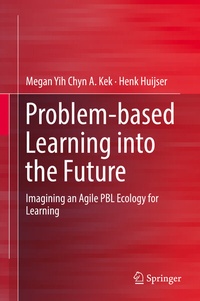
Problem-based Learning into the Future
Imagining an Agile PBL Ecology for Learning
Published on 17. October 2016
XVIII, 195 pages
978-981-10-2454-2 (ISBN)
Description

In this book we respond to a higher education environment that is on the verge of profound changes by imagining an evolving and agile problem-based learning ecology for learning. The goal of doing so is to humanise university education by pursuing innovative approaches to student learning, teaching, curricula, assessment, and professional learning, and to employ interdisciplinary methods that go far beyond institutional walls and include student development and support, curriculum sustainability, research and the scholarship of teaching and learning, as well as administration and leadership.
An agile problem-based learning (PBL) ecology for learning deliberately blurs the boundaries between disciplines, between students and teachers, between students and employers, between employers and teachers, between academics and professional staff, between formal and informal learning, and between teaching and research. It is based on the recognition that all of these elements are interconnected and constantly evolving, rather than being discrete and static.
Throughout this book, our central argument is that there is no single person who is responsible for educating students. Rather, it is everyone's responsibility - teachers, students, employers, administrators, and wider social networks, inside and outside of the university. Agile PBL is about making connections, rather than erecting barriers.
In summary, this book is not about maintaining comfort zones, but rather about becoming comfortable with discomfort. The actual implementation is beyond the scope of this book and we envisage that changing perceptions towards this vision will itself be a mammoth task. However, we believe that the alternative of leaving things as they are would ultimately prove untenable, and more distressingly, would leave a generation of students afraid to think, feel, and act for themselves, let alone being able to face the challenges of the 21st century.
An agile problem-based learning (PBL) ecology for learning deliberately blurs the boundaries between disciplines, between students and teachers, between students and employers, between employers and teachers, between academics and professional staff, between formal and informal learning, and between teaching and research. It is based on the recognition that all of these elements are interconnected and constantly evolving, rather than being discrete and static.
Throughout this book, our central argument is that there is no single person who is responsible for educating students. Rather, it is everyone's responsibility - teachers, students, employers, administrators, and wider social networks, inside and outside of the university. Agile PBL is about making connections, rather than erecting barriers.
In summary, this book is not about maintaining comfort zones, but rather about becoming comfortable with discomfort. The actual implementation is beyond the scope of this book and we envisage that changing perceptions towards this vision will itself be a mammoth task. However, we believe that the alternative of leaving things as they are would ultimately prove untenable, and more distressingly, would leave a generation of students afraid to think, feel, and act for themselves, let alone being able to face the challenges of the 21st century.
More details
Series
Edition
1st ed. 2017
Language
English
Place of publication
Singapore
Singapore
Publishing group
Springer Singapore
Target group
Professional and scholarly
Product notice
Reflowable
Illustrations
XVIII, 195 p. 3 illus., 2 illus. in color.
File size
2,55 MB
ISBN-13
978-981-10-2454-2 (9789811024542)
DOI
10.1007/978-981-10-2454-2
Schweitzer Classification
Other editions
Additional editions
Megan Yih Chyn A. Kek | Henk Huijser
Problem-based Learning into the Future
Imagining an Agile PBL Ecology for Learning
Book
10/2016
Springer
€106.99
Shipment within 15-20 days
Persons
Dr Megan Kek
is a senior lecturer with the Academic Services Division at the University of Southern Queensland, with a particular specialisation in PBL, student development and learning, and educational environments. She has published a number of papers in influential and high-ranking journals. In 2002 she published a co-authored book with Prentice Hall, Singapore entitled Authentic Problem-based Learning: Rewriting Business Education. She was a member of the team that won the national Singapore Prime Minister's Enterprise Award for Innovation in Education for Problem-based Learning in 2001 and again in 2003. The award recognises the most outstanding team whose work has created the highest new value to the public service.
Dr Henk Huijser holds a PhD in Screen and Media Studies, and has been an Academic Developer involved in Learning and Teaching in Higher Education since 2005. Between 2010 and 2012 he was responsible for the institution-wide implementation of Problem Based Learning at Bahrain Polytechnic in the Arabian Gulf, followed by a three-year stint at the Bachelor Institute of Indigenous Tertiary Education in Australia's Northern Territory, where he was responsible for online learning and teaching. He is currently an Educational Developer at Xi'an Jiaotong-Liverpool University in Suzhou, China, and an Adjunct Researcher at Bachelor Institute. Henk has published extensively in the field of learning and teaching in higher education, including on PBL.
Dr Henk Huijser holds a PhD in Screen and Media Studies, and has been an Academic Developer involved in Learning and Teaching in Higher Education since 2005. Between 2010 and 2012 he was responsible for the institution-wide implementation of Problem Based Learning at Bahrain Polytechnic in the Arabian Gulf, followed by a three-year stint at the Bachelor Institute of Indigenous Tertiary Education in Australia's Northern Territory, where he was responsible for online learning and teaching. He is currently an Educational Developer at Xi'an Jiaotong-Liverpool University in Suzhou, China, and an Adjunct Researcher at Bachelor Institute. Henk has published extensively in the field of learning and teaching in higher education, including on PBL.
Content
Chapter 1 Introduction.- Part 1: Imagining PBL in a changing world for learning.- Chapter 2 Imagining an agile PBL: Towards an ecology for connected learning.- Chapter 3 Agile PBL and the next generation of learners.- Part 2 Imagining an agile PBL curriculum for learning.- Chapter 4 Imagining an agile PBL curriculum: Focusing on learning outcomes and authentic interdisciplinary problems.- Chapter 5 Assessing agile PBL.- Part 3 Imagining an agile university for learning.- Chapter 6 Agile student development and engagement for learning.- Chapter 7 Agile staff professional learning for learning.- Chapter 8 Agile curriculum sustainability: Continuous improvement.- Chapter 9 Agile PBL research: Developing a sustainable research and scholarship agenda.- Chapter 10 Conclusion.
