

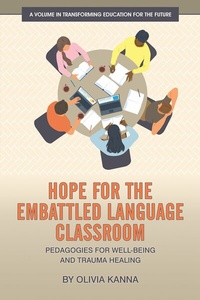
Hope for the Embattled Language Classroom
Pedagogies for Well-Being and Trauma Healing
1st Edition
Published on 1. January 2023
218 pages
978-1-64802-858-8 (ISBN)
Description

Learning, as it is being increasingly recognized, is centrally predicated upon students' well-being. Research findings indicate that in the instances of wounding and trauma, students' capacity and ability to learn can be severely compromised. This understanding applies particularly to the immigrant students in the language classroom, many of whom are refugees bringing with them past experiences of privation, violence, wounding and trauma. Since teachers often find themselves wearing multiple hats, not only as instructors, but also as friends, philosophers, guides, confidantes, and counsellors to their refugee and immigrant learners, addressing those students' trauma with compassion, and employing appropriate pedagogical practices to mitigate their suffering should be of great relevance and inform the teachers' praxis in the classroom. This book takes an interdisciplinary look at trauma from the vantage points of critical language theories, neuroscience, psychotherapy, and Buddhist psychology, and suggests pedagogies for well-being and trauma healing that utilize contemplative ways of education. The practical aim of this book is to support teachers in addressing trauma in their classrooms.
More details
Other editions
Additional editions
Book
10/2022
Information Age Publishing
€62.60
Shipment within 3-4 weeks
Content
- Front Cover
- Hope for the Embattled Language Classroom
- Pedagogies for Well-Being and Trauma Healing
- A Volume in Transforming Education for the Future
- Series Editors:
- Jing Lin, University of Maryland Vachel W. Miller, Appalachian State University Rebecca L. Oxford, University of Maryland
- DEDICATION
- Acknowledgments
- PROLOGUE
- CHAPTER 1
- Nowhere to Call Home
- The Trauma of Displacement
- THE TRAUMA STORY OF WAR
- Immigrant stress and trauma
- IMMIGRANTS AND LANGUAGE LEARNING
- CHAPTER 2
- The Silent Scream of Trauma
- THE TRAUMA STORY OF PRISON TORTURE
- WHAT IS "TRAUMA?"
- PTSD IN THE DIAGNOSTIC AND STATISTICAL MANUAL OF MENTAL DISORDERS (DSM-5)
- THE NEUROSCIENCE OF TRAUMA
- THEORIES OF TRAUMA AND TRAUMATIZATION
- SOME EMINENT TRAUMA SCHOLARS AND THEIR THEORIES
- Bessel van der Kolk
- Cathy Caruth
- Judith Herman
- The Cardinal symptoms of PTSD
- Trauma Recovery
- Peter Levine
- Kai Erikson
- Jeffrey Alexander and the Social Theory of Trauma
- Some anthropological engagements with trauma
- CHILDHOOD AND DEVELOPMENTAL TRAUMA
- CHAPTER 3
- Critical Language Pedagogies for Empowerment and Social Change
- The Trauma Story of Persecution
- Identity, Language Learning, and Empowerment
- FREIRE'S CRITICAL PEDAGOGY
- PEDAGOGIES AND EMOTIONS IN LANGUAGE LEARNING
- CHAPTER 4
- Relating pedagogy to trauma
- THE TRAUMA STORY OF THE PROCESS OF DYING
- Writing About Trauma
- TRAUMA NARRATIVES
- TRAUMA AND TESTIMONY: LAYING TO REST THE GHOSTS OF THE PAST
- DANCE, Theater, FILM, AND PHOTOGRAPHS TO DEAL WITH TRAUMA
- Trauma and Storytelling
- CHAPTER 5
- Language Education Policies, Teachers, and the Ethics of Care
- THE TRAUMA STORY OF TERMINAL ILLNESS
- THE NEED FOR TRAUMA EDUCATION IN TEACHER TRAINING
- CANADIAN IMMIGRATION POLICY AND ENGLISH LANGUAGE TRAINING
- THE NEUROSCIENCE OF ADULT LEARNING
- CLINICAL EXPLANATION OF BASELINE TRAUMA
- THE ETHICS OF CARE AND THE WOUNDED HEALER PEDAGOGY
- TRAUMA-INFORMED PRACTICE
- The HPRT Toolkit
- 1. Ask about the patient's trauma story. (Since the language teacher only has students and not patients, this could be done directly through writing or speaking tasks, or indirectly by listening to the student's trauma story when it comes up unas...
- 2. Identify concrete physical and mental effects. (With adequate training on how to identify trauma in their learners, teachers can watch out for symptoms such as rage, anxiety, panic attacks, dissociation, hyperarousal, hypervigilance, etc.)
- 3. Diagnose and treat generalized anxiety, depression, PTSD, grief, and chronic insomnia. (If not what trained medical professionals can do in this regard, teachers can help in their own way through trauma pedagogies and contemplative practices for h...
- 4. Refer screened cases of serious mental illness. (When a teacher feels medical intervention is necessary, one must refer the student to the management or to the appropriate medical services in the community.)
- 5. Reinforce and teach positive coping behaviors. (This again requires trauma education, so the teacher can help the student calm down or learn to interrupt their negative thoughts and focus on the lesson being taught.)
- 6. Recommend altruism, work, and spiritual activities. (Volunteering at the local food bank, hospitals, seniors' centers, etc., participating in community events, attending their own places of worship if they follow a particular religion, and so on...
- 7. Reduce high-risk behaviors. (Teachers could always include lessons on the dangers of high-risk behaviors such as excessive drinking, chain smoking, too much of partying, gambling, etc., all of which are attempts by traumatized individuals to self-...
- 8. Be culturally attuned in communicating and prescribing. (The teacher must be mindful of cultural norms when a student is hesitant to access help for their trauma because of the stigma attached to revealing he or she has mental health problems. Stu...
- 9. Prescribe psychotropic drugs if necessary. (This is not directly applicable for teachers
- they could prescribe appropriate classroom trauma interventions instead.)
- 10. Close and schedule follow-up visits. (Mental health practitioners always keep track of the patient's trauma story and follow it up closely during treatment. Teachers, for their part, could potentially follow up on the outcomes of their trauma-i...
- 11. Prevent burnout by discussing with colleagues. (When teachers feel overwhelmed or fatigued, they must reach out to the members within their community of practice for support, guidance, and advice. The realization that we are not alone in doing th...
- SELF-CARE FOR TEACHERS
- EMPATHY-HOW MUCH IS TOO MUCH?
- CHAPTER 6
- Trauma and Healing in the Language Classroom Through Contemplative Pedagogies
- THE TRAUMA STORY OF VIOLENCE IN THE NAME OF RELIGION
- CLASSROOMS RIFE WITH TRAUMA
- PTSD and Brain Function
- TESTIMONY AND WITNESSING OF TRAUMA
- CALMING THE PTSD-AFFECTED BRAIN THROUGH CONTEMPLATIVE PEDAGOGIES
- MINDFULNESS AND MEDITATION
- YOGA
- OTHER CONTEMPLATIVE METHODS/TOOLS TO ADDRESS TRAUMA, IMPLICATIONS, AND PRAXIS
- CHAPTER 7
- Buddhism as Brain Practice and its Role in Education
- The Trauma Story of Sudden Death
- THE FOUR TRUTHS AND THE EIGHTFOLD PATH
- BUDDHISM AND EVOLUTIONARY PSYCHOLOGY
- MINDFULNESS MEDITATION
- Buddhism Through the Lens of Neurobiology
- Criticism Against Mindfulness
- SCIENTIFIC RESEARCH ON THE EFFICACY OF BUDDHIST PRACTICES
- NEUROSCIENCE AND MEDITATION: SOME STUDIES
- MINDFULNESS AND TRAUMA
- THE ROLE OF MINDFULNESS IN EDUCATION
- Epilogue
- Appendix
- Trauma Interventions: A Minimodule for Teachers
- 1. YOGIC BREATHING EXERCISES (PRANAYAMA)
- Alternate Nostril Breath (Nadi Shodhan Pranayama)
- 1. Inhale through the right nostril, with left nostril closed.
- 2. Exhale through the left nostril, with right nostril closed.
- 3. Inhale through the left nostril, with right nostril closed.
- 4. Exhale through the right nostril, with left nostril closed.
- 5. Inhale and exhale with deep, long, slow breaths.
- 6. Continue this pattern for 2-5 minutes.
- 7. To close the nostril, hold it gently closed with the finger: use the right thumb to close the right nostril and the middle finger to close the left nostril. This makes it easier to alternate between the nostrils.
- Bellows Breath (Bhastrika Pranayama)
- 1. Inhale deeply through both the nostrils. Feel: the diaphragm move down, lungs expand, abdomen move out, chest expand, with collarbones rising last.
- 2. Exhale quickly through the nostrils, faster than the inhaling. Feel: the collarbones drop, chest deflate, abdomen shrink, and lungs deflate.
- 3. Repeat for 2-5 minutes, expanding the chest when inhaling, and deflating it when exhaling.
- 4. Start the practice slowly and gradually speed up the breathing.
- External Breath (Bahya Pranayama)
- 1. Inhale deeply through the nose. Feel: the diaphragm move down, lungs expand, abdomen move out, chest expand, with collarbones rising last.
- 2. Exhale with enough force, using the stomach and diaphragm to push the air out.
- 3. Bend the head down so the chin touches the chest and suck in the stomach. This leaves a hollow below the ribcage, pressing the front muscle wall of the abdomen against the back. Hold the breath in this position for as long as it is comfortable.
- 4. Lift your chin and breathe in slowly, allowing the lungs to fill with air.
- 5. Repeat 3 to 5 times.
- 2. YOGA STRETCHES (ASANAS)
- Standing Asanas
- Stretch 1: Tadasana
- 1. Stand with your heels slightly apart and hang the arms by the side.
- 2. Gently lift and spread your toes, then lay them softly down on the floor, balancing your body weight on your feet.
- 3. Lift your ankles and firm your thigh muscles while rotating them inwards.
- 4. Inhale, elongating your torso as you do so.
- 5. Now exhale, releasing your shoulder blades away from your head
- broaden your collarbone and elongate your neck, and make sure your ears, shoulders, hips and ankles are all in one line.
- 6. Repeat for 2 to 3 breaths.
- Stretch 2
- 1. Raise your arms up and stretch them toward the sky.
- 2. Lift your head and look up at your thumbs.
- 3. Breathe easy.
- Stretch 3: Vrikshasana or Tree Pose
- 1. Place your right foot on your left leg. Make sure the sole of the foot is flat and firmly in place. Keep your left leg straight and find your balance.
- 2. Inhale and raise your arms over your head, joining your palms together. Keep your spine straight and hold your breath for as long as you can.
- 3. Exhale slowly and bring down your arms.
- 4. Release your right leg back to the standing position.
- 5. Repeat the same with the other leg.
- Stretch 4: Uttanasana or Standing Forward Bend
- 1. Inhale deeply standing in the mountain pose.
- 2. Exhale as you bend forward, with knees slightly bent.
- 3. Touch the floor with your fingertips placed next to your toes.
- 4. Push forehead as much as you can toward your legs.
- Stretch 5: Urdhva Uttanasana or Upward Forward Fold
- 1. From your bent position in Stretch 4, inhale and lift your body halfway up, placing your fingers on the shins or knees.
- 2. Keep your legs, back, and arms straight.
- 3. Lift your torso and look upward, with fingers still on the shins or knees.
- 4. Return to mountain pose and repeat Stretches 4 and 5 twice.
- Stretch 6:
- Stretch 7: Urdhva Hastasana or the Upward Salute Pose
- 1. Stand in the mountain pose and put your hands together.
- 2. Inhale as you raise your arms up over your head, with the fingers pointing upward. Press down on your feet and tighten your core.
- 3. Exhale and press the right hip out, as you arch over to the left.
- 4. Inhale and hold for 3 to 4 breaths.
- 5. Exhale and press the left hip out, as you arch over to the right.
- 6. Inhale and hold for 3-4 breaths.
- 7. Exhale and return to mountain pose.
- Stretch 8: Anuvittasana or Standing Backbend Pose
- 1. Place palms on the lower back, with fingers pointed down. Press feet down, tighten kneecaps, thighs, and core, and inhale.
- 2. Press hips forward and arch your back, using your arms to support you, as you exhale. Keep the head up, or if you are comfortable, tilt your head back a little.
- 3. Breathe and hold for 2 to 4 breaths.
- 4. Slowly move back up to the vertical position and get back to the mountain pose.
- Stretch 9: Sukhasana (Easy Pose)
- Seated Savasana (Chair Pose)
- 1. If at the gym or at home, one may sit on the floor with legs crossed, with feet under the knees. If in the classroom, sit on the chair, with hands on the lap and feet planted firmly on the floor.
- 2. Rest hands on the lap or form a mudra with the fingers.
- 3. Press the hips down and relax the shoulders, with chest out front.
- 4. Lengthen the spine and take deep breaths. Hold them for as long as you are comfortable.
- 5. Finally, sit with your eyes closed and hands on your lap for 30 seconds, absorbing all the goodness of the previous stretches you have done.
- Seated Asanas (On Chairs, to Suit the Classroom Setting)
- Ujjayi Pranayama (Breath Exercise)
- Marjaryasana (Cat Pose)/Bitilasana (Cow Pose)
- Bharmanasana (Hip Circles)
- Surya Namaskara (Sun Salutation)
- Surya Namaskara (With Side Twists)
- (Seated) Parsva Bhanga or Tiryak Tadasana (High Altar Stretches)
- Garudasana (Eagle Pose)
- Seated Variation of Sukhasana (Ear to Shoulder/Neck Stretches)
- (Seated) Agnistambhasana (Fire Log Pose)
- Variation of Utkata Konasana (Goddess Pose)
- Variation of Virabhadrasana (Warrior Pose)
- (Seated) Uttanasana (Forward Fold Pose)
- 3. Meditations
- I. Nature Meditations
- II. Tree Meditation
- III. Walking Meditation
- IV. Sitting Meditation
- V. Loving-Kindness Meditation
- 4. Yoga mudras
- 5. Kirtan kriya
- 6. Mindfulness eating
- A. Take a raisin or peanut or any other food in your hand. Imagine that you have never tasted this food before. Now begin to explore the food in your palm with all of your senses.
- B. Focus your sight on the food, scanning every part of it minutely as if you have never seen it before. Use your fingers to touch, feel, turn, and rotate this object, and also notice its color. Observe its folds and creases and notice how the light...
- C. Hold the food under your nose and mindfully notice its smell.
- D. Then take the food to your ear, rolling it around and squishing it to hear what sound comes from it.
- E. Take the food slowly and mindfully to your mouth, noticing the saliva secretion in your mouth in anticipation of the food.
- F. Move the food around in your mouth with your tongue for a while, then gently nip at it with your front teeth to taste it. Start chewing on it slowly and when you are done, begin to swallow it gently and mindfully, noticing the sensation of it movi...
- 7. Ba Duan Jin Qigong (Eight-section brocade, or Eight silken movements)
- A. Two Hands Press the Heavens
- i. Stand erect with your feet apart and arms by your sides. Inhale slowly, lift your arms and bring your hands together under your abdomen, interlacing your fingers.
- ii. Turn your hands with the palms facing up. Raise them slowly above your head as you inhale, turning your hands once again above your head so the palms are now facing downward.
- iii. Turn your hands yet again and make the palms face up to the heavens. Come up on your toes, lifting your heels, and push up with your hands, pressing the heavens and stretching your body in doing so. Hold the pose for 3-5 breaths.
- iv. Exhale slowly and lower your arms down to the sides, as you bring your heels back to the floor. Return to the initial position with fingers interlaced below the abdomen.
- v. Repeat the stretch 2-3 times.
- B. Draw the Bow to Shoot the Vulture
- i. Stand erect, with feet apart and planted firmly on the floor, arms at your sides. Take a step to the left with the left foot and bend your knees slightly. Cross your arms at the wrists, with the left arm in front of the right.
- ii. Keep the fists closed, with only the index fingers pointing out.
- iii. Push the left arm out in front as if you would hold a bow, turn your head slowly to the left, and pull the right hand at the same time to the right side of the chest as if you would pull the bowstring. Be mindful of your breathing as you focus o...
- iv. Turn back to original position with feet apart and arms at your side. Inhale, hold your breath for a few seconds, and exhale slowly. Once again, cross your arms at the wrist, this time the right arm in front of the left. Clench both fists, with o...
- v. Repeat the bow and arrow position, the right arm holding the bow, and the left arm pulled back to the left chest.
- vi. Inhale and hold your breath. Exhale and cross arms at the wrists, with the left arm in front of the right, as in Step i).
- vii. Repeat the stretch twice.
- C. Separate Heaven and Earth
- i. Stand comfortably with feet apart, and back erect, arms at the sides. Bring both hands up to the navel, palms up, and fingers interlaced with each other.
- ii. Raise the left hand above the head and twist the arm so that the palm faces the heaven and the fingers are pointed inward
- bring the right arm down simultaneously, twisting it so that palm faces the earth and the fingers are pointed inward. Stret...
- iii. Repeat the stretch with the right arm.
- iv. Do the sequence twice for each arm.
- D. Wise Owl Gazes Backwards
- i. Stand straight, with feet apart and arms at the sides.
- ii. Cross the hands in front of the face, just below the chin, the right hand in front of the left.
- iii. Pull your hands back down the sides to the back, keeping them straight, with the palms facing up. Turn your head to the left and look back, taking care not to rotate your body at the waist. Return to the original position.
- iv. Cross the hands once again, this time the left hand in front of the right. Pull your hands down the sides to the back, palms facing up. Turn your head to the right as far back as you can and look back, without twisting your body at the waist.
- v. Repeat twice for each side.
- E. Big Bear Bends Sideways
- i. Stand comfortably with back straight, feet apart and arms at the sides. Spread your legs apart, and place hands on hips.
- ii. Bend head, shoulders and body to the left, without moving your feet. Be mindful of the breath.
- iii. Return to original position. Now bend head, shoulders, and body to the right, without moving your feet.
- iv. Return to original position. Bend body and head forward.
- v. Straighten up, and then bend backwards as far as you can. Inhale, hold, and exhale during the forward and backward bends. Return to original position. Repeat right, left, forward, and backward bends.
- vi. Return to original position. Now rotate your head slowly clockwise and counterclockwise 5 times.
- F. Punching With an Angry Gaze
- i. Stand comfortably with feet apart, hands on the hips. Take a step to the left with your left foot and bend the knees slightly.
- ii. Remove hands from hips, clench both fists, and bring them up to the shoulders. Open your eyes wide to look fierce.
- iii. Punch with the left fist, keeping your eyes on the knuckles. Bring the left fist down, on par with the right.
- iv. Take a step to the right with the right foot and bend your knees slightly. Punch with the right fist, keeping your eyes on the knuckles. Then bring the right fist down next to the left.
- v. Repeat the steps twice, by punching forward with the right fist and then with the left fist.
- G. Bouncing on the Toes
- i. Stand comfortably, feet apart, and arms at the sides.
- ii. Lift the heels slowly and hold it for several seconds.
- iii. Return the heels to the ground slowly.
- iv. Repeat 3-4 times.
- H. Touching the Toes, Then Bending Backwards
- i. Stand in a comfortable manner, legs apart, and hands on the hips.
- ii. Bring your hands together to interlock your fingers and as you inhale, raise the arms over your head.
- iii. As you exhale, bend forward, keeping your knees straight. Stretch your back with the forward bend.
- iv. Straighten your body up, back to the starting position, with the hands on your hips. Now arch your head back as far back as is comfortable for you.
- v. Return to original position and repeat the forward and backward bend twice.
- 8. Do-In Shiatsu
- 9. Drawing a family tree
- 10. Show and tell (With family photos or any other object the learner chose to bring from back home)
- 11. Classroom objects that represent feelings
- 12. Guided imagery, meditations, and visualizations for relaxation and healing
- 13. Check-ins at the start of class
- 14. Nature walks
- 15. Mirroring the partner's body language
- 16. Repeating affirmations
- 17. Grounding to prevent anxiety attacks
- 18. Coloring of Mandalas
- 19. Music therapy
- 20. Tai Chi
- 21. WRITING THE ABCs OF A GOOD LIFE
- Other suggestions
- References
- PROLOGUE
- Chapter 1
- Chapter 2
- Chapter 3
- Chapter 4
- Chapter 5
- Chapter 6
- Chapter 7
- About the Author
- CONTENTS
- 1. Nowhere to Call Home: The Trauma of Displacement 1
- 2. The Silent Scream of Trauma 11
- 3. Critical Language Pedagogies for Empowerment and Social Change 35
- 4. Relating Pedagogy to Trauma 45
- 5. Language Education Policies, Teachers, and the Ethics of Care 59
- 6. Trauma and Healing in the Language Classroom Through Contemplative Pedagogies 79
- 7. Buddhism as Brain Practice and its Role in Education 97
- 8. Epilogue 115
- 9. Appendix: Trauma Interventions: A Minimodule for Teachers 117
- Transforming Education for the Future
- Jing Lin, Vachel W. Miller, and Rebecca L. Oxford, Series Editors
- Hope for the Embattled Language Classroom
- Pedagogies for Well-Being and Trauma Healing
- By
- Olivia Kanna
- Language College of the Immigrant Services Society of BC, British Columbia, Canada
- Information Age Publishing, Inc. Charlotte, North Carolina www.infoagepub.com
- Back Cover
