

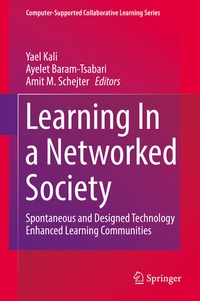
Learning In a Networked Society
Description

More details
Other editions
Additional editions
Persons
Yael Kali is an Associate Professor of Technology Enhanced Learning at the University of Haifa, as well as the Director of the Learning In a NetworKed Society (LINKS) Israeli Center of Research Excellence (I-CORE). Together with the TEL-Design Team members, she explores learning and teaching with Information Communication Technologies (ICT), at various levels, from junior high school to higher education. Her work focuses on the role of design principles for supporting Computer Supported Collaborative Learning (CSCL). Kali also serves as an Associate Editor for the journal Instructional Science.
Ayelet Baram Tsabari is an Associate Professor at the Technion - Israel Institute of Technology, where she heads the Science Communication research group. Her training in science education (PhD, Weizmann Institute of Science) and science communication (visiting scholar, Cornell University) alongside rich experience as a journalist, editor, and a TV presenter, shaped her interest in building a community of science communication practitioners and scholars. Baram Tsabari founded the Israeli Science Communication Conference series, and, as an elected member of the Israel Young Academy built a national infrastructure for science communication training for scientists.Amit Schejter is Professor and Head of the Communication Studies department at Ben Gurion University of the Negev in Israel and Visiting Professor of Communications and co-director of the Institute for Information Policy at the College of Communications of Pennsylvania State University.
Content
Foreword: Roots and future of LINKS research: New trajectories and approaches for advancement.- Part I - Learning in a networked society.- Introduction: Technology-enhanced learning communities on a continuum between spontaneous and designed.- Information & Knowledge Research @LINKS.- Part II - From Spontaneous to Designed TEL Communities.- The double-edged sword of new media in supporting public engagement with science.- Citizen science: An opportunity for learning in a networked society.- Democracy, Communication, and Education in the 21st Century.- Part III - From Designed to Spontaneous TEL Communities.- Networked Learning Analytics: A Theoretically Informed Methodology for Collaborative.- E-Textbook: Challenges to Pedagogy, Law and Policy.- Future Learning Spaces: Exploring Perspectives from LINKS Research.- ICTs in Religious Communities: Communal and Domestic Integration of New Media among Jewish ultra-Orthodoxy in Israel.- Part IV - Policy Implications.
