

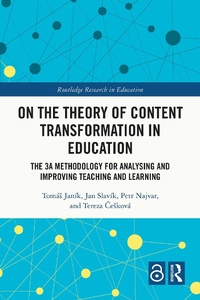
On the Theory of Content Transformation in Education
The 3A Methodology for Analysing and Improving Teaching and Learning
1st Edition
Published on 21. March 2024
192 pages
978-1-040-02461-4 (ISBN)
Description

This volume presents a novel, theoretical, micro-analytical model - the 3A Methodology - for assessing the quality of school education.
Drawing on philosophers as well as theoretical and pedagogical traditions from European and American contexts, the authors construct a model that is relevant to teachers, researchers, and teacher educators regardless of cultural setting. The chapters explain the 3A Methodology as a specific research tool developed to study classroom situations in the form of case studies, revealing findings that demonstrate prototypical failures (didactic formalism) that threaten to compromise the quality of learning as well as prototypical didactic virtues that verifiably support students' learning. Ultimately building on the distinction of three modes of existence of educational content (the intersubjective, the subjective, and the objective modes), the book helps rediscover didactics as a transdisciplinary theory of content transformation and contributes to the improvement of teaching and learning in the classroom long term.
This volume will be of interest to scholars, researchers, and postgraduate students working in school education, educational psychology, and didactics more broadly. Teacher educators and school administrators may also find the book of interest.
Chapters 1, 3, and 6 of this book is freely available as a downloadable Open Access PDF at http://www.taylorfrancis.com under a Creative Commons Attribution-Non Commercial-No Derivatives (CC-BY-NC-ND) 4.0 license.
Drawing on philosophers as well as theoretical and pedagogical traditions from European and American contexts, the authors construct a model that is relevant to teachers, researchers, and teacher educators regardless of cultural setting. The chapters explain the 3A Methodology as a specific research tool developed to study classroom situations in the form of case studies, revealing findings that demonstrate prototypical failures (didactic formalism) that threaten to compromise the quality of learning as well as prototypical didactic virtues that verifiably support students' learning. Ultimately building on the distinction of three modes of existence of educational content (the intersubjective, the subjective, and the objective modes), the book helps rediscover didactics as a transdisciplinary theory of content transformation and contributes to the improvement of teaching and learning in the classroom long term.
This volume will be of interest to scholars, researchers, and postgraduate students working in school education, educational psychology, and didactics more broadly. Teacher educators and school administrators may also find the book of interest.
Chapters 1, 3, and 6 of this book is freely available as a downloadable Open Access PDF at http://www.taylorfrancis.com under a Creative Commons Attribution-Non Commercial-No Derivatives (CC-BY-NC-ND) 4.0 license.
More details
Series
Edition
1. Auflage
Language
English
Place of publication
London
United Kingdom
Publishing group
Taylor & Francis Ltd
Target group
College/higher education
Professional and scholarly
Illustrations
5 Tables, black and white; 21 Line drawings, black and white; 21 Illustrations, black and white
ISBN-13
978-1-040-02461-4 (9781040024614)
Copyright in bibliographic data and cover images is held by Nielsen Book Services Limited or by the publishers or by their respective licensors: all rights reserved.
Schweitzer Classification
Other editions
Additional editions
Tomas Janik | Jan Slavik | Petr Najvar
On the Theory of Content Transformation in Education
The 3A Methodology for Analysing and Improving Teaching and Learning
Book
07/2025
1st Edition
Routledge
€64.70
Shipment within 10-20 days
Tomas Janik | Jan Slavik | Petr Najvar
On the Theory of Content Transformation in Education
The 3A Methodology for Analysing and Improving Teaching and Learning
Book
03/2024
1st Edition
Routledge
€207.30
Shipment within 10-20 days
Persons
Tomas Janik is a professor of Educational Sciences and a Head of the Institute for Research, School of Education, Faculty of Education, Masaryk University, Czech Republic.
Jan Slavik is an associate professor of Educational Sciences, Department of Art Education and Culture, University of West Bohemia in Pilsen, Czech Republic.
Petr Najvar is an associate professor of Education, Department of Primary Education, Faculty of Education, Masaryk University, Brno, Czech Republic.
Tereza Ceskova is an assistant professor at the Department of Primary Education and the Institute for Research in School Education, Faculty of Education, Masaryk University, Brno, Czech Republic.
Jan Slavik is an associate professor of Educational Sciences, Department of Art Education and Culture, University of West Bohemia in Pilsen, Czech Republic.
Petr Najvar is an associate professor of Education, Department of Primary Education, Faculty of Education, Masaryk University, Brno, Czech Republic.
Tereza Ceskova is an assistant professor at the Department of Primary Education and the Institute for Research in School Education, Faculty of Education, Masaryk University, Brno, Czech Republic.
Content
Contents
Acknowledgements
List of Key Terminology
Part one: Introduction and Context
1 Introduction
2 Didactics (Re)Discovered
Part Two: Theory of Content Transformation
3 Towards the Theory of Content Transformation
4 Active Content: From Content Transformation to Cognitive Change
5 Cognitive Change between the Subject and Culture
Part Three: Research in Transdisciplinary Didactics
6 Content-Focused Approach for Improving Teaching and Learning: 3A Methodology for Didactic Case Studies
7 Research on Content Transformation in Transdisciplinary Didactics: Identifying Aspects of Quality of Teaching and Learning
8 Conclusions and Outlook
Index
Acknowledgements
List of Key Terminology
Part one: Introduction and Context
1 Introduction
2 Didactics (Re)Discovered
Part Two: Theory of Content Transformation
3 Towards the Theory of Content Transformation
4 Active Content: From Content Transformation to Cognitive Change
5 Cognitive Change between the Subject and Culture
Part Three: Research in Transdisciplinary Didactics
6 Content-Focused Approach for Improving Teaching and Learning: 3A Methodology for Didactic Case Studies
7 Research on Content Transformation in Transdisciplinary Didactics: Identifying Aspects of Quality of Teaching and Learning
8 Conclusions and Outlook
Index
