

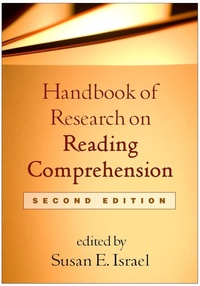
Handbook of Research on Reading Comprehension
2nd Edition
Published on 29. November 2016
696 pages
978-1-4625-2891-2 (ISBN)
Description

Teacher educators, literacy researchers, and graduate students in education; educational and school psychologists. May serve as a text in graduate-level courses such as Curriculum and Instruction, Foundations of Reading, and Literacy Pedagogy.
More details
Other editions
Additional editions
Susan E. Israel
Handbook of Research on Reading Comprehension, Second Edition
Book
01/2017
2nd Edition
Guilford Press
€104.50
Shipment within 15-20 days
Person
Susan E. Israel, PhD, is a literacy researcher, educator, and author who has focused on reading comprehension since her early days teaching in the classroom in the 1990s. She taught at the University of Notre Dame, in the Alliance for Catholic Education summer program, and at the University of Dayton, where she received the Panhellenic Council Outstanding Professor Award. Dr. Israel is a recipient of a Teacher as Researcher grant from the International Literacy Association (ILA) and has served on several ILA committees and interest groups, including as president of the History of Literacy Special Interest Group. Dr. Israel has written or edited more than 25 books on literacy and teacher education, including, most recently, Verbal Protocols in Literacy Research.
Content
I. Historical Analysis
1. Introduction: The Consequential Pulse of Reading Comprehension Research, Susan E. Israel and D. Ray Reutzel
2. The Roots of Reading Comprehension Instruction, P. David Pearson & Gina N. Cervetti
3. Comprehension Is Not Simple: Considering the Persisting Dangers in the Simple View of Reading Comprehension, James V. Hoffman
4. Professional Learning for Educators Focused on Reading Comprehension: A Historical Perspective, Barbara Laster & Carla Finkelstein
5. Research on Helping Readers Make Sense of Print: Evolution of Comprehension-Based Pedagogy, Kenneth S. Goodman, Yetta M. Goodman, & Kelly L. Allen
II. Theoretical Perspectives
6. An Evolving Perspective of Constructively Responsive Reading Comprehension Strategies in Multilayered Digital Text Environments, Byeong-Young Cho & Peter Afflerbach
7. Toward a Theory of Literacy Meaning Making within Virtual Worlds, Richard Beach and Robert J. Tierney
8. Meaning Making in the 21st Century: The Sociogenesis of Reading Comprehension, James Gavelek & Colleen E. Whittingham
9. Literacy, Comprehension, and the Neurosciences, George G. Hruby
III. Diagnosis, Assessment, and Intervention
10. Assessments of Reading Comprehension: Challenges and Directions, Lauren Leslie and JoAnne Schudt Caldwell
11. Using Assessments to Map and Evaluate the Comprehension Development of Young Children, Katherine A. Dougherty Stahl & Georgia Earnest García
12. Comprehension Difficulties and Struggling Readers, Richard L. Allington & Anne McGill-Franzen
13. Self-Regulation and Reading Comprehension: Moving Beyond the Individual's Cognition in Regulated Learning, Dixie D. Massey & Samuel D. Miller
14. Reconsidering Fluency's Role in Reading Comprehension, Melanie Kuhn & Paula J. Schwanenflugel
IV. Impact of Text and Higher-Order Processing
15. Text and Comprehension: A Retrospective, Perspective, and Prospective, Emily Fox & Patricia A. Alexander
16. Reading Comprehension in the Middle Grades: Characteristics, Challenges, and Effective Supports, Ruth Wharton-McDonald & Joy Erickson
17. Vocabulary and Reading Comprehension: The Nexus of Meaning, Gwynne Ellen Ash & James F. Baumann
18. Improving Adolescent Comprehension: Developing Strategies in the Content Areas, Mark W. Conley
19. Structure, Epistemology, and Metalanguage Foundations of Reading Comprehension in Scientific Texts, Linda M. Phillips & Anat Yarden
20. Graphic Text and Visual Literacies in Reading Comprehension, Stergios Botzakis, Jason D. DeHart, & Sean P. Connors
V. Diverse Components and Engagement
21. Reading Comprehension Research and the Shift Toward Culturally Sustaining Pedagogy, Colleen M. Fairbanks, Jewell E. Cooper, Sandra M. Webb, & Lynn A. Masterson
22. Comprehension in the Disciplines, Cynthia Shanahan
23. Constructing Meaning through Discussion, Keli Garas-York & Janice F. Almasi
24. The Role of Interest in Reading Comprehension, Sheree E. Springer, Janice A. Dole, & Douglas J. Hacker
25. Comprehension Strategies Instruction for Learners of English: Where We Have Been, Where We Are Now, Where We Still Might Go, Rachel Brown
26. Family Literacy Initiatives and Reading Comprehension, Patricia A. Edwards, Maria Selena Protacio, Marliese Peltier, & Laura Hopkins
VI. Future Directions
27. The Role of Literacy Coaching in Improving Comprehension Instruction, Misty Sailors, Sylvia Minton, & Lorena Villarreal
28. Public Policy in an Era of Changing Literacies: A Focus on Reading Comprehension, Lori Helman & Cory Stai
29. Sophistication of Reading Comprehension: Where to from Here?, Susan E. Israel
