

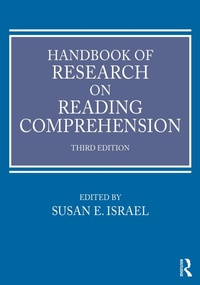
Handbook of Research on Reading Comprehension
3rd Edition
Published on 15. April 2026
610 pages
978-1-040-47549-2 (ISBN)
Description

The Handbook of Research on Reading Comprehension is the seminal research handbook on reading comprehension. The third edition is an edited comprehensive compilation that summarizes the body of research on reading comprehension, building on the research of the first and second editions.
The purpose of the third edition is to provide a resource to:
* Summarize the theory, methods, instruction, assessment, landmark studies, recent advances, and trends in reading comprehension research
* Provide a comprehensive reference for a broad spectrum of stakeholders, including scholars, educators, leaders, policymakers, and the general public, on matters that influence and directly affect the educational goals relative to literacy achievement
* Guide mentors and doctoral candidates seeking doctoral-level preparation in the area of reading comprehension research
* Make available the developments in reading comprehension from a global perspective by focusing on international researchers and populations
* Highlight cutting-edge technological trends and implications
* Guide leaders toward decision-making grounded in scientific structures and research
* Focus on equity issues as they relate to the domain of reading comprehension situated within the context of cultural demands in today's society
Noteworthy Features in the Third Edition: The handbook consists of the following unique features:
* Comprehensive Overview: Each chapter provides a review of the research base in an area of reading comprehension research, as well as the historical and theoretical perspectives inherent to the topic, with authors emphasizing the landmark studies that have been published since the second edition.
* Contributor Expertise: Each chapter author is the leading expert in the area of expertise on the topic, bringing extensive breadth and depth to the topic, covering all aspects of the domain.
* Chapter Structure: Each chapter will include similar organizational features, which focus on the overall outline of the chapter and questions the chapter will address, a summary of the research, significant contributions, recent advances, guiding principles relevant to the domain, a summary of instructional interventions, and applications for future research. New chapter features will attend to technology, methodology, policy applications, and international scholarship.
* Questions for Discussion: New to the third edition is the contribution of two-four guiding questions that share the breadth and depth of the primary focus of the chapter's contents. Guiding questions can be used to stimulate deeper conversation in school professional development groups, as well as classroom and study groups.
* Technology Links: Each chapter author identifies technological advancements both on- and offline, as well as including any relevant digital resources that readers can readily access. This new feature is to provide an interactive platform with the author and the readers.
This is an essential reference volume for the international community of researchers, scholars, educators, graduate students, and professionals working in the area of reading and literacy.
The purpose of the third edition is to provide a resource to:
* Summarize the theory, methods, instruction, assessment, landmark studies, recent advances, and trends in reading comprehension research
* Provide a comprehensive reference for a broad spectrum of stakeholders, including scholars, educators, leaders, policymakers, and the general public, on matters that influence and directly affect the educational goals relative to literacy achievement
* Guide mentors and doctoral candidates seeking doctoral-level preparation in the area of reading comprehension research
* Make available the developments in reading comprehension from a global perspective by focusing on international researchers and populations
* Highlight cutting-edge technological trends and implications
* Guide leaders toward decision-making grounded in scientific structures and research
* Focus on equity issues as they relate to the domain of reading comprehension situated within the context of cultural demands in today's society
Noteworthy Features in the Third Edition: The handbook consists of the following unique features:
* Comprehensive Overview: Each chapter provides a review of the research base in an area of reading comprehension research, as well as the historical and theoretical perspectives inherent to the topic, with authors emphasizing the landmark studies that have been published since the second edition.
* Contributor Expertise: Each chapter author is the leading expert in the area of expertise on the topic, bringing extensive breadth and depth to the topic, covering all aspects of the domain.
* Chapter Structure: Each chapter will include similar organizational features, which focus on the overall outline of the chapter and questions the chapter will address, a summary of the research, significant contributions, recent advances, guiding principles relevant to the domain, a summary of instructional interventions, and applications for future research. New chapter features will attend to technology, methodology, policy applications, and international scholarship.
* Questions for Discussion: New to the third edition is the contribution of two-four guiding questions that share the breadth and depth of the primary focus of the chapter's contents. Guiding questions can be used to stimulate deeper conversation in school professional development groups, as well as classroom and study groups.
* Technology Links: Each chapter author identifies technological advancements both on- and offline, as well as including any relevant digital resources that readers can readily access. This new feature is to provide an interactive platform with the author and the readers.
This is an essential reference volume for the international community of researchers, scholars, educators, graduate students, and professionals working in the area of reading and literacy.
Reviews / Votes
"In toto the third edition of this handbook performs a pedagogical hat trick by delving into the past, covering expansively the state of the art, and postulating both possibilities and potentials for a myriad of futures for scholarship on reading comprehension. The text admirably covers the theory, knowledge bases, and methodologies that serve as the foundations of all work in the field of reading comprehension. Further, in serving as a text for the third decade of the 21st century, it provides coverage of the new and ever-expanding technologies along with coverage of the evolving perspectives on culture, sociolinguistics, policy, equity, etc. as part and parcel to comprehension of text."Norman A. Stahl, Professor Emeritus of Literacy Education at Northern Illinois University, USA
"This third edition of the Handbook of Research on Reading Comprehension is needed to evince the ever-evolving nature of reading comprehension. It will be invaluable to professors, students, university program and course development, national accreditation, and professional development. I believe it is a cutting-edge reading comprehension research resource."
Maureen McLaughlin, Professor Emerita, East Stroudsburg University of Pennsylvania
More details
Edition
3rd edition
Language
English
Place of publication
London
United Kingdom
Publishing group
Taylor & Francis Ltd
Target group
College/higher education
Professional and scholarly
Illustrations
17 Tables, black and white; 24 Line drawings, black and white; 3 Halftones, black and white; 27 Illustrations, black and white
File size
8,19 MB
ISBN-13
978-1-040-47549-2 (9781040475492)
Copyright in bibliographic data and cover images is held by Nielsen Book Services Limited or by the publishers or by their respective licensors: all rights reserved.
Schweitzer Classification
Other editions
Additional editions
Susan E. Israel
Handbook of Research on Reading Comprehension
Book
04/2026
3rd Edition
Routledge
€301.50
Shipment within 15-20 days
Susan E. Israel
Handbook of Research on Reading Comprehension
Book
04/2026
3rd Edition
Routledge
€151.60
Shipment within 15-20 days
Person
Susan E. Israel, PhD, is a literacy researcher, educator, and author who has focused her research agenda on reading comprehension since her early days teaching in the classroom over 25 years ago. She taught at the University of Notre Dame, in the Alliance for Catholic Education summer program, and at the University of Dayton, where she received the Panhellenic Council Outstanding Professor Award. Dr. Israel is a recipient of a Teacher as Researcher grant from the International Literacy Association (ILA) and has served on several ILA committees and interest groups, including as president of the History of Literacy Special Interest Group.
Content
Part 1: FOUNDATIONS: Ways of Knowing and Doing 1. Introduction: Examining Comprehension Through New Lenses 2. The Roots of Reading Comprehension Instruction 3. Professional Development in an Era of Literacy Mandates: Teaching Comprehension in the United States and in the World Part 2: Theoretical Perspectives 4. Advancing an Equity-Oriented, Sociocultural Account of Reading Comprehension 5. Understanding the Nature of Reading Comprehension: Viewing Comprehension as a Multifaceted Phenomenon 6. Reading Comprehension as Social Practice(s) in Social Events 7. Theoretical Transformations in Comprehension: Reflections on the Past and Visions for the Future Part 3: DEVELOPMENTAL IMPACT 8. The Roles of Oral Language and Knowledge Development In Supporting Text Comprehension in Young Children 9. Using Assessment to Map and Evaluate the Comprehension Development of Young Children 10. Choosing Texts for Comprehension 11. Reading Fluency and Comprehension Development 12. Vocabulary and Reading Comprehension: More Than a Simple Equation Part 4: TEXT PROCESSING AND KNOWLEDGE ACQUISITION 13. The Connection Between Reading Comprehension and Written Composition: Theory and Evidence 14. The Knowledge-Comprehension Connection: Activating, Building, And Revising Knowledge During Reading 15. More than Words: Examining Reading Comprehension as an Act of Communication 16. Self-Regulation with Agency: A Path Less Traveled Part 5: DIGITAL TEXT COMPREHENSION AND STRATEGIES 17. Background Research on Historical, Social, and Cultural Factors Shaping Students: Reading Comprehension of Digital, Multimodal Texts 18. Constructing Meaning through Discussion 19. Research on Informational and Digital Text Comprehension Part 6: CULTURE, EQUITY, AND ENGAGEMENT 20. Reading Comprehension Research from an Intersectional Lens: Examining the Knowledge Base in the Context of Race, Language, and Disability 21. Family Literacy and Reading Comprehension: Evolving Understandings and Emerging Directions 22. Perspectives on Reading Comprehension for Multilingual Learners 23. Racial Literacies and Comprehension: Readers, Histories, Contexts, Texts, Practices, Assessments, and Intersubjective Meanings before/since/beyond 21st Century Race Customs of the U.S. Part 7: FUTURE DIRECTIONS 24. Public Policy in the Era of Pandemic Response and Recovery, The Science of Reading, and New Literacies 25. Where to From Here? Afterword: The Future of Reading Comprehension Analyses: Addressing Methodological Concerns in Order to Advance Conceptual Understanding Final Thoughts: How Classroom Teachers Can Benefit from Reading the Handbook of Research on Reading Comprehension, 3rd Edition
