

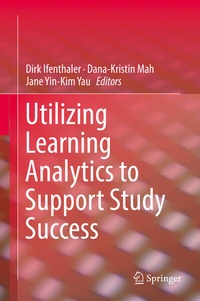
Utilizing Learning Analytics to Support Study Success
Description

Students often enter higher education academically unprepared and with unrealistic perceptions and expectations of university life, which are critical factors that influence students' decisions to leave their institutions prior to degree completion. Advances in educational technology and the current availability of vast amounts of educational data make it possible to represent how students interact with higher education resources, as well as provide insights into students' learning behavior and processes. This volume offers new research in such learning analytics and demonstrates how they support students at institutions of higher education by offering personalized and adaptive support of their learning journey. It focuses on four major areas of discussion:
· Theoretical perspectives linking learning analytics and study success.
· Technological innovations forsupporting student learning.
· Issues and challenges for implementing learning analytics at higher education institutions.
· Case studies showcasing successfully implemented learning analytics strategies at higher education institutions.
Utilizing Learning Analytics to Support Study Success ably exemplifies how educational data and innovative digital technologies contribute to successful learning and teaching scenarios and provides critical insight to researchers, graduate students, teachers, and administrators in the general areas of education, educational psychology, academic and organizational development, and instructional technology.
More details
Other editions
Additional editions
Persons
Dana-Kristin Mah is currently a doctoral candidate as well as research and teaching assistant at the Department Educational and Socialization Processes at the University of Potsdam, Germany. Besides, she is teaching assistant at the Center for Scientific Continuing Education and Cooperation at the Berlin Institute of Technology, Germany. She studied at the Berlin Institute of Technology, Germany, and Stockholm University, Sweden to receive her Master degree in Educational Science. Her research concentrates on students' first-year experience in higher education with focus on students' perception of academic competencies and institutional support. Besides, she is interested in the potential of learning technologies on student retention in higher education. In particular, she explores learning analytics, digital badges, and ePortfolios.
Jane Yin-Kim Yau is a Researcher in Mobile Learning Analytics at the Chair for Learning, Design and Technology in the Business School at the University of Mannheim, Germany. She has been an active Researcher in Mobile Learning since 2005. She completed a PhD Computer Science (Mobile Learning) at the University of Warwick, UK, in 2010. Her doctoral thesiswas entitled "A mobile context-aware learning schedule framework with Java learning objects". She has research expertise in context-awareness, personalization, and user profiling. She was awarded a Postdoctoral Research Fellowship at the Centre for Learning and Knowledge Technologies at Linnaeus University (CeLeKT), Sweden, where she collaborated with multidisciplinary research teams in the various projects undertaken by the group such as GeM (Geometry Mobile), mHealth, Co-Create and LETS GO (Learning Ecology with Technologies for Global Outcomes). Thereafter, she was a Postdoc at the School of Technology, Malmö University, Sweden, and was a co-applicant in two large successful research applications: Practice-based Experimental Learning Analytics Research Support project, PELARS (EU FP7, 2014-17), and the Internet of Things and People Research Center at Malmö University. She was also a Visiting Researcher at the German Institute for International Educational Research (DIPF) in 2016 atFrankfurt Am Main, Germany. She was a book reviewer in Wong, Milrad & Specht (eds.) (2015) Seamless Learning in the Age of Mobile Connectivity. Singapore, Springer. Additionally, she is a reviewer in the IEEE Transactions in Learning Technologies, Educational Technology & Society, Int. Journal of Mobile & Blended Learning, and Int. Journal on Mobile Learning & Organisation amongst others. To date, she has published around 40 peer-reviewed articles including 15 journal articles and 1 book chapter mainly in the area of Mobile Learning.
