

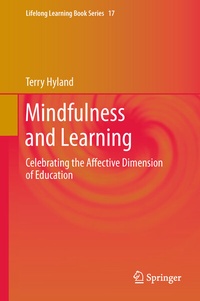
Mindfulness and Learning
Description

In recent decades, education at all levels has been seriously impoverished by a growing obsession with standards, targets, skills and competences. According to this model, only a circumscribed range of basic cognitive skills and competences are the business of education, whose main role is to provide employability credentials for people competing for jobs in the global economy. The result is a one-dimensional, economistic and bleakly utilitarian conception of the educational task.
In
Mindfulness and Learning: Celebrating the Affective Dimension of Education
, Terry Hyland advances the thesis that education stands in need of a rejuvenation of its affective function - the impact it has on the emotional, social, moral and personal development of learners. Drawing on the Buddhist conception of mindfulness, he advances a powerful argument for redressing this imbalance by enhancing the affective domain of learning.
Mindfulness and Learning: Celebrating the Affective
Dimension of Education
shows how the concept and practice of 'mindfulness' - non-judgmental, present moment awareness and experience - can enrich learning at all levels. Mindfulness thus contributes to the enhanced achievement of general educational goals, and helps remedy the gross deficiency of the affective/emotional aspects of contemporary theory and practice.
The author outlines a mindfulness-based affective education (MBAE) programme and shows how it might be introduced into educational provision from the early years to adult education with a view to harmonising the cognitive-affective balance across the system.
More details
Other editions
Additional editions
Content
List of Acronyms.- About the Author.- Editorial by Series Editors.- Preface.- 1. The Therapeutic Turn in Education.- 2. Education and Therapy.- 3. The Nature of Mindfulness.- 4. The Practice of Mindfulness.- 5. Applications of Mindfulness.- 6. The Education of the Emotions.- 7. The Affective Domain of Education.- 8. Learning, Teaching and Curriculum.- 9. From School to Lifelong Learning.- 10. Vocational Education and Training.- 11. Professionalism, Research and Teaching.- 12. Mindfulness, Morals and the Aims of Education.- General References.- Index.
