

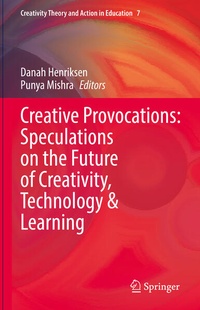
Creative Provocations: Speculations on the Future of Creativity, Technology & Learning
Description

This book explores the complex, yet critical, relationship between technology and creativity, specifically in educational contexts. Creativity is important for success in today's rapidly changing, radically contingent and hyperconnected world. This is even more relevant in the context of teaching and learning-where the psychological, sociological and cultural aspects of human learning confront the challenges of a rapidly changing, technologically saturated world.
Written by some of the foremost thinkers and researchers in the area of creativity and/or technology, the chapters in this volume examine the impact of recent and future technologies on creativity, teaching and learning. Individually and collectively, they help us develop an understanding of this nexus of creativity and technology for education. They offer new perspectives on this rapidly evolving future-exploring issues, paradoxes, tensions, and points of interest for creativity and technology. They position these issues in ways that consider implications for thinking, learning, teaching, and education in general.Reviews / Votes
"Creative Provocations: Speculations on the Future of Creativity, Technology & Learning represents a significant contribution to the field of educational theory and practice. Its thoughtful analysis of the intersection between creativity, technology, and learning provides valuable insights for educators, administrators, and policymakers. The authors' ability to balance theoretical depth with practical applications, coupled with their attention to equity issues and future challenges, makes this work an essential resource for anyone interested in future of education." (Suherman Suherman, AI & SOCIETY, Vol. 41 (2), 2026)
More details
Other editions
Additional editions
Persons
Dr. Henriksen has served as a working group leader at EDUsummIT-a UNESCO global consortium of leaders in policy, practice, and scholarship in education. She is an Associate Editor at Educational Policy Analysis Archives journal and has guest-edited special issues of journals such as: the Journal of Technology and Teacher Education, TechTrends journal, and Australasian Journal of Educational Technology. Dr. Henriksen is the prior Co-Chair of the Creativity SIG for the Society of Information Technology in Education, and the current Co-Chair of the Dissertation in Practice SIG with the Carnegie Project in the Education Doctorate. She has taught or developed varied courses in educational psychology, innovation and leadership, research methods, design thinking, and teacher education, across higher education contexts-including undergraduate, Masters, and doctoral courses, in online, hybrid/blended, and face-to-face mediums (both on-campus and overseas/study abroad).
Dr. Punya Mishra is Associate Dean of Scholarship & Innovation and Professor in the Divisionof Educational Leadership & Innovation in the Mary Lou Fulton Teachers College at Arizona StateUniversity. He also has an affiliate faculty position in the Herberger Institute for Design and the Arts. Prior to coming to ASU, Dr. Mishra was at Michigan State University where he directed theaward-winning Master of Arts in Educational Technology program. In 2016 he received the WilliamJ. Beal Outstanding Faculty Award for his comprehensive and sustained record of scholarlyexcellence in research and creative activities, instruction and outreach.
He has served on the Executive Council of the Society for Information Technology in Teacher Education. He started and served as chair of the Creativity Special Interest Group at the Society for Information Technology in Teacher Education for two years. He (with Dr. Matthew J. Koehler) co-chaired the SITE2011 conference and is former chair of the Innovation & Technology Committee of the American Association of Colleges of Teacher Education (AACTE). He was a member of the School Board for the Okemos Public School District.
Heis internationally recognized for his work in technology integration in teaching; therole of creativity and aesthetics in learning; and the application of design-based approaches toeducational innovation. He (in collaboration with Dr. M. J. Koehler) developed the TechnologicalPedagogical Content Knowledge (TPACK) framework, which has been described as being "the most significant advancement in the area of technology integration in the past 25 years." He has been named as one of the ten most influential people in educational technology by the readers and editors of Technology and Learning journal. He has received over $7 million in grants; published over 100 articles and edited 3 books.
Dr. Mishra is an award-winning instructor who has taught courses at undergraduate,masters and doctoral levels in the areas of educational technology, educational psychology,design, and creativity. He has also taught courses and conducted workshops on creativity,innovation and design for the MBA program at the Indian School of Business (Hyderabad) as well as the Executive MBA program at the Broad School of Business, MSU. Dr. Mishra has received many accolades for his teaching, including a Lilly Faculty Fellowship (2001), the MSU Teacher Scholar Award (2004), the College of Education's Teaching Excellence Award (2006), and the AT&T-MSU award for Instructional Technology twice (2008 & 2014).
