

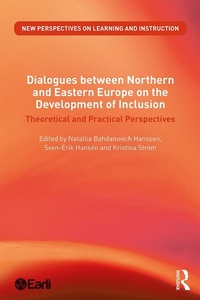
Dialogues between Northern and Eastern Europe on the Development of Inclusion
Theoretical and Practical Perspectives
1st Edition
Published on 28. February 2021
272 pages
978-1-000-34632-9 (ISBN)
Description

The concepts of inclusion and inclusive education for children with special education needs (SEN) have been widely accepted as imperative undertakings in the education spectrum. This book posits the practice of these ideas by scrutinizing the methodologies adopted by varied nations of the two regions towards inclusive education along with juxtaposing the dichotomous observations to enable a dialogue regarding the actualization of inclusive education.
The book looks at the distinct approaches taken by Northern and Eastern European education systems to realize inclusive education for children with SEN and aims to enable a space for dialogue wherein the reader would be able to access the cultural context of each practice, expand their cognizance regarding the concept of inclusivity and develop a more nuanced and sensitive approach to inclusive education. In the act of exploring the myriad ways in which inclusivity is practiced in the two regions, the book thusly provides insights into the pluralities and significance of inclusion in the education sector across a global spectrum.
The anthology will be of interest to a vast range of audience, videlicet, individuals, students, researchers, professionals, et al., invested in the education sector, special needs education and pedagogy. It further proposes appeal for individuals interested in performing scientific research on the subject. The book practically aims to be of interest for any individual invested in the discipline of education, development of community and the topics pertaining to education for children with SEN.
The book looks at the distinct approaches taken by Northern and Eastern European education systems to realize inclusive education for children with SEN and aims to enable a space for dialogue wherein the reader would be able to access the cultural context of each practice, expand their cognizance regarding the concept of inclusivity and develop a more nuanced and sensitive approach to inclusive education. In the act of exploring the myriad ways in which inclusivity is practiced in the two regions, the book thusly provides insights into the pluralities and significance of inclusion in the education sector across a global spectrum.
The anthology will be of interest to a vast range of audience, videlicet, individuals, students, researchers, professionals, et al., invested in the education sector, special needs education and pedagogy. It further proposes appeal for individuals interested in performing scientific research on the subject. The book practically aims to be of interest for any individual invested in the discipline of education, development of community and the topics pertaining to education for children with SEN.
Reviews / Votes
"Ensuring equal access to education for everyone regardless of gender, race, health status, place of residence, language of communication or other circumstances, is one of the most important indicators of the development of the nation's consciousness, which is enshrined in the Constitution of Ukraine. Of course, inclusive education is not only architectural accessibility of educational institutions. First of all, it is the creation of an inclusive educational environment which primarily depends on the conceptual bases of the perception of each child and quality training of qualified teachers. That is why today it is important to study and apply the best practices in the organization of inclusive education. The book addresses issues that will help countries to improve mechanisms to implement inclusive education at the national level. I am confident that together we can build an inclusive educational environment in view of the today's challenges."Note from Maryna Poroshenko
The Head of Charitable Foundation of Poroshenko, Ukraine
The First Lady of Ukraine and is the wife of the fifth Ukrainian President Petro Poroshenko (2014- 2019)
"I consider this book to be informative and professionally valuable in many ways. On the one hand, several of the book's chapters provide good descriptions of the values ??that are desired to be achieved with an inclusive school. On the other hand, this book gives many nuanced descriptions and illustrations of conditions in different countries, with possibilities and obstacles to implement inclusion in practice. These conditions reflect socio-cultural variations, economic and political differences, as well as varying special educational traditions. This content makes the book valuable as a contribution in comparative special education."
Note from Edvard Befring, Ph.D., Professor Emeritus in Special Education, University of Oslo, Norway "Ensuring equal access to education for everyone regardless of gender, race, health status, place of residence, language of communication or other circumstances, is one of the most important indicators of the development of the nation's consciousness, which is enshrined in the Constitution of Ukraine. Of course, inclusive education is not only architectural accessibility of educational institutions. First of all, it is the creation of an inclusive educational environment which primarily depends on the conceptual bases of the perception of each child and quality training of qualified teachers. That is why today it is important to study and apply the best practices in the organization of inclusive education. The book addresses issues that will help countries to improve mechanisms to implement inclusive education at the national level. I am confident that together we can build an inclusive educational environment in view of the today's challenges."
Note from Maryna Poroshenko
The Head of Charitable Foundation of Poroshenko, Ukraine
The First Lady of Ukraine and is the wife of the fifth Ukrainian President Petro Poroshenko (2014- 2019)
"I consider this book to be informative and professionally valuable in many ways. On the one hand, several of the book's chapters provide good descriptions of the values ??that are desired to be achieved with an inclusive school. On the other hand, this book gives many nuanced descriptions and illustrations of conditions in different countries, with possibilities and obstacles to implement inclusion in practice. These conditions reflect socio-cultural variations, economic and political differences, as well as varying special educational traditions. This content makes the book valuable as a contribution in comparative special education."
Note from Edvard Befring, Ph.D., Professor Emeritus in Special Education, University of Oslo, Norway
More details
Series
Edition
1. Auflage
Language
English
Place of publication
London
United Kingdom
Publishing group
Taylor & Francis Ltd
Target group
College/higher education
Illustrations
11 Tables, black and white; 3 Line drawings, black and white; 3 Illustrations, black and white
ISBN-13
978-1-000-34632-9 (9781000346329)
Copyright in bibliographic data and cover images is held by Nielsen Book Services Limited or by the publishers or by their respective licensors: all rights reserved.
Schweitzer Classification
Other editions
Additional editions
Natallia Bahdanovich Hanssen | Sven-Erik Hansen | Kristina Stroem
Dialogues between Northern and Eastern Europe on the Development of Inclusion
Theoretical and Practical Perspectives
Book
03/2021
1st Edition
Routledge
€179.51
Shipment within 15-20 days
Natallia Bahdanovich Hanssen | Sven-Erik Hansen | Kristina Stroem
Dialogues between Northern and Eastern Europe on the Development of Inclusion
Theoretical and Practical Perspectives
Book
03/2021
1st Edition
Routledge
€60.50
Shipment within 15-20 days
Persons
Natallia Bahdanovich Hanssen is an Associate Professor of Special Needs Education at Nord University in Bodo, Norway. Natallia's research interests are currently linked to comparative studies, inclusion, special needs education, inclusive education, language difficulties, aesthetic and special needs education, bullying, psychosocial learning challenges and behavioral and relational impairments.
Sven-Erik Hansen is an Emeritus Professor of Education in the Faculty of Education and Welfare Studies at Abo Akademi University, Finland, and was Professor II at the University of Oslo (2010-13), at Nord University (2018-20) Norway, and Docent at the University of Helsinki. His research areas include teacher education, teachers' professional development, curriculum studies; and evaluations of teacher education, higher education institutions and of research project applications. He was President of NERA (Nordic Educational Research Association) from 2004-07.
Kristina Stroem is Professor of Special Education at Abo Akademi University, Finland. Her main research interests include the work and role of special education teachers, special education and special educational support in the school system, special education in rural areas and inclusive education. She has also a special interest in special and inclusive education in low income countries, especially in East Africa.
Sven-Erik Hansen is an Emeritus Professor of Education in the Faculty of Education and Welfare Studies at Abo Akademi University, Finland, and was Professor II at the University of Oslo (2010-13), at Nord University (2018-20) Norway, and Docent at the University of Helsinki. His research areas include teacher education, teachers' professional development, curriculum studies; and evaluations of teacher education, higher education institutions and of research project applications. He was President of NERA (Nordic Educational Research Association) from 2004-07.
Kristina Stroem is Professor of Special Education at Abo Akademi University, Finland. Her main research interests include the work and role of special education teachers, special education and special educational support in the school system, special education in rural areas and inclusive education. She has also a special interest in special and inclusive education in low income countries, especially in East Africa.
Content
PART 1
Chapter 1
Understanding Inclusion and Inclusive Education for Students with Special Educational Needs -Ideals and Reality
Hanssen Natallia & Khitruk Vera
Chapter 2
Inclusion and Special Needs Education: a Theoretical Framework of an Overall Perspective of Inclusive Special Education
Hausstaetter Rune & Vik Stine
PART 2 Inclusion and Inclusive Education in North Europe
Chapter 3
Inclusive Education in Sweden: Policy, Politics, and Practices
Barow Thomas & Berhanu Girma
Chapter 4
Special needs education and the inclusion process in Denmark. Conceptual and practical challenges at national and local levels
Egelund Niels & Dyssegaard Camilla
Chapter 5
Dialogues between Western and Eastern Europe on the development of inclusion: Theoretical and practical perspectives
Gunnthorsdottir Hermina
Chapter 6
In pursuit of the inclusive school - the case of Finland
Stroem Kristina & Sundqvist Christel
Chapter 7
A practical-theoretical perspective on the inclusive school in Norway
Harkestad Olsen Mirjam
PART 3: Inclusion and Inclusive Education in East Europe
Chapter 8
Teachers' attitudes towards policy and practice of inclusion and inclusive education in Russia
Kutepova Elena, Suntsova Aleksandra, Alekseeva Aleksandra, Hanssen Natallia & Harju-Luukkainen Heidi
Chapter 9
Gained experience and new perspectives in the field of inclusive education in Belarus
Gajdukevich Svetlana, Lemeh Elena, Khitruk Vera & Torhava Anna
Chapter 10
Inclusive education in Ukraine - tension between policy and practice
Martynchuk Olena, Skrypnyk Tetiana, Sofiy Natalia & Hanssen Natallia
Chapter 11
Development of special education in the Republic of Moldova: paradoxes as to inclusion
Kalinnikova Magnusson Liya & Rosenqvist Jeremias
Chapter 12
Changes towards inclusion in the lithuanian education system
Alisauskiene Stefanija & Harju-Luukkainen Heidi
PART 4 : Dialogues between North and East Europe
Chapter 13
Moving Towards Inclusive Schools: Teacher Collaboration as a Key Aspect of the Development of Inclusive Practices
Sundqvist Christel
Chapter 14
One Word - Different Understandings Inclusion and Inclusive Education in Eastern and Northern Europe
Hanssen Natallia, Hansen Sven-Erik & Stroem Kristina
Chapter 1
Understanding Inclusion and Inclusive Education for Students with Special Educational Needs -Ideals and Reality
Hanssen Natallia & Khitruk Vera
Chapter 2
Inclusion and Special Needs Education: a Theoretical Framework of an Overall Perspective of Inclusive Special Education
Hausstaetter Rune & Vik Stine
PART 2 Inclusion and Inclusive Education in North Europe
Chapter 3
Inclusive Education in Sweden: Policy, Politics, and Practices
Barow Thomas & Berhanu Girma
Chapter 4
Special needs education and the inclusion process in Denmark. Conceptual and practical challenges at national and local levels
Egelund Niels & Dyssegaard Camilla
Chapter 5
Dialogues between Western and Eastern Europe on the development of inclusion: Theoretical and practical perspectives
Gunnthorsdottir Hermina
Chapter 6
In pursuit of the inclusive school - the case of Finland
Stroem Kristina & Sundqvist Christel
Chapter 7
A practical-theoretical perspective on the inclusive school in Norway
Harkestad Olsen Mirjam
PART 3: Inclusion and Inclusive Education in East Europe
Chapter 8
Teachers' attitudes towards policy and practice of inclusion and inclusive education in Russia
Kutepova Elena, Suntsova Aleksandra, Alekseeva Aleksandra, Hanssen Natallia & Harju-Luukkainen Heidi
Chapter 9
Gained experience and new perspectives in the field of inclusive education in Belarus
Gajdukevich Svetlana, Lemeh Elena, Khitruk Vera & Torhava Anna
Chapter 10
Inclusive education in Ukraine - tension between policy and practice
Martynchuk Olena, Skrypnyk Tetiana, Sofiy Natalia & Hanssen Natallia
Chapter 11
Development of special education in the Republic of Moldova: paradoxes as to inclusion
Kalinnikova Magnusson Liya & Rosenqvist Jeremias
Chapter 12
Changes towards inclusion in the lithuanian education system
Alisauskiene Stefanija & Harju-Luukkainen Heidi
PART 4 : Dialogues between North and East Europe
Chapter 13
Moving Towards Inclusive Schools: Teacher Collaboration as a Key Aspect of the Development of Inclusive Practices
Sundqvist Christel
Chapter 14
One Word - Different Understandings Inclusion and Inclusive Education in Eastern and Northern Europe
Hanssen Natallia, Hansen Sven-Erik & Stroem Kristina
