

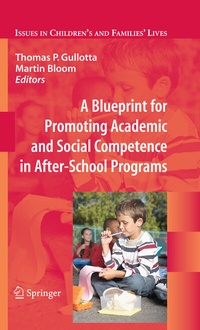
A Blueprint for Promoting Academic and Social Competence in After-School Programs
Description

School activities alone are not always sufficient to ensure children's academic progress or socio-emotional development and well-being. And the time when many children typically have the least adult supervision - immediately after school - is also the time that they are at the highest risk to act as perpetrators or become victims of antisocial behavior.
Throughout A Blueprint for Promoting Academic and Social Competence in After-School Programs, which focuses on children in grades 1 through 6, noted experts identify the best practices of effective programs and pinpoint methods for enhancing school-based skills and making them portable to home and neighborhood settings. This volume: (1) Analyzes the concepts central to effective after-school programs. (2) Offers developmental, cognitive, and social ecology perspectives on how children learn. (3) Features more than 100 exercises that develop young people's capabilities for academic, social, moral, and emotional learning - These exercises are ready to use or can be adapted to students' unique needs. (4) Emphasizes young people's development as students and as productive members of society during middle to late childhood and early adolescence. (5) Presents explicit theory and evidence that can be used to explain the value of after-school programs for budget proposals.
This important book will find an appreciative, ready audience among the program directors who design after-school curricula, the educators who implement them, the mental health and social work professionals who help staff them, and the current crop of graduate students who will create the next generation of programs.
More details
Other editions
Additional editions
Persons
Thomas P. Gullotta is C.E.O. of Child and Family Agency and is a member of the psychology and education departments at Eastern Connecticut State University. He is the senior author of the 4th edition of The Adolescent Experience, co-editor of The Encyclopedia of Primary Prevention and Health Promotion, and editor emeritus of the Journal of Primary Prevention. He is the senior book series editor for Issues in Children's and Families' Lives. Tom holds editorial appointments on the Journal of Early Adolescence, the Journal of Adolescent Research, and the Journal of Educational and Psychological Consultation. He has published extensively on young people and primary prevention. In 1999, Tom was honored by the Society for Community Research and Action, Division 27 of the American Psychological Association with their Distinguished Contributions to Practice in Community Psychology Award.
Martin Bloom is a retired professor of social work at the University of Connecticut. He is past editor of the Journal of Primary Prevention and co-edited The Encyclopedia of Primary Prevention and Health Promotion. He has published extensively on primary prevention and its practice applications.
