

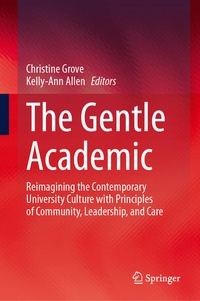
The Gentle Academic
Description

This book presents principles that offer an alternative approach to current academic practices by fostering thoughtful engagement with scholarly work and collegial relationships. Academic work exists within a system of substantial workloads, publication expectations, funding requirements, workforce casualization, structural inequities, and academic rejection. These systemic barriers affect staff wellbeing and job satisfaction while creating challenging work contexts. This edited volume examines eleven key principles: Be upfront and honest about the things you do not know; Acknowledge the intrinsic value of others' knowledge bases even if they do not seem important to you from your institutional context; Do not feign mastery where you have none; Respect the gaps in others' knowledge bases; Be generous with others; Be generous with yourself; You overwork yourself at the risk of legitimising a culture of overwork; Privilege voices and perspectives that have historically been left out of the academy; Nothing is ever neutral or apolitical; Support the progress of other scholars; and Collaboration over competition.
More details
Other editions
Additional editions
Persons
Dr Christine Grove is an Associate Professor in Educational and Developmental Psychology, previous Vice-Chancellor's Advanced Research Fellow at RMIT University, and Adjunct Associate Professor at Monash University. She holds a PhD in Psychology and is a Fulbright Scholar (2021-22). Her research bridges psychology, education, and health promotion, with a particular focus on prevention and early intervention in mental health.
Dr. Kelly-Ann is an associate professor and Educational and Developmental psychologist in the School of Educational Psychology and Counselling, Faculty of Education, Monash University, Australia. She is also an honorary principal fellow at the Centre for Wellbeing Science, MelbourneGraduate School of Education, University of Melbourne, Australia.
Content
Academia needs more gentle academics.- Principle 1 be upfront and honest about the things you do not know.- Principle 2 acknowledge the intrinsic value of others knowledge bases even if they do not seem important to you from your institutional context.- Principle 3 do not feign mastery where you have none.- Principle 4 respect the gaps in knowledge of others.- Principle 5 be generous with others be kind.- Principle 6 be generous with yourself.- Principle 7 you overwork yourself at the risk of legitimising a culture of overwork.- Principle 8 privilege voices and perspectives that have historically been left out of the academy.- Principle 9 nothing is ever neutral or apolitical.- Principle 10 support the progress of other scholars.- Principle 11 collaboration over competition enacting academic method writing through collaborative authorship.- Towards a future of gentle academics policy practice and patiences.
