

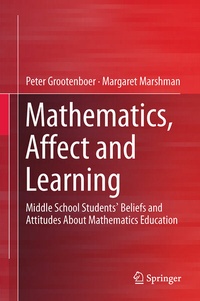
Mathematics, Affect and Learning
Description

More details
Other editions
Additional editions
Persons
Associate Professor Peter Grootenboer was a school teacher and leader for 12 years before moving into the tertiary sector. He received a national Jim Campbell Award for teaching excellence. He is now an Associate Professor in Education at Griffith University and a member of the Griffith Institute for Educational Research. His research interests include mathematics education, educational leadership, practice/praxis theory, and issues of social justice.
Dr Margaret Marshman worked as a hospital physicist, in laser physics and mathematical modelling for magnetic resonance imaging before becoming a secondary Mathematics and Science teacher and Mathematics Head of Department on the Gold Coast. She is involved in teacher education in the Graduate Diploma and undergraduate programs and has been involved in the professional development of practitioners through post-graduate programs. She is particularly interested in how students formulate and solve mathematical and scientific problems and also publishes in other areas of mathematical investigations, collaborative learning, middle schooling and mathematics and science education.
Content
1 Introduction.- 2 The Affective domain, mathematics, and mathematics education.- 3 Investigating students' ideas about mathematics and mathematics education.- 4 Students' beliefs and attitudes about mathematics and learning mathematics.- 5 Differences in the affective responses of various groups.- 6 Changes in affective responses to mathematics through the middle school years.- 7 Building positive affect in mathematics.
