

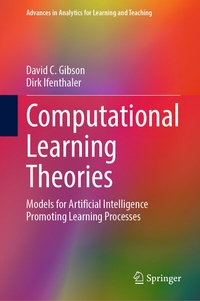
Computational Learning Theories
Description

This book shows how artificial intelligence grounded in learning theories can promote individual learning, team productivity and multidisciplinary knowledge-building. It advances the learning sciences by integrating learning theory with computational biology and complexity, offering an updated mechanism of learning, which integrates previous theories, provides a basis for scaling from individuals to societies, and unifies models of psychology, sociology and cultural studies.
The book provides a road map for the development of AI that addresses the central problems of learning theory in the age of artificial intelligence including:
- optimizing human-machine collaboration
- promoting individual learning
- balancing personalization with privacy
- dealing with biases and promoting fairness
- explaining decisions and recommendations to build trust and accountability
- continuously balancing and adapting to individual, team and organizational goals
- generating and generalizing knowledge across fields and domains
The book will be of interest to educational professionals, researchers, and developers of educational technology that utilize artificial intelligence.
More details
Other editions
Additional editions
Persons
Professor David Gibson, is the UNESCO Chair on Data Science in Higher Education Learning and Teaching at Curtin University in Perth Australia. He received his doctorate in Leadership and Policy Studies from the University of Vermont in 1999 based on a study of complex systems modeling of educational change. His study demonstrated the feasibility of bridging from qualitative information to quantifiable dynamic relationships in complex models that verify trajectories of organizational change. He provides thought leadership as a researcher, professor, learning scientist and innovator.
He is creator of simSchool, a classroom flight simulator for preparing educators and provides vision and sponsorship for Curtin University's Challenge, a mobile, game-based learning platform. His research has extended from learning analytics, complex systems analysis and modeling of education to application of complexity via games and simulations in teacher education, web applications and the future of learning. Dr. Gibson has also advanced the use of technology to personalize education via cognitive modeling, design and implementation.
Dirk Ifenthaler is Professor and Chair of Learning, Design and Technology at University of Mannheim, Germany and UNESCO Deputy Chair on Data Science in Higher Education Learning and Teaching at Curtin University, Australia. Dirk's research focuses on the intersection of cognitive psychology, educational technology, data analytics, and organisational learning. He is the Editor-in-Chief of the Technology, Knowledge and Learning and Editor-in-Chief of Educational Technology & Society.
Content
1. Why 'Computational' Learning Theories?.- 2. AI and Learning Processes.- 3. A Complex Hierarchical Framework of Learning.- 4. Piaget and the Ontogeny of Intelligence.- 5. Keller and the ARCS Model of Motivation.- 6. Complexity Theory and Learning.- 7. AI Roles for Enhancing Individual Learning.- 8. Informal Social Learning.- 9. How People Learn.- 10. AI Assisting Individuals as Team Members.- 11. AI Roles for the Team or Organization.- 12. A Network Theory of Culture.- 13. AI Roles in Cultural Learning.- 14. Open Questions.
