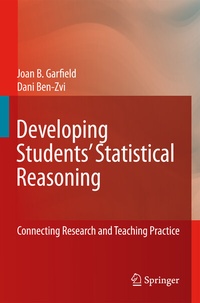
Developing Students' Statistical Reasoning
Description

Increased attention is being paid to the need for statistically educated citizens: statistics is now included in the K-12 mathematics curriculum, increasing numbers of students are taking courses in high school, and introductory statistics courses are required in college. However, increasing the amount of instruction is not sufficient to prepare statistically literate citizens. A major change is needed in how statistics is taught. To bring about this change, three dimensions of teacher knowledge need to be addressed: their knowledge of statistical content, their pedagogical knowledge, and their statistical-pedagogical knowledge, i.e., their specific knowledge about how to teach statistics. This book is written for mathematics and statistics educators and researchers. It summarizes the research and highlights the important concepts for teachers to emphasize, and shows the interrelationships among concepts. It makes specific suggestions regarding how to build classroom activities, integrate technological tools, and assess students' learning.
This is a unique book. While providing a wealth of examples through lessons and data sets, it is also the best attempt by members of our profession to integrate suggestions from research findings with statistics concepts and pedagogy. The book's message about the importance of listening to research is loud and clear, as is its message about alternative ways of teaching statistics. This book will impact instructors, giving them pause to consider: "Is what I'm doing now really the best thing for my students? What could I do better?"
J. Michael Shaughnessy, Professor, Dept of Mathematical Sciences, Portland State University, USA
This is a much-needed text for linking research and practice in teaching statistics. The authors have provided a comprehensive overview of the current state-of-the-art in statistics education research. The insights they have gleaned from theliterature should be tremendously helpful for those involved in teaching and researching introductory courses.
Randall E. Groth, Assistant Professor of Mathematics Education, Salisbury University, USA
Reviews / Votes
From the reviews:
This is a unique book. While providing a wealth of examples through lessons and data sets, it is also the best attempt by members of our profession to integrate suggestions from research findings with statistics concepts and pedagogy.
The book's message about the importance of listening to research is loud and clear, as is its message about alternative ways of teaching statistics. This book will impact instructors, giving them pause to consider: "Is what I'm doing now really the best thing for my students? What could I do better?"
Professor J. Michael Shaughnessy, Department of Mathematical Sciences, Portland State University, USA
This is a much-needed text for linking research and practice in teaching statistics. The authors have provided a comprehensive overview of the current state-of-the-art in statistics education research. The insights they have gleaned from the literature should be tremendously helpful for those involved in teaching and researching introductory courses.
Dr Randall E. Groth, Mathematics Education, Salisbury University, USA
"Garfield and Ben-Zvi have taken on an enormous task in their book, Developing Students' Statistical Reasoning. . The book contains an extended reference list that will be of great assistance to those who not only want to implement change in their teaching but also want to carry out research on that change with a view to reporting to the wider statistical educational community. . the authors have met their goal of providing a new way of thinking about teaching and learning introductory formal statistics courses." (Jane Watson, The International Journal on Mathematics Education, Vol. 41, 2009)
"The main goal of the book . is to reconciliate the research results with practical suggestions for teachers. . Teachers of introductory statistics courses at the high school or college levelwill find in this book ideas, activities, research summaries directly applicable in classrooms. . Unquestionably, the book will be . a worthy resource filling in the gap between the researchers and the practitioners in the fast expanding field of statistics education." (Mihai Cipu, Zentralblatt MATH, Vol. 1156, 2009)
More details
Other editions
Additional editions