

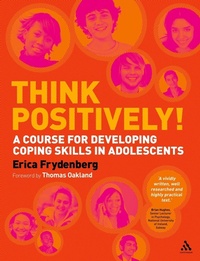
Think Positively!
A Course for Developing Coping Skills in Adolescents
1st Edition
Published on 3. March 2010
240 pages
978-1-4411-2661-0 (ISBN)
Description

Depression is experienced in epidemic proportions in many Western societies. There is concern over the number of young people who are suffering, sometimes to the extent of committing suicide. This book will help prevent stress and depression by taking a positive approach to the promotion of health and wellbeing in young people, giving them the skills to cope with the problems of everyday life.
Erica Frydenberg introduces the theory behind a cognitive behavioural approach to coping skills and offers a program of modules that can be used with young people to train them in coping skills. The principle that underscores this program is that we can all do what we do better. If we do not like how we cope in certain contexts we can learn new strategies. It is possible to enhance one's coping if we have a framework within which to do so. The program is universally applicable and can be taught in any group setting, although instructors will be able to bring their own experience to adapt the sessions.
Erica Frydenberg introduces the theory behind a cognitive behavioural approach to coping skills and offers a program of modules that can be used with young people to train them in coping skills. The principle that underscores this program is that we can all do what we do better. If we do not like how we cope in certain contexts we can learn new strategies. It is possible to enhance one's coping if we have a framework within which to do so. The program is universally applicable and can be taught in any group setting, although instructors will be able to bring their own experience to adapt the sessions.
Reviews / Votes
'...a vividly written, well researched, and highly practical text.' Brian Hughes, Senior Lecturer in Psychology, National University of Ireland, Galway 'Welcome to the Age of Resilience! "Think Positively" is a timely summons for teachers and parents to actively assume responsibility for making declarations such as "look on the bright side," or "the sky is the limit" to be more than just encouragements and instead become the way of life for young people. Erica Frydenberg's course is carefully grounded in developmental theories and empirical research on stress and coping. This resourceful book offers very practical templates for teaching children and teenagers productive coping strategies with past, present and future stressors. Yes we can, with the aid of this volume, coach our children to make well-informed choices regarding different ways of coping.' Krys Kaniasty, Professor of Psychology, Indiana University of Pennsylvania, USA & Opole University, Poland 'Erica Frydenberg's Think Positively! is a highly important and valuable manual that should be widely consulted. So much of the popular literature on positive thinking offers advice that is well-meaning but poorly evidence-based. However, this text is different. Its uniqueness lies in its promotion of coping skills and empowerment strategies based on principles drawn from empirical research. In adopting this approach, Frydenberg can be credited with providing an important service to young people and their mentors. This is a vividly written, well researched, and highly practical text.'Brian Hughes, Senior Lecturer in Psychology, National University of Ireland, Galway '... a great resource for psychologists, teachers and adolescents. The good news of this book is like the author says - that coping skills can be learnt, whether as part of a universal class-based program, in a small group setting for young people with particular needs, or for an individual.' Maria Emilia Lucio Gomez-Maqueo, Professor of Psychology, National Autonomous University of Mexico (UNAM) 'I think Erica's new book serves two valuable purposes: one is giving a reliable picture of the latest research in the topical area of positive psychology. The other, even more important purpose is its practical usefulness in the classroom....I think it's a perfect text for schools and teachers who might want to start up or develop their positive thinking programs for students.' Glyn Davis, Vice-Chancellor and Principal of the University of Melbourne, Australia 'Erica Frydenberg's excellent text, published last year, is a welcome addition to the field of education for personal and emotional learning ... an excellent set of resources, clearly based on theory, attractively produced and supported by website materials.'More details
Edition
1. Auflage
Language
English
Place of publication
New York
United States
Target group
Professional and scholarly
ISBN-13
978-1-4411-2661-0 (9781441126610)
Copyright in bibliographic data and cover images is held by Nielsen Book Services Limited or by the publishers or by their respective licensors: all rights reserved.
Schweitzer Classification
Other editions
Additional editions
Book
05/2010
Continuum Publishing Corporation
€35.50
Shipment within 15-20 days
Person
Erica Frydenberg is a clinical, organisational, counselling and educational psychologist. She practiced extensively in educational settings in Australia before joining the staff of the University of Melbourne, where she is an Associate Professor in Psychology in the Melbourne Graduate School of Education. She is a Fellow of the Australian Psychological Society and an elected member of its Board 2007-2009.
Thomas Oakland is a professor at the University of Florida, and President of the International Foundation for Children's Education.
Thomas Oakland is a professor at the University of Florida, and President of the International Foundation for Children's Education.
Content
Foreword Tom Oakland \ Acknowledgements \ Introduction \ Section I: Positive psychology, cognitive behavioural theory and the field of coping: what we know \ Cognitive Behaviour Therapy \ The Adolescent Brain \ Social and Emotional Learning
The Challenge \ From Stress to Coping \ Definitions of Coping \ So what is Coping? \ Measurement of Coping \ What we know about Coping \ Achievement \ Wellbeing and Coping \ Dysfunctional Behaviour and Coping \ Learning to Cope \ How the 12 modules can be used \ Section II: The modules of the program \ Module 1: The Language of Coping \ Module 2: Positive Thinking \ Module 3: Strategies that Don't Help \ Module 4: Getting Along with Others \ Module 5: Asking for Help \ Module 6: Coping with Conflict \ Module 7: Problem Solving \ Module 8: Social Problem Solving \ Module 9: Decision-making \ Module 10: Coping in Cyberworld \ Module 11: Goal Setting and Goal Getting \ Module 12: Time Management \ Section III: Coping Skills for Particular Groups \ Learning Disabled \ Students who have Specific Learning Disabilities \ Features of the Population \ Adapting the Program \ Evaluation \ What learned \ Children who have Experienced Divorce \ The group \ How adapted \ What found \ Dealing with Depression \ What is Depression? \ What are the effects of Depression? \ Intervention \ Helping a young person with Depression \ Chronic Illness \ Features of the Population \ Adaptation of the program \ Young people with Asperger's \ Particular need of students who have Asperger's \ Features of the population \ Adaptation of the program \ Working in small groups \ Concluding remarks \ References
The Challenge \ From Stress to Coping \ Definitions of Coping \ So what is Coping? \ Measurement of Coping \ What we know about Coping \ Achievement \ Wellbeing and Coping \ Dysfunctional Behaviour and Coping \ Learning to Cope \ How the 12 modules can be used \ Section II: The modules of the program \ Module 1: The Language of Coping \ Module 2: Positive Thinking \ Module 3: Strategies that Don't Help \ Module 4: Getting Along with Others \ Module 5: Asking for Help \ Module 6: Coping with Conflict \ Module 7: Problem Solving \ Module 8: Social Problem Solving \ Module 9: Decision-making \ Module 10: Coping in Cyberworld \ Module 11: Goal Setting and Goal Getting \ Module 12: Time Management \ Section III: Coping Skills for Particular Groups \ Learning Disabled \ Students who have Specific Learning Disabilities \ Features of the Population \ Adapting the Program \ Evaluation \ What learned \ Children who have Experienced Divorce \ The group \ How adapted \ What found \ Dealing with Depression \ What is Depression? \ What are the effects of Depression? \ Intervention \ Helping a young person with Depression \ Chronic Illness \ Features of the Population \ Adaptation of the program \ Young people with Asperger's \ Particular need of students who have Asperger's \ Features of the population \ Adaptation of the program \ Working in small groups \ Concluding remarks \ References
