

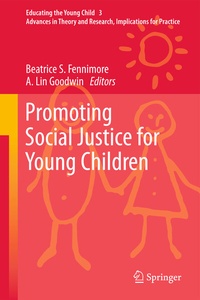
Promoting Social Justice for Young Children
Description

This book explores important current social justice issues that confront young children in America. A broad range of topics related to the fair treatment of young children and their families are approached with a fresh and hopeful energy. The central argument of this volume is that a fair and just society must protect the basic needs of all children so they are able to reach their full potential to learn, grow, and ultimately become productive democratic citizens. The book includes contributions from an impressive group of authors who have been consistent voices for the fair and equitable treatment of children in school and society. Each chapter examines a critical issue in child social justice with a focus on the current problem, historical importance of the issue, potential solutions, and a vision for the future. The book has been developed to reach a wide audience of professionals whose work involves children and who have grown concerned about social forces that cause child suffering and threaten the well-being or even the survival of children in the United States. Readers will come away with up to date information and a renewed commitment to being life-long advocates for children.
More details
Other editions
Additional editions
Content
Introduction: The Continuing Struggle for Social Justice for Children; Beatrice S. Fennimore.- Part I. SAFEGUARDING CHILD WELFARE AND PROTECTING CHILDREN'S RIGHTS.- 1. Child Poverty, Child Care, and Children's Rights; Valerie Polakow.- 2. Objectified Self, Objectified Relationships: The Sexualization of Childhood Promotes Social Injustice; Diane Levin.- 3. Child Justice, Caregiver Empowerment, and Community Self-Determination; Joshua Sparrow.- 4. Not In Harm's Way. Or Are They? War, Social Justice, and Young Children in the United States; Judith Van Hoorn and Diane Levin.- Part II. RELEVANCE AND MEANINGFULNESS IN EARLY LEARNING EXPERIENCES.- 5. Playful Learning: Early Education that Makes Sense to Children; Celia Genishi, Anne Haas Dyson, and Lindsey Russo.- 6. Education That Is Multicultural And Promotes Social Justice: The Need; Yvonne De Gaetano.- 7. Revolutionary Pedagogy: Art, Culture, and Place-Based Education in an Era of Standardization; Paula Purnell.- Part III. CHILDREN OF THE WORLD IN OUR CLASSROOMS-HONORING MULTIPLE IDENTITIES, LANGUAGES, AND KNOWLEDGES.- 8. Working with Immigrant Children of "Undocumented" and "Mixed" Families; Xue Lan Rong, Liv Thorstensson Dávila, and Jeremy Hilburn.- 9. Challenging the Text and Context of (Re)Naming Immigrant Children: Children's Literature as Tools for Change; Mariana Souto-Manning.- 10. Creating Meaningful Contexts in Schools for English Language Learners; Min Hong.- Part IV. EDUCATING PROFESSIONALS FOR SOCIAL JUSTICE COMMITMENTS.- 11. Beyond Inclusion: Disability Studies In Early Childhood Teacher Education; Beth Ferri and Jessica Bacon.- 12. Preparing Teachers of Young Children to be Social Justice-Oriented Educators; Celia Oyler.- Conclusion: Protecting the Rights of All Children: Using What We Know; A. Lin Goodwin.- About the Contributors.-Index.
