

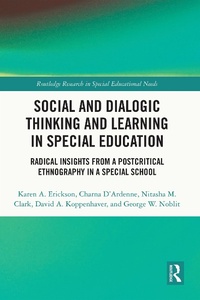
Social and Dialogic Thinking and Learning in Special Education
Radical Insights from a Post-Critical Ethnography in a Special School
1st Edition
Published on 28. December 2021
214 pages
978-1-000-51476-6 (ISBN)
Description

Drawing on a three-year post-critical ethnography, this volume counters deficit-based notions of disability to present a new social and dialogic theory of thinking and learning for students with significant support needs.
Dismantling ideas around ableism/disableism, Social and Dialogic Thinking and Learning offers a uniquely theoretical and conceptual contribution to special education and capability research. Illustrating how students exhibit varied practical, social, and creative abilities, possess agency and perform identity, chapters present a challenge to the restrictive ways in which disability is constructed through prescriptive forms of teacher-student interaction and instruction. The text ultimately offers a powerful re-imagining of how educators and researchers can perceive, observe, and respond to students beyond current institutional and cultural norms.
This text will benefit researchers, academics, and educators with an interest in inclusion and special educational needs, disability studies, and the theories of learning more broadly. Those specifically interested in educational psychology and the study of severe, profound, and multiple learning difficulties will also benefit from this book.
Dismantling ideas around ableism/disableism, Social and Dialogic Thinking and Learning offers a uniquely theoretical and conceptual contribution to special education and capability research. Illustrating how students exhibit varied practical, social, and creative abilities, possess agency and perform identity, chapters present a challenge to the restrictive ways in which disability is constructed through prescriptive forms of teacher-student interaction and instruction. The text ultimately offers a powerful re-imagining of how educators and researchers can perceive, observe, and respond to students beyond current institutional and cultural norms.
This text will benefit researchers, academics, and educators with an interest in inclusion and special educational needs, disability studies, and the theories of learning more broadly. Those specifically interested in educational psychology and the study of severe, profound, and multiple learning difficulties will also benefit from this book.
More details
Series
Edition
1. Auflage
Language
English
Place of publication
London
United Kingdom
Publishing group
Taylor & Francis Ltd
Target group
College/higher education
Product notice
Reflowable
Illustrations
2 Tables, black and white
ISBN-13
978-1-000-51476-6 (9781000514766)
Copyright in bibliographic data and cover images is held by Nielsen Book Services Limited or by the publishers or by their respective licensors: all rights reserved.
Schweitzer Classification
Other editions
Additional editions
Karen A. Erickson | Charna D'Ardenne | Nitasha M. Clark
Social and Dialogic Thinking and Learning in Special Education
Radical Insights from a Post-Critical Ethnography in a Special School
Book
09/2023
1st Edition
Routledge
€63.50
Shipment within 10-20 days
Karen A. Erickson | Charna D'Ardenne | Nitasha M. Clark
Social and Dialogic Thinking and Learning in Special Education
Radical Insights from a Post-Critical Ethnography in a Special School
Book
12/2021
1st Edition
Routledge
€206.20
Shipment within 10-20 days
Persons
Karen A. Erickson is the David E. & Dolores J. Yoder Distinguished Professor and Director of the Center for Literacy and Disability Studies, University of North Carolina at Chapel Hill, USA
Charna D'Ardenne is Assistant Professor at the Center for Literacy and Disability Studies, University of North Carolina at Chapel Hill, USA
Nitasha M. Clark is Research Affiliate with the Center for Literacy and Disability Studies, University of North Carolina at Chapel Hill, USA
David A. Koppenhaver is Professor in the Reading Education and Special Education Department at Appalachian State University, USA
George W. Noblit is Joseph R. Neikirk Distinguished Professor of Sociology of Education Emeritus at the University of North Carolina at Chapel Hill, USA
Charna D'Ardenne is Assistant Professor at the Center for Literacy and Disability Studies, University of North Carolina at Chapel Hill, USA
Nitasha M. Clark is Research Affiliate with the Center for Literacy and Disability Studies, University of North Carolina at Chapel Hill, USA
David A. Koppenhaver is Professor in the Reading Education and Special Education Department at Appalachian State University, USA
George W. Noblit is Joseph R. Neikirk Distinguished Professor of Sociology of Education Emeritus at the University of North Carolina at Chapel Hill, USA
Content
Part 1: Challenges in Studying Thinking and Learning in Students with Significant Support Needs
1: On Teaching versus Learning: An Introduction
2: Productive Mistakes
Part 2: Restrictive Contexts for Thinking and Learning
3: The Discursive Construction of Dis/Ability
4: Praise and Patterns of Instructional Practice (with Sofia Benson-Goldberg, PhD, CCC/SLP)
5: The Intersection of Race and Severe Disability
6: Enacting Imprisonment on Students with Significant Support Needs
Part 3: Students with Significant Support Needs Demonstrate Thinking and Learning
7: Students Asserting Themselves and Resisting the Hidden Curriculum
8: Students Demonstrating Smartness Outside the Constraints of Schooling
9: Agency Through Relation and Relation Through Agency
10: The Intersection of Structure and Sanction with Initiation and Persistence
Part 4: Relations at the Core of Teaching and Learning
11: Being with to Achieve Shared Perceptual and Emotional Awareness
12: Engaging in Dialogue without Conventional Language
13: Embodiment and Its Role in Extended Dialogue and Narrative
14: Radical Possibilities Beyond the Horizon
1: On Teaching versus Learning: An Introduction
2: Productive Mistakes
Part 2: Restrictive Contexts for Thinking and Learning
3: The Discursive Construction of Dis/Ability
4: Praise and Patterns of Instructional Practice (with Sofia Benson-Goldberg, PhD, CCC/SLP)
5: The Intersection of Race and Severe Disability
6: Enacting Imprisonment on Students with Significant Support Needs
Part 3: Students with Significant Support Needs Demonstrate Thinking and Learning
7: Students Asserting Themselves and Resisting the Hidden Curriculum
8: Students Demonstrating Smartness Outside the Constraints of Schooling
9: Agency Through Relation and Relation Through Agency
10: The Intersection of Structure and Sanction with Initiation and Persistence
Part 4: Relations at the Core of Teaching and Learning
11: Being with to Achieve Shared Perceptual and Emotional Awareness
12: Engaging in Dialogue without Conventional Language
13: Embodiment and Its Role in Extended Dialogue and Narrative
14: Radical Possibilities Beyond the Horizon
