

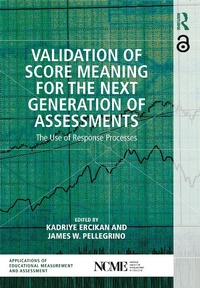
Validation of Score Meaning for the Next Generation of Assessments
The Use of Response Processes
Published on 27. March 2017
164 pages
978-1-317-48334-2 (ISBN)
Description

Despite developments in research and practice on using examinee response process data in assessment design, the use of such data in test validation is rare. Validation of Score Meaning in the Next Generation of Assessments Using Response Processes highlights the importance of validity evidence based on response processes and provides guidance to measurement researchers and practitioners in creating and using such evidence as a regular part of the assessment validation process. Response processes refer to approaches and behaviors of examinees when they interpret assessment situations and formulate and generate solutions as revealed through verbalizations, eye movements, response times, or computer clicks. Such response process data can provide information about the extent to which items and tasks engage examinees in the intended ways.
With contributions from the top researchers in the field of assessment, this volume includes chapters that focus on methodological issues and on applications across multiple contexts of assessment interpretation and use. In Part I of this book, contributors discuss the framing of validity as an evidence-based argument for the interpretation of the meaning of test scores, the specifics of different methods of response process data collection and analysis, and the use of response process data relative to issues of validation as highlighted in the joint standards on testing. In Part II, chapter authors offer examples that illustrate the use of response process data in assessment validation. These cases are provided specifically to address issues related to the analysis and interpretation of performance on assessments of complex cognition, assessments designed to inform classroom learning and instruction, and assessments intended for students with varying cultural and linguistic backgrounds.
The Open Access version of this book, available at http://www.taylorfrancis.com, has been made available under a Creative Commons Attribution-Non Commercial-No Derivatives 4.0 license.
With contributions from the top researchers in the field of assessment, this volume includes chapters that focus on methodological issues and on applications across multiple contexts of assessment interpretation and use. In Part I of this book, contributors discuss the framing of validity as an evidence-based argument for the interpretation of the meaning of test scores, the specifics of different methods of response process data collection and analysis, and the use of response process data relative to issues of validation as highlighted in the joint standards on testing. In Part II, chapter authors offer examples that illustrate the use of response process data in assessment validation. These cases are provided specifically to address issues related to the analysis and interpretation of performance on assessments of complex cognition, assessments designed to inform classroom learning and instruction, and assessments intended for students with varying cultural and linguistic backgrounds.
The Open Access version of this book, available at http://www.taylorfrancis.com, has been made available under a Creative Commons Attribution-Non Commercial-No Derivatives 4.0 license.
Reviews / Votes
"This book, focusing on the validation of score meaning using response process, introduces a unique dimension to the validation of assessments. It is a must-read source for anyone who is involved in assessment development and use. Currently, the field of assessment is mainly focused on content and psychometrics aspects in assessment validation; therefore, the internationally respected scholars who wrote the chapters of this volume have made a timely contribution to the assessment field by highlighting the importance of validity evidence based on response process."--Jamal Abedi, Professor, School of Education, University of California, Davis, USA
"Ercikan and Pellegrino have provided a thorough investigation of how the test-taker response processes influence the validity of score interpretations. By including studies that incorporate new technology with those using more traditional methods, assessment developers can better understand best practices in validity research. This highly readable book offers information that applies to multiple assessment types and purposes."
--Marianne Perie, Director, Center for Assessment and Accountability Research and Design, USA
"This volume and its approach to test validation represent an exciting addition to the field. Using examinee responses as a part of test validation will help those of us concerned about bias and fairness in testing."
--Martha Thurlow, Director, National Center on Educational Outcomes, USA
""With its clear organization, theoretical, and practical contributions to the topic, and the inclusion of a variety ofassessment types, the book can be considered an effective starting point for assessment researchers and practitioners who consider using response process data in their validation studies."
--Journal of Educational Measurement, Vol. 57, No. 1
More details
Series
Language
English
Place of publication
London
United Kingdom
Publishing group
Taylor & Francis Ltd
Target group
College/higher education
Professional and scholarly
Illustrations
19 s/w Abbildungen, 1 s/w Tabelle
1 Tables, black and white; 19 Illustrations, black and white
File size
23,06 MB
ISBN-13
978-1-317-48334-2 (9781317483342)
Copyright in bibliographic data and cover images is held by Nielsen Book Services Limited or by the publishers or by their respective licensors: all rights reserved.
Schweitzer Classification
Other editions
Additional editions
Kadriye Ercikan | James W. Pellegrino
Validation of Score Meaning for the Next Generation of Assessments
The Use of Response Processes
Book
04/2017
1st Edition
Routledge
€171.12
Shipment within 10-20 days
Kadriye Ercikan | James W. Pellegrino
Validation of Score Meaning for the Next Generation of Assessments
The Use of Response Processes
Book
03/2017
1st Edition
Routledge
€80.75
Shipment within 10-20 days
Persons
Kadriye Ercikan is Professor of Measurement, Evaluation, and Research Methodology in the Faculty of Education at the University of British Columbia, Canada and Vice President of Statistical Analysis, Data Analysis and Psychometric Research at the Educational Testing Service.
James W. Pellegrino is Liberal Arts and Sciences Distinguished Professor and Distinguished Professor of Education and Co-Director of the Learning Sciences Research Institute at the University of Illinois at Chicago, USA.
James W. Pellegrino is Liberal Arts and Sciences Distinguished Professor and Distinguished Professor of Education and Co-Director of the Learning Sciences Research Institute at the University of Illinois at Chicago, USA.
Content
Contents
Contributors
1. Introduction
Kadriye Ercikan and James W. Pellegrino
Part I. Conceptual & Methodological Issues Associated with Using Examinee Response Process Data to Validate Score Meaning
2. Validating Score Interpretations Based on Response Processes
Michael Kane & Robert Mislevy
3. Collecting and Analyzing Verbal Response Process Data in the Service of Interpretative and Validity Arguments
Jacqueline P. Leighton
4. Collecting, Analyzing and Interpreting Response time, Eye-tracking, and Log data
Andreas Oranje, Joanna Gorin, Yue Jia, Deirdre Kerr
5. Commentary I
Lauress L. Wise
Part II. Using Examinee Response Process Data to Validate Score Meaning: Applications in Different Assessment Contexts
6. Assessments of Complex Thinking
Paul Nichols and Kristen Huff
7. Threats to Score Meaning in Automated Scoring
Isaac I. Bejar
8. The Contribution of Student Response Processes to Validity Analyses for Instructionally Supportive Assessments
Louis V. DiBello, James W. Pellegrino, Brian D. Gane, & Susan R. Goldman
9. Score Processes in Assessing Academic Content of Non-native Speakers
Rebecca J. Kopriva and Laura Wright
10. Assessment of Students with Learning Disabilities: Using Students' Performance and Progress to Inform Instruction
Gerald Tindal, Julie Alonzo, Leilani Saez, and Joseph F. T. Nese
11. Multiple Language Versions of Tests
Guillermo Solano-Flores and Magda Chia
12. Commentary 2: The Value of Response Process Studies to Evaluate Score Meaning
Suzanne Lane
Index
Contributors
1. Introduction
Kadriye Ercikan and James W. Pellegrino
Part I. Conceptual & Methodological Issues Associated with Using Examinee Response Process Data to Validate Score Meaning
2. Validating Score Interpretations Based on Response Processes
Michael Kane & Robert Mislevy
3. Collecting and Analyzing Verbal Response Process Data in the Service of Interpretative and Validity Arguments
Jacqueline P. Leighton
4. Collecting, Analyzing and Interpreting Response time, Eye-tracking, and Log data
Andreas Oranje, Joanna Gorin, Yue Jia, Deirdre Kerr
5. Commentary I
Lauress L. Wise
Part II. Using Examinee Response Process Data to Validate Score Meaning: Applications in Different Assessment Contexts
6. Assessments of Complex Thinking
Paul Nichols and Kristen Huff
7. Threats to Score Meaning in Automated Scoring
Isaac I. Bejar
8. The Contribution of Student Response Processes to Validity Analyses for Instructionally Supportive Assessments
Louis V. DiBello, James W. Pellegrino, Brian D. Gane, & Susan R. Goldman
9. Score Processes in Assessing Academic Content of Non-native Speakers
Rebecca J. Kopriva and Laura Wright
10. Assessment of Students with Learning Disabilities: Using Students' Performance and Progress to Inform Instruction
Gerald Tindal, Julie Alonzo, Leilani Saez, and Joseph F. T. Nese
11. Multiple Language Versions of Tests
Guillermo Solano-Flores and Magda Chia
12. Commentary 2: The Value of Response Process Studies to Evaluate Score Meaning
Suzanne Lane
Index
