


Reflective and Impulsive Determinants of Human Behavior
Published on 13. September 2016
280 pages
978-1-315-52308-8 (ISBN)
Description

Conflicts between the "head" and the "heart" are very common in everyday life. Over the past decade, research on such self-regulatory conflicts has been strongly shaped by Strack and Deutsch's 2004 Reflective-Impulsive Model (RIM). The award-winning theory integrates cognitive, affective, and motivational influences on overt behavior, offering a domain-independent framework that is applicable to wide range of social and non-social phenomena. This book provides a state-of-the-art overview of research under the framework of the RIM. Its 15 chapters provide an overview of basic principles of behavior determination, showcase the RIM's integrative and predictive power in many cross-cutting areas of inquiry, and illustrate the value of the theory for understanding the fundamental role of reflective and impulsive processes in various applied domains.
Expanding on an introduction that discusses the significance of the RIM from a historical view, the book is divided into three major sections. The first section covers basic psychological principles within the RIM, including selective accessibility, embodiment, associative and propositional operations, and implementation intentions. The second section reviews the integrative and predictive power of the RIM in many cross-cutting areas of inquiry, including intuition, attitudes, self-control, and personality. Finally, the third section showcases the generative power of the RIM in various applied areas, including research on health behavior, addiction, anxiety, economic behavior, sexual behavior, and aggression. In its entirety, this volume provides an indispensable resource for any scholar interested in the psychological underpinnings of reflective and impulsive behavior in various areas of inquiry.
Expanding on an introduction that discusses the significance of the RIM from a historical view, the book is divided into three major sections. The first section covers basic psychological principles within the RIM, including selective accessibility, embodiment, associative and propositional operations, and implementation intentions. The second section reviews the integrative and predictive power of the RIM in many cross-cutting areas of inquiry, including intuition, attitudes, self-control, and personality. Finally, the third section showcases the generative power of the RIM in various applied areas, including research on health behavior, addiction, anxiety, economic behavior, sexual behavior, and aggression. In its entirety, this volume provides an indispensable resource for any scholar interested in the psychological underpinnings of reflective and impulsive behavior in various areas of inquiry.
Reviews / Votes
Self-regulatory conflicts - tensions between the "head" and the "heart" - are a prominent part of daily human experience. This outstanding volume reviews cutting edge research into their causes and consequences, using Strack and Deutsch's Reflective-Impulsive Model as a powerful integrative framework.-Norbert Schwarz, Provost Professor of Psychology and Marketing, University of Southern California
A valuable complement to other recent volumes dealing generally with dual-process models, this book specifically focuses on Strack and Deutsch's RIM model. Authoritative chapters elucidate the model's fundamental processes and important areas of application including health, addiction, and economic behavior.
-Eliot R. Smith, Distinguished Professor of Psychological and Brain Sciences, Indiana University
This volume is a homage to Fritz Strack, one of the most creative contemporary minds in social psychology and the creator of the versatile and integrative Reflective-Impulsive Model, which has evolved to become one of the most influential theoretical contributions to psychology.
-Guen R. Semin, Research Professor of Psychology and Director of the William James Center for Research, Instituto Universitario de Ciencias Psicologicas, Sociais e da Vida
More details
Language
English
Place of publication
London
United Kingdom
Publishing group
Taylor & Francis Ltd
Target group
College/higher education
Professional and scholarly
File size
1,30 MB
ISBN-13
978-1-315-52308-8 (9781315523088)
Copyright in bibliographic data and cover images is held by Nielsen Book Services Limited or by the publishers or by their respective licensors: all rights reserved.
Schweitzer Classification
Other editions
Additional editions
Roland Deutsch | Bertram Gawronski | Wilhelm Hofmann
Reflective and Impulsive Determinants of Human Behavior
Book
09/2016
1st Edition
Routledge
€242.10
Shipment within 10-20 days
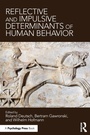
Roland Deutsch | Bertram Gawronski | Wilhelm Hofmann
Reflective and Impulsive Determinants of Human Behavior
Book
09/2016
1st Edition
Routledge
€86.80
Shipment within 10-20 days
Persons
Roland Deutsch, PhD, is Professor of Social Psychology at the Technical University of Dresden. His research is focused on the mechanisms and measurement of spontaneous evaluations and approach/avoidance motivation.
Bertram Gawronski, PhD, is Professor of Psychology and David Wechsler Regents Chair at the University of Texas at Austin. His research investigates the mental underpinnings and behavioral consequences of spontaneous and deliberate evaluations of objects, individuals, groups, and social issues.
Wilhelm Hofmann, PhD, is Professor of Social and Economic Cognition at the University of Cologne, Germany. His research is concerned with desire, self-control, and moral behavior, particularly the emergence of impulses and desires, the role of executive functioning in self-control and health behavior, and the connection between self-control, morality, and happiness.
Bertram Gawronski, PhD, is Professor of Psychology and David Wechsler Regents Chair at the University of Texas at Austin. His research investigates the mental underpinnings and behavioral consequences of spontaneous and deliberate evaluations of objects, individuals, groups, and social issues.
Wilhelm Hofmann, PhD, is Professor of Social and Economic Cognition at the University of Cologne, Germany. His research is concerned with desire, self-control, and moral behavior, particularly the emergence of impulses and desires, the role of executive functioning in self-control and health behavior, and the connection between self-control, morality, and happiness.
Content
Preface
Reflection and Impulse: A Framework for Basic Research and Applied Science
Roland Deutsch, Bertram Gawronski, Wilhelm Hofmann
I. Basic Principles
Reflections on Comparison: The Selective Accessibility Mechanism
Thomas Mussweiler, Corinna Michels, Alexa Weiss
Manual and Facial Approach and Avoidance Behavior: Flexible and Inflexible Links to Affect
Roland Neumann, Julia Kozlik
Associative and Propositional Processes from the Perspective of the Reflective-Impulsive Model
Roland Deutsch
From Thought to Automatic Action: Strategic and Incidental Action Control by If-Then Planning
Torsten Martiny-Huenger, Maik Bieleke, Gabriele Oettingen, Peter M. Gollwitzer
II. Cross-Cutting Perspectives
Flotsam on the Shore of Ignorance - Towards a Definition of Intuition
Sascha Topolinski
The Associative-Propositional Duality in the Representation, Formation, and Expression of Attitudes
Bertram Gawronski, Skylar M. Brannon, Galen V. Bodenhausen
Passion versus Reason: Impulsive and Reflective Determinants of Self-Control Success and Failure
Wilhelm Hofmann, Malte Friese
Dual Process Approaches to Personality
Mitja D. Back, Steffen Nestler
III. Applications
Health Behavior and the Reflective-Impulsive Model
Martin Hagger
Reflective and Impulsive Processes in Addiction and the Role of Motivation
Reinout W. Wiers, Thomas E. Gladwin
Integrating the Reflective-Impulsive Model with Cognitive-Behavioral Therapy for Anxiety Disorders
Allison Ouimet
Economic Behavior and the Reflective-Impulsive Duality
Carlos Alos-Ferrer
Sexual Behavior
Michael Haefner, Kai Epstude
Aggression from the Perspective of the Reflective-Impulsive Model: Testing Predictions Using Indirect Measures
Rainer Banse, Alexander F. Schmidt, Roland Imhoff
Reflection and Impulse: A Framework for Basic Research and Applied Science
Roland Deutsch, Bertram Gawronski, Wilhelm Hofmann
I. Basic Principles
Reflections on Comparison: The Selective Accessibility Mechanism
Thomas Mussweiler, Corinna Michels, Alexa Weiss
Manual and Facial Approach and Avoidance Behavior: Flexible and Inflexible Links to Affect
Roland Neumann, Julia Kozlik
Associative and Propositional Processes from the Perspective of the Reflective-Impulsive Model
Roland Deutsch
From Thought to Automatic Action: Strategic and Incidental Action Control by If-Then Planning
Torsten Martiny-Huenger, Maik Bieleke, Gabriele Oettingen, Peter M. Gollwitzer
II. Cross-Cutting Perspectives
Flotsam on the Shore of Ignorance - Towards a Definition of Intuition
Sascha Topolinski
The Associative-Propositional Duality in the Representation, Formation, and Expression of Attitudes
Bertram Gawronski, Skylar M. Brannon, Galen V. Bodenhausen
Passion versus Reason: Impulsive and Reflective Determinants of Self-Control Success and Failure
Wilhelm Hofmann, Malte Friese
Dual Process Approaches to Personality
Mitja D. Back, Steffen Nestler
III. Applications
Health Behavior and the Reflective-Impulsive Model
Martin Hagger
Reflective and Impulsive Processes in Addiction and the Role of Motivation
Reinout W. Wiers, Thomas E. Gladwin
Integrating the Reflective-Impulsive Model with Cognitive-Behavioral Therapy for Anxiety Disorders
Allison Ouimet
Economic Behavior and the Reflective-Impulsive Duality
Carlos Alos-Ferrer
Sexual Behavior
Michael Haefner, Kai Epstude
Aggression from the Perspective of the Reflective-Impulsive Model: Testing Predictions Using Indirect Measures
Rainer Banse, Alexander F. Schmidt, Roland Imhoff
