

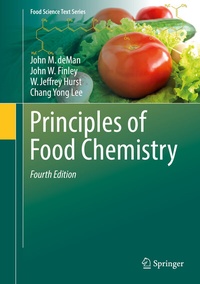
Principles of Food Chemistry
Description

More details
Other editions
Additional editions
Persons
John M. deMan (1926-2010) was a University Professor Emeritus in the Department of Food Science at the University of Guelph, Ontario, Canada. He was the Chairman of the Department and Past President of the Canadian Institute of Food Science and Technology. He published over 250 papers and book chapters on multiple aspects of food science and technology. He received many professional awards, including the Dairy Research Award of the American Dairy Science Association, The Institute Award of the Canadian Institute of Food Science and Technology, the Alton E. Baily award of the American Oil Chemist Society, the Stephen S. Chang award of the Institute of Food Technologists, and the Kaufmann Memorial award of the International Society of Fat Research. He was a Fellow of the Institute of Food Technologists, the Canadian Institute of Food Science and Technology and the Malaysian Oil Science and Technology Association.
Dr Finley is a Fellow American Chemical Society, Fellow-Agricultural and Food Division of American Chemical Society, Fellow Royal Society of Chemistry, Fellow Institute of Food Technologists, Certified Food Technologist by Fellow Institute of Food Technologists. Other Awards include Outstanding Alumnus Michigan State University. Othr awards include Harris Distinguished lecturer at the Ohio State University, aLeadership Award at Nabisco and membership in Sigma Xi at Michigan State University, and Phi Kappa Phi at Cornell University.
Dr Finley has edited eight books, holds 70 patents and 135 Publications.
Chang Yong Lee received a B.S. in Chemistry from Chung-Ang University in Seoul, Korea and a PhD from Utah State University. He has been working as a faculty member at Cornell University since 1969. Professor Lee has been teaching food chemistry for a number of years in the Department of Food Science. His research interests have been on biochemical aspects of plant foods. Recently his laboratory has been working on bioactivity of phytochemicals that related to health benefits. He served as Chair of Department of Food Science and Technology and Co-director of Cornell Institute of Food Science (2002-2008). Dr. Lee has held visiting professor appointments at several institutions, including Korea Institute of Science and Technology; Inter-American Institute of Agricultural Science at EMBRAPA, Brazil; Institut National de la Recherche Agronomique, Avignon, France; Beijing Vegetable Research Center, China; Ecole Nationale Superieure des Industries Agricoles et Alimentaire, France; Graduate School of Biotechnology, Korea University; and Kyung Hee University, Korea. Professor Lee has authored more than 300 research articles. He was a recipient of Platinum Award on his edited books on polyphenols from American Chemical Society's Division of Agricultural and Food Chemistry. Journal of Agricultural and Food Chemistry and the Institute for Scientific Information (ISI) acknowledged Professor Lee as one of the Highly Cited Researchers (HCR) in 2004. Thomson Reuters selected him as one of 112 scientists in the world in the field of Agricultural Science during 2002-2012 who published the greatest number of highly cited papers ranked in the top 1% by citations.Again in 2015, Thomson Reuters listed Lee as one of the World's Most Influential Scientific Minds in Agricultural Science. Professor Lee was awarded USDA Secretary's Honor Award for Excellence in Research in 2001 and 2004, and Babcock-Hart Award from International Life Science Institute and Institute of Food Technologists in 2003. He is elected Fellow of American Chemical Society's Division of Agriculture and Food Chemistry (1991), the Institute of Food Technologists (1996), the Korean Academy of Science and Technology (1998), and International Academy of Food Science and Technology (2006). He was appointed as International Scholar (2011-2014) at Kyung Hee University in Korea and recently (2014-present) he has been serving as Adjunct Distinguished Professor at King Abdulaziz University, Saudi Arabia.
