

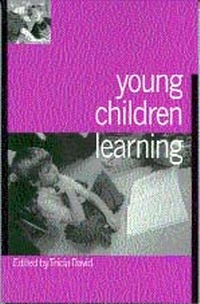
Young Children Learning
1st Edition
Published on 10. March 1999
240 pages
978-1-4462-6628-1 (ISBN)
Description

`I particularly enjoyed Judith Roden's chapter "Young Children Are Natural Scientists" especially her thoughts on children's drawings, which puncture some popular assumptions' - Times Educational Supplement, Friday Magazine
`This expertly argued and fascinating book seeks to redress the balance; it places the child firmly at the centre of the educational process and examines in detail the many and varied factors (such as health and physical development, play, stress, and early intervention) which affect the way in which the young child learns and develops' - Who Minds
`Tricia David, an internationally recognized expert in early years education, has brought together 11 tutors from Canterbury Christ Church University College to "encourage debate and disagreement".... It has... some absorbing and helpful contributions which both bring forward the debate in early years education and also may cause readers to reappraise their own practice, possibly as a result of disagreeing with one or other contributors' - International Journal of Early Years Education
Young Children Learning brings together current thinking on young children's learning, with ideas about the curriculum for children aged 0 to eight years old. Areas covered in this book include: play; health and physical development; early intervention; stress; children understanding their worlds; bilingualism; children's spiritual development; national identity; young children as natural scientists; assessing learning; the needs of parents, children and teachers; and childhood in changing societies.
Written by experienced practitioners from the centre for International Studies in early childhood, Young Children Learning shows that in the earliest years of childhood, all children should experience the delight which can be part of effective pedagogy - pedagogy which takes account of the child's individuality and development, in the context of changing socio-cultural constructions of childhood.
`This expertly argued and fascinating book seeks to redress the balance; it places the child firmly at the centre of the educational process and examines in detail the many and varied factors (such as health and physical development, play, stress, and early intervention) which affect the way in which the young child learns and develops' - Who Minds
`Tricia David, an internationally recognized expert in early years education, has brought together 11 tutors from Canterbury Christ Church University College to "encourage debate and disagreement".... It has... some absorbing and helpful contributions which both bring forward the debate in early years education and also may cause readers to reappraise their own practice, possibly as a result of disagreeing with one or other contributors' - International Journal of Early Years Education
Young Children Learning brings together current thinking on young children's learning, with ideas about the curriculum for children aged 0 to eight years old. Areas covered in this book include: play; health and physical development; early intervention; stress; children understanding their worlds; bilingualism; children's spiritual development; national identity; young children as natural scientists; assessing learning; the needs of parents, children and teachers; and childhood in changing societies.
Written by experienced practitioners from the centre for International Studies in early childhood, Young Children Learning shows that in the earliest years of childhood, all children should experience the delight which can be part of effective pedagogy - pedagogy which takes account of the child's individuality and development, in the context of changing socio-cultural constructions of childhood.
Reviews / Votes
`I particularly enjoyed Judith Roden's chapter "Young Children Are Natural Scientists", especially her thoughts on children's drawings, which puncture some popular assumptions' - Times Educational Supplement, Friday MagazineMore details
Language
English
Place of publication
London
United Kingdom
Target group
College/higher education
Professional and scholarly
ISBN-13
978-1-4462-6628-1 (9781446266281)
Copyright in bibliographic data and cover images is held by Nielsen Book Services Limited or by the publishers or by their respective licensors: all rights reserved.
Schweitzer Classification
Other editions
Additional editions
Tricia David
Young Children Learning
Book
03/1999
SAGE Publications Ltd
€231.76
Shipment within 15-20 days
Tricia David
Young Children Learning
Book
03/1999
1st Edition
SAGE Publications Ltd
€103.80
Shipment within 15-20 days
Person
Tricia David is a Professor of Education at Canterbury Christ Church College, where she directs the Centre for International Studies in Early Childhood. She is a past president of OMEP-UK (OMEP is the World Organization for Early Childhood Education) and she is currently a member of BERA ( British Educational Research Associaton) Council and the editor of the International Journal of Early Childhood.
CONTRIBUTORSAFFILIATIONS:
Teresa Aguado Universidad Nacional a Distancia, Madrid
Stig Brostrom Royal Danish School of Educational Studies
Noirin Hayes Dublin Institute of Technology
Rosario Jimenez-Frias Universidad Nacional a Distancia, Madrid
Malgorzata Karwowska-Struczyk Poland
Alkistis Kondoyianni Ministry of Education, Athens
Ulla Lind Stockholm Institute of Education
Helen Penn Institute of Education, London
Eric Plaisance Universite Rene Descartes, Paris V
Sylvie Rayne Institut National de Recherche Pedagogique, Paris
Karin Vilien Educational Consultant, Copenhagen
CONTRIBUTORSAFFILIATIONS:
Teresa Aguado Universidad Nacional a Distancia, Madrid
Stig Brostrom Royal Danish School of Educational Studies
Noirin Hayes Dublin Institute of Technology
Rosario Jimenez-Frias Universidad Nacional a Distancia, Madrid
Malgorzata Karwowska-Struczyk Poland
Alkistis Kondoyianni Ministry of Education, Athens
Ulla Lind Stockholm Institute of Education
Helen Penn Institute of Education, London
Eric Plaisance Universite Rene Descartes, Paris V
Sylvie Rayne Institut National de Recherche Pedagogique, Paris
Karin Vilien Educational Consultant, Copenhagen
Content
Changing Minds - Tricia David
Young Children Learning
Balancing the Needs of Children, Parents and Teachers - Angela D Nurse and Rita Headington
Assessment - Beryl Webber
The Key to Learning
Play, Health and Physical Development - Richard Bailey
Early Intervention - Christopher Robertson
The Education of Young Children with Developmental Co-Ordination Disorder (DCD)
Pressure, Stress and Children's Behaviour at School - John Cornwall
Co-Constructing Reality - Mike Radford
The Child's Understanding of the World
Using Interpretive Procedures - Keith Sharpe
Young Children Are Natural Scientists - Judith Roden
Bilingual Children in a Monolingual Society - Martine Jago
Spiritual Development and Religious Education - Mike Radford
Young Citizens - Keith Sharpe
Children's Development and National Identity
Changing Childhoods, Changing Minds - Tricia David and Sacha Powell
Young Children Learning
Balancing the Needs of Children, Parents and Teachers - Angela D Nurse and Rita Headington
Assessment - Beryl Webber
The Key to Learning
Play, Health and Physical Development - Richard Bailey
Early Intervention - Christopher Robertson
The Education of Young Children with Developmental Co-Ordination Disorder (DCD)
Pressure, Stress and Children's Behaviour at School - John Cornwall
Co-Constructing Reality - Mike Radford
The Child's Understanding of the World
Using Interpretive Procedures - Keith Sharpe
Young Children Are Natural Scientists - Judith Roden
Bilingual Children in a Monolingual Society - Martine Jago
Spiritual Development and Religious Education - Mike Radford
Young Citizens - Keith Sharpe
Children's Development and National Identity
Changing Childhoods, Changing Minds - Tricia David and Sacha Powell
