

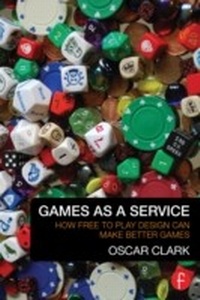
Games As A Service
How Free to Play Design Can Make Better Games
1st Edition
Published on 5. February 2014
312 pages
978-1-317-90887-6 (ISBN)
Description

The games industry is serious business and the role of a games designer has dramatically changed over just the last few years. Developers now have to rethink everything they know about the creative, technical and business challenges to adapt to the transition to games as a service.
Games as a Service: How Free to Play Design Can Make Better Games has been written to help designers overcome many of the fears and misconceptions surrounding freemium and social games. It provides a framework to deliver better games rather than the 'evil' or 'manipulative' experiences some designers fear with the move away from wasteful Products to sustainable, trustworthy Services.
Oscar Clark is a consultant and Evangelist for Everyplay from Applifier. He has been a pioneer in online, mobile and console social games services since 1998 including Wireplay (British Telecom), Hutchison Whampoa (3UK) and PlayStation (R)Home. He is a regular columnist on PocketGamer.Biz and is an outspoken speaker and moderator at countless games conferences on Games Design, Discovery, and Monetisation. He is also a notorious hat wearer.
Games as a Service: How Free to Play Design Can Make Better Games has been written to help designers overcome many of the fears and misconceptions surrounding freemium and social games. It provides a framework to deliver better games rather than the 'evil' or 'manipulative' experiences some designers fear with the move away from wasteful Products to sustainable, trustworthy Services.
Oscar Clark is a consultant and Evangelist for Everyplay from Applifier. He has been a pioneer in online, mobile and console social games services since 1998 including Wireplay (British Telecom), Hutchison Whampoa (3UK) and PlayStation (R)Home. He is a regular columnist on PocketGamer.Biz and is an outspoken speaker and moderator at countless games conferences on Games Design, Discovery, and Monetisation. He is also a notorious hat wearer.
Reviews / Votes
"The writer has not only researched widely, he has also read extensively. For non-games professionals, the notes themselves are a treasure trove of information and reference sources to follow up on, even if the thought of playing games is anathema to you." -- Monty Munford, founder of Mob76 OutlookMore details
Language
English
Place of publication
London
United Kingdom
Publishing group
Taylor & Francis Ltd
Target group
Professional and scholarly
Illustrations
12 farbige Abbildungen, 12 Farbfotos bzw. farbige Rasterbilder, 12 farbige Zeichnungen
12 Line drawings, color; 12 Halftones, color; 12 Illustrations, color
File size
4,75 MB
ISBN-13
978-1-317-90887-6 (9781317908876)
Copyright in bibliographic data and cover images is held by Nielsen Book Services Limited or by the publishers or by their respective licensors: all rights reserved.
Schweitzer Classification
Other editions
Additional editions
Book
08/2018
1st Edition
Routledge
€252.78
Shipment within 10-20 days
Book
02/2014
1st Edition
Routledge
€62.50
Shipment within 15-20 days
Person
Oscar Clark has been a pioneer in online, mobile and console social games services since 1998 including Wireplay (British Telecom), Hutchison Whampoa (3UK), PlayStation (R)Home and Applifier. He is a regular columnist on PocketGamer.Biz and Develop-Online as well as a Mentor for Game Founders. He is also an outspoken speaker at countless games conferences on Games Design, Discovery, and Monetisation. He is also a notorious top hat wearer.
http://www.linkedin.com/in/oscarclark
http://www.linkedin.com/in/oscarclark
Content
Chapter 1: Introduction
Exercise 1: Coming up with an initial concept
Chapter 2: What is a game?
Exercise 2: Who Are Your Players?
Chapter 3: The Anatomy of Play
Exercise 3: What is the Mechanic?
Chapter 4: Player Lifecycle
Exercise 4: What is the Context Loop?
Chapter 5: The Rhythm of Play
Exercise 5: What is the MetaGame?
Chapter 6: Building on Familiarity
Exercise 6: What is Your Bond Opening?
Chapter 7: Counting on Uncertainty
Exercise 7: What is Your Flash Gordon Cliffhanger?
Chapter 8: Six Degrees of Socialization
Exercise 8: What is your Star Wars Factor?
Chapter 9: Engagement Led Design
Exercise 9: What is Your Columbo Twist?
Chapter 10: Delivering Discovery
Exercise 10: What makes your game social?
Chapter 11: Counting on Data
Exercise 11: How Does Your Design Encourage Discovery?
Chapter 12: Service Strategies
Exercise 12: How Will You Capture Data?
Chapter 13: The Psychology of Pricing
Exercise 13: Writing Use Cases
Chapter 14: Tools of the Trade
Exercise 14: How will you Monetize?
Chapter 15: Conclusions
Exercise 1: Coming up with an initial concept
Chapter 2: What is a game?
Exercise 2: Who Are Your Players?
Chapter 3: The Anatomy of Play
Exercise 3: What is the Mechanic?
Chapter 4: Player Lifecycle
Exercise 4: What is the Context Loop?
Chapter 5: The Rhythm of Play
Exercise 5: What is the MetaGame?
Chapter 6: Building on Familiarity
Exercise 6: What is Your Bond Opening?
Chapter 7: Counting on Uncertainty
Exercise 7: What is Your Flash Gordon Cliffhanger?
Chapter 8: Six Degrees of Socialization
Exercise 8: What is your Star Wars Factor?
Chapter 9: Engagement Led Design
Exercise 9: What is Your Columbo Twist?
Chapter 10: Delivering Discovery
Exercise 10: What makes your game social?
Chapter 11: Counting on Data
Exercise 11: How Does Your Design Encourage Discovery?
Chapter 12: Service Strategies
Exercise 12: How Will You Capture Data?
Chapter 13: The Psychology of Pricing
Exercise 13: Writing Use Cases
Chapter 14: Tools of the Trade
Exercise 14: How will you Monetize?
Chapter 15: Conclusions
