

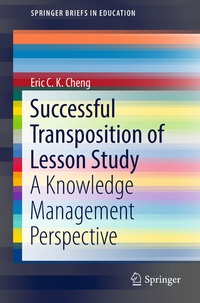
Successful Transposition of Lesson Study
Description

This book analyses the organisation cultures that promote Japanese Lesson Study, identifies the soul of lesson study, which is missing in other cultures, and discusses the conditions for successfully transplanting the Lesson Study to other cultures. Adopting Nonaka and Tateuchi's (1995) SECI knowledge creation model as the analytical lens, it explores the tacit and explicit knowledge convention and creation processes in lesson study. Unpacking the mechanism of the knowledge management process and practices could assist policy makers and school administrators, educators in contextualising lesson study to their school systems. The book provides an accessible discussion of the benefits and challenges of introducing lesson study, and presents three new research dimensions to analyse it: reviewing the historical development of lesson study in terms of the pendulum swings between professional accountability and state accountability in developing the school-based curriculum and the national curriculum; examining lesson study as a knowledge management tool for creating pedagogical knowledge for curriculum implementation: and studying the "kaizen kata" embedded in the PDCA cycles of lesson study as an organization routine for school improvement.
Reviews / Votes
"Successful Transposition of Lesson Study is a well-informed work that approaches LS, KM and the SECI model not only from the literature, but also from the personal and professional experience of the author (a strength of the book). . This volume will be a useful tool to help teachers and schools outside Japan make the necessary adjustments and decisions when incorporating LS into their practice and organisational routine to create, manage and share knowledge." (Gabriel Hervas, Educational Review, Vol. 71 (4), 2019)More details
Other editions
Additional editions
Person
Content
1 Conceptualising Lesson Study from International Literature.- 2 Reconceptualising Lesson Study as Knowledge Management.- 3 Applying SECI Model for Creating Pedagogical Knowledge.- 4 Rotating PDCA Cycles through SECI Processes for Curriculum Management.- 5 Institutionalizing Lesson Study for Managing Knowledge.
