

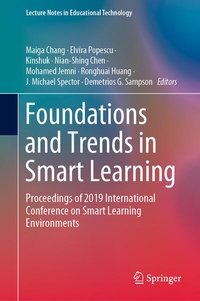
Foundations and Trends in Smart Learning
Proceedings of 2019 International Conference on Smart Learning Environments
1st Edition
Published on 14. March 2019
XIII, 194 pages
978-981-13-6908-7 (ISBN)
Description

This book focuses on the interplay between pedagogy and technology, and their fusion for the advancement of smart learning environments. It discusses various components of this interplay, including learning and assessment paradigms, social factors and policies, emerging technologies, innovative application of mature technologies, transformation of curriculum and teaching behavior, transformation of administration, best infusion practices, and piloting of new ideas.
The book provides an archival forum for researchers, academics, practitioners and industry professionals interested and/or engaged in reforming teaching and learning methods by promoting smart learning environments. It also facilitates discussions and constructive dialogue among various stakeholders on the limitations of existing learning environments, the need for reform, innovative uses of emerging pedagogical approaches and technologies, and sharing and promoting best practices, leading to the evolution, design and implementation of smart learning environments.
The book provides an archival forum for researchers, academics, practitioners and industry professionals interested and/or engaged in reforming teaching and learning methods by promoting smart learning environments. It also facilitates discussions and constructive dialogue among various stakeholders on the limitations of existing learning environments, the need for reform, innovative uses of emerging pedagogical approaches and technologies, and sharing and promoting best practices, leading to the evolution, design and implementation of smart learning environments.
More details
Other editions
Additional editions
Maiga Chang | Elvira Popescu | Kinshuk
Foundations and Trends in Smart Learning
Proceedings of 2019 International Conference on Smart Learning Environments
Book
03/2019
Springer
€160.49
Shipment within 15-20 days
Persons
Dr. Maiga Chang is Full Professor at the School of Computing Information and Systems at Athabasca University, Canada. His researches mainly focus on mobile learning and ubiquitous learning, museum e-learning, game-based learning, educational robots, learning behaviour analysis, data mining, intelligent agent technology, computational intelligence in e-learning, and mobile healthcare.
Elvira Popescu is Full Professor at the Computers and Information Technology Department, University of Craiova, Romania. Her research interests include technology enhanced learning, adaptation and personalization in Web-based systems, learner modeling, Web 2.0 and social learning environments, learning analytics, intelligent and distributed computing.
Prof. Huang is now the Dean of Smart Learning Institute in Beijing Normal University, which aims to promote the education technology discipline and its related subjects. Prof. Huang has been engaged in the research on educational technology as well as knowledge engineering since 1997.
Dr. Kinshuk is the Dean of the College of Information at the University of North Texas. His work has been dedicated to advancing research on the innovative paradigms, architectures and implementations of online and distance learning systems for individualized and adaptive learning in increasingly global environments.
Nian-Shing Chen is the Chair Professor at the Department of Information Management at the National Sun Yat-sen University in Taiwan and chair of IEEE Technical Committee on Learning Technology. Prof Chen has published over 350 papers in the international referred journals, conferences and book chapters.
Mohamed Jemni is the Head and the founder of the Research Laboratory of Technologies of Information and Communication & Electrical Engineering of the University of Tunis. His research projects during the last 24 years include Enhanced Learning Technologies, High Performance & Grid computing and Accessibility of ICT to People with Disabilities.
J. Michael Spector is a Professor of Learning Technologies at the University of North Texas. His research focuses on intelligent support for instructional design, assessing learning in complex domains, and technology integration in education.
Demetrios Sampson is a Professor of Digital Systems for Learning and Education at the Department of Digital Systems, University of Piraeus, Greece, and a Professor of Learning Technologies at the School of Education, Curtin University, Australia.
Elvira Popescu is Full Professor at the Computers and Information Technology Department, University of Craiova, Romania. Her research interests include technology enhanced learning, adaptation and personalization in Web-based systems, learner modeling, Web 2.0 and social learning environments, learning analytics, intelligent and distributed computing.
Prof. Huang is now the Dean of Smart Learning Institute in Beijing Normal University, which aims to promote the education technology discipline and its related subjects. Prof. Huang has been engaged in the research on educational technology as well as knowledge engineering since 1997.
Dr. Kinshuk is the Dean of the College of Information at the University of North Texas. His work has been dedicated to advancing research on the innovative paradigms, architectures and implementations of online and distance learning systems for individualized and adaptive learning in increasingly global environments.
Nian-Shing Chen is the Chair Professor at the Department of Information Management at the National Sun Yat-sen University in Taiwan and chair of IEEE Technical Committee on Learning Technology. Prof Chen has published over 350 papers in the international referred journals, conferences and book chapters.
Mohamed Jemni is the Head and the founder of the Research Laboratory of Technologies of Information and Communication & Electrical Engineering of the University of Tunis. His research projects during the last 24 years include Enhanced Learning Technologies, High Performance & Grid computing and Accessibility of ICT to People with Disabilities.
J. Michael Spector is a Professor of Learning Technologies at the University of North Texas. His research focuses on intelligent support for instructional design, assessing learning in complex domains, and technology integration in education.
Demetrios Sampson is a Professor of Digital Systems for Learning and Education at the Department of Digital Systems, University of Piraeus, Greece, and a Professor of Learning Technologies at the School of Education, Curtin University, Australia.
Content
1. A framework for designing an immersive language learning environment integrated with educational robots and IoT-based toys.- 2. A Framework of Learning Activity Design for Flow Experience in Smart Learning Environment.- 3. A Partner Robot for Decreasing Negative Concerns in Collaborative Reading.- 4. An Architecture for Mobile-based Assessment Systems in Smart Learning Environments.- 5. Analysis of Key Features in Conclusions of Student Reports.- 6. Artificial Intelligence and Commonsense.- 7. Can Fragmentation Learning Promote Students' Deep Learning in C Programming?.- 8. Challenges in recruiting and retaining participants for smart learning environment studies.- 9. Constructing a Hybrid Automatic Q&A System Integrating Knowledge Graph and Information Retrieval Technologies.- 10. Conversation Quest in MEGA World (Multiplayer Educational Game for All).- 11. Correlational Analysis of IRS Features and Learning Performance in Synchronous Sessions of an Online Course.- 12. Creating Smart Learning Environments with Virtual Worlds.- 13. Cultural Embodiment in Virtual Reality Education and Training: A Reflection on Representation of Diversity.- 14. Design of Online Teacher Training Mode: a Cognitive Apprenticeship approach.- 15. Diagnosis with Linked Open Data for Question Decomposition in Web-based Investigative Learning.- 16. Emarking: A collaborative platform to support feedback in higher education assessment.- 17. How Technologies Change Classrooms - A Case Study of K-12 Education in Sudan.- 18. Influence of Pre-service and In-service Teachers' Gender and Experience on the Acceptance of AR Technology.- 19. Integrating Enhanced Peer Assessment Features in Moodle Learning Management System.- 20. Investigation Report on the Status and Needs of Beijing Citizens for Lifelong Learning.- 21. Learning to Use the Fitness Equipment: Development and Evaluation of a Context-aware System with iBeacon Technology.- 22. Library Makerspaces and Connected Learning to Advance Rural Teen Creativity.- 23. Mobile-Based Teacher Professional Training: Influence Factor of Technology Acceptance.- 24. Personalized Adaptive Learning: An Emerging Pedagogical Approach Enabled by a Smart Learning Environment.- 25. Prototyping theory: Applying Design Thinking to adapt a framework for Smart Learning Environments inside organizations.- 26. Research on the Status Quo of Smart School Development in China.- 27. Towards the Enactment of Learning Situations Connecting Formal and Non-Formal Learning in SLEs.- 28. Using augmented reality in a beginning drawing course for design students.
