

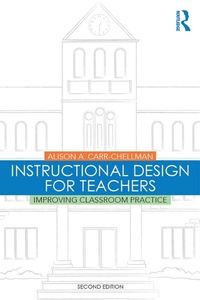
Instructional Design for Teachers
Improving Classroom Practice
2nd Edition
Published on 26. June 2015
214 pages
978-1-317-68021-5 (ISBN)
Description

Instructional Design for Teachers, Second Edition focuses on the instructional design (ID) process specifically for K-12 teachers. The first edition introduced a new, common-sense model of instructional design to take K-12 teachers through the ID process step by step, with a special emphasis on preparing, motivating, and encouraging new and ongoing use of ID principles. This second edition includes new material on design in gaming, cybercharters, online classrooms, and flipped classrooms, as well as special considerations for the Common Core.
Each chapter contains framing questions, common errors, easy-to-use rules of thumb, clearly stated outcomes, and examples showing ID in action. The basic model and its application within constructivism and user-design will help teachers adapt from a behavioral approach to a more open, student-centered design approach. Combining basics with strategies to implement this model in the most advanced instructional approaches, this book empowers teachers and learners to use good instructional design with the most recent research-based approaches to learning.
Instructional Design for Teachers shows how ID principles can impact instructional moments in positive and practical ways. The book can be used for basic ID courses and introductory curriculum courses, and is accessible to in-service as well as pre-service teachers.
Each chapter contains framing questions, common errors, easy-to-use rules of thumb, clearly stated outcomes, and examples showing ID in action. The basic model and its application within constructivism and user-design will help teachers adapt from a behavioral approach to a more open, student-centered design approach. Combining basics with strategies to implement this model in the most advanced instructional approaches, this book empowers teachers and learners to use good instructional design with the most recent research-based approaches to learning.
Instructional Design for Teachers shows how ID principles can impact instructional moments in positive and practical ways. The book can be used for basic ID courses and introductory curriculum courses, and is accessible to in-service as well as pre-service teachers.
Reviews / Votes
"This book is a treasure for teachers! First, it is highly reader-friendly. It uses plain, engaging language, accompanied by helpful visuals, examples, and stories. And it is organized for easy access, such as having call-out boxes for heuristics and common errors. Second, this book presents powerful ideas for improving student learning, both in terms of the teacher's planning process and the teaching methods that are most likely to help students learn. Third, this book is flexible. It offers variations for different approaches to teaching, such as behaviorist, constructivist, user-design, inquiry learning, and standards-based curriculum. I strongly recommend this book for teachers at all levels of education."--Charles Reigeluth, Professor, Instructional Systems Technology, Indiana University, Bloomington, USA
"I am delighted with the information in this text! It breaks down the ID process in a very sensible and teacher-friendly manner. Standards-based learning has created an atmosphere wherein the lesson planning process feels very much out of teachers' hands. This text shows teachers how to take back the reins of their lesson planning-how to creatively analyze, synthesize, and implement their own well thought-out goals, objectives and individual lessons. In short, the text teaches teachers a shorthand process for creating sensible lessons that originate from the standards but grow out of their own identities as teachers. For this, I say, 'Well done!'"
--Melissa Merritt, 17-year Veteran Home School Teacher/Middle School Teacher, Fort Collins, Colorado, USA
"This book is an invaluable tool for teachers who want to plan interesting and effective lessons for their students. It not only provides teachers with a very practical, easy-to-employ model for designing instruction, it also demonstrates how the model can be integrated with a wide variety of teaching approaches that are popular today, ranging from constructivist, student-centered techniques to standards-based instructional methods. If you are a pre-service or in-service teacher who wants to improve instruction and learning in your classroom, you should definitely read this book!"
--Robert A. Reiser, Distinguished University Teaching Professor and Robert M. Morgan Professor of Instructional Systems, Florida State University, USA
"Instructional Design for Teachers is a very teacher-friendly and easy-to-read book full of great ideas for both the first-year and veteran teachers among us who are interested in using instructional design tomorrow in our classrooms. This book takes you step-by-step through the processes of implementation in a very practical and delightful journey. If you want to be a better teacher, read Instructional Design for Teachers."
--Kitsy Fisher, 31-year Kindergarten Teacher, Dublin, Ohio, USA
More details
Edition
2nd edition
Language
English
Place of publication
London
United Kingdom
Publishing group
Taylor & Francis Ltd
Target group
College/higher education
Edition type
Revised edition
Illustrations
33 s/w Abbildungen, 12 s/w Tabellen
12 Tables, black and white; 33 Illustrations, black and white
File size
4,49 MB
ISBN-13
978-1-317-68021-5 (9781317680215)
Copyright in bibliographic data and cover images is held by Nielsen Book Services Limited or by the publishers or by their respective licensors: all rights reserved.
Schweitzer Classification
Other editions
Additional editions
Book
06/2015
2nd Edition
Routledge
€241.60
Shipment within 10-20 days
Book
06/2015
2nd Edition
Routledge
€58.00
Shipment within 10-20 days
Person
Alison A. Carr-Chellman, PhD, is Department Head of Learning and Performance Systems and Professor of Education (Learning, Design, and Technology) at Pennsylvania State University, USA.
Content
List of Figures and Tables
Foreword by Walter Dick
Acknowledgments
1 What is Instructional Design?
2 What is the Instructional Design for Teachers (ID4T) Model?
3 How Does the ID4T Model Really Work in My Classroom?
4 How Can We Integrate Constructivist Notions into the ID4T Model?
5 How Can We Integrate User-Design into the ID4T Model?
6 How Can We Integrate Inquiry Learning into the ID4T Model?
7 How Can We Integrate the Standards-Based Curriculum into the ID4T Model?
8 Using ID4T in the Online classroom
9 Using ID4T in the Flipped classroom
10 Gaming and ID4T
11 What are the Primary Advantages and Drawbacks of the ID4T Model for Teachers?
Notes
References
Subject Index
Author Index
Foreword by Walter Dick
Acknowledgments
1 What is Instructional Design?
2 What is the Instructional Design for Teachers (ID4T) Model?
3 How Does the ID4T Model Really Work in My Classroom?
4 How Can We Integrate Constructivist Notions into the ID4T Model?
5 How Can We Integrate User-Design into the ID4T Model?
6 How Can We Integrate Inquiry Learning into the ID4T Model?
7 How Can We Integrate the Standards-Based Curriculum into the ID4T Model?
8 Using ID4T in the Online classroom
9 Using ID4T in the Flipped classroom
10 Gaming and ID4T
11 What are the Primary Advantages and Drawbacks of the ID4T Model for Teachers?
Notes
References
Subject Index
Author Index
