

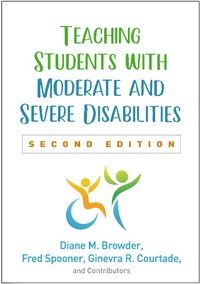
Teaching Students with Moderate and Severe Disabilities
2nd Edition
Published on 22. January 2020
440 pages
978-1-4625-4242-0 (ISBN)
Description

Students in special education and school psychology; K-12 special educators, school psychologists, reading specialists, classroom teachers, and administrators. Will serve as a text in advanced undergraduate- and graduate-level courses such as Methods for Students with Severe Disabilities.
More details
Other editions
Additional editions
Diane M. Browder | Fred Spooner | Ginevra R. Courtade
Teaching Students with Moderate and Severe Disabilities, Second Edition
Book
06/2020
2nd Edition
Guilford Press
€84.00
Article not available at the moment
Persons
Diane M. Browder, PhD, is Distinguished Professor Emerita of Special Education at the University of North Carolina at Charlotte (UNC Charlotte). Dr. Browder has researched and written about assessment and instruction for students with severe developmental disabilities since the 1980s. She worked closely with the Charlotte-Mecklenburg School System in developing new interventions for students with autism spectrum disorder and intellectual disabilities, with a focus on reading, science, and math. She continues to provide consultation to local school systems and to teach preservice special education courses at UNC Charlotte. Dr. Browder is a recipient of the Special Education Research Award from the Council for Exceptional Children (CEC), the Burton Blatt Humanitarian Award from the CEC Division on Autism and Developmental Disabilities, and the Distinguished Researcher Award from the American Educational Research Association Special Education Special Interest Group, among other honors.
Fred Spooner, PhD, is Professor of Special Education at the University of North Carolina at Charlotte. Dr. Spooner has researched and written about instructional strategies for students with severe disabilities since the 1980s. Recently, he has focused on alternate assessment and linking both assessment and instruction to the general education curriculum. He is coeditor of the Journal of Special Education and associate editor of Research and Practice for Persons with Severe Disabilities. Dr. Spooner has worked closely with Diane M. Browder in the development and implementation of federally funded research projects in the area of early literacy, mathematics, and science for students with significant cognitive disabilities, serving in the capacity of research associate and co-principal investigator.
Ginevra R. Courtade, PhD, is Associate Professor of Special Education at the University of Louisville. She has worked in the field of moderate and severe disabilities since the late 1990s. Dr. Courtade's work focuses specifically on teaching academics to students with moderate and severe disabilities and preparing teachers to instruct students in the general education curriculum using evidence-based practices. Her numerous publications include peer-reviewed journal articles, book chapters, books, and curricula. Dr. Courtade was recently recognized by her college for service to the profession.
Fred Spooner, PhD, is Professor of Special Education at the University of North Carolina at Charlotte. Dr. Spooner has researched and written about instructional strategies for students with severe disabilities since the 1980s. Recently, he has focused on alternate assessment and linking both assessment and instruction to the general education curriculum. He is coeditor of the Journal of Special Education and associate editor of Research and Practice for Persons with Severe Disabilities. Dr. Spooner has worked closely with Diane M. Browder in the development and implementation of federally funded research projects in the area of early literacy, mathematics, and science for students with significant cognitive disabilities, serving in the capacity of research associate and co-principal investigator.
Ginevra R. Courtade, PhD, is Associate Professor of Special Education at the University of Louisville. She has worked in the field of moderate and severe disabilities since the late 1990s. Dr. Courtade's work focuses specifically on teaching academics to students with moderate and severe disabilities and preparing teachers to instruct students in the general education curriculum using evidence-based practices. Her numerous publications include peer-reviewed journal articles, book chapters, books, and curricula. Dr. Courtade was recently recognized by her college for service to the profession.
Content
I. Educational Foundations
1. Introduction to the Education of Students with Severe Disabilities, with Irene Meier
2. Multicultural Perspectives: Culture, Family, Relationships, and Instruction, with Chris Rivera
3. Building Communication Competence, with Pamela J. Mims
4. Using Assessment for Planning Standards-Based Individualized Education Programs, with Bree Jimenez
5. Monitoring and Enhancing Student Progress: Getting the Most Out of Data, with Robert Pennington
6. Using Instruction That Works: Evidence-Based Practices, with Pamela J. Mims
II. Academics
7. Building Early Literacy and Reading Skills, with Lynn Ahlgrim-Delzell
8. Teaching English Language Arts Standards across the Grades, with Melissa Hudson
9. Promoting Writing: Creation of Permanent Product Communications, with Robert Pennington
10. Building Early Numeracy and Problem Solving, with Alicia Saunders
11. Teaching Mathematical Standards across the Grades, with Katherine Trela
12. Science and Engineering Practices, with Bree Jimenez
13. Expanding Cultural and Social Competence through Social Studies, with Leah Wood
III. Related Skills and Supports
14. Promoting Social Skills and Positive Behavior Support, with Chelsi R. Brosh & Victoria F. Knight
15. Addressing Sensory, Physical, and Health Care Needs, with Pamela J. Mims
16. Teaching Personal and Daily Living Skills, with Joshua Baker
17. Planning and Teaching for Adult Living, with Valerie L. Mazzotti
References
Index
1. Introduction to the Education of Students with Severe Disabilities, with Irene Meier
2. Multicultural Perspectives: Culture, Family, Relationships, and Instruction, with Chris Rivera
3. Building Communication Competence, with Pamela J. Mims
4. Using Assessment for Planning Standards-Based Individualized Education Programs, with Bree Jimenez
5. Monitoring and Enhancing Student Progress: Getting the Most Out of Data, with Robert Pennington
6. Using Instruction That Works: Evidence-Based Practices, with Pamela J. Mims
II. Academics
7. Building Early Literacy and Reading Skills, with Lynn Ahlgrim-Delzell
8. Teaching English Language Arts Standards across the Grades, with Melissa Hudson
9. Promoting Writing: Creation of Permanent Product Communications, with Robert Pennington
10. Building Early Numeracy and Problem Solving, with Alicia Saunders
11. Teaching Mathematical Standards across the Grades, with Katherine Trela
12. Science and Engineering Practices, with Bree Jimenez
13. Expanding Cultural and Social Competence through Social Studies, with Leah Wood
III. Related Skills and Supports
14. Promoting Social Skills and Positive Behavior Support, with Chelsi R. Brosh & Victoria F. Knight
15. Addressing Sensory, Physical, and Health Care Needs, with Pamela J. Mims
16. Teaching Personal and Daily Living Skills, with Joshua Baker
17. Planning and Teaching for Adult Living, with Valerie L. Mazzotti
References
Index
