

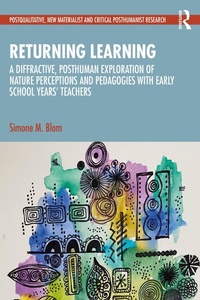
Returning Learning
A Diffractive, Posthuman Exploration of Nature Perceptions and Pedagogies with Early School Years' Teachers
1st Edition
Published on 30. December 2024
336 pages
978-1-040-27288-6 (ISBN)
Description

Returning Learning explores early school years teachers' perceptions of nature and how this informs their pedagogy through a posthuman theoretical framework. The theoretical framework is purposefully designed to disrupt dichotomies and reject abuse to marginalised others. In doing so, this book offers a reconceptualisation of learning in environmental education, and education more broadly.
The posthuman theoretical framework is a transdisciplinary offering informed by material-discursive practices, affective atmospheres, and childhoodnature. The theoretical framework and transqualitative methodology support diffractive ethnographic methods where data are generated through an iterative and entangled data collection and data analysis process. This process is presented as a series of "diffractive data entanglements" that explore teachers' perceptions of nature, their pedagogical practices, and the implications of these data through a posthuman framing. These non-conventional approaches to undertaking research are the foundation for this book that listens to teacher's voices by conducting research with teachers rather than to teachers.
Through a deep exploration into the intricacies of everyday classroom practices and happenings, this book privileges the voices of the teachers and the nonhuman, thus the response-ability of teachers to their students and the planet, is re-turned. It will be of interest to researchers who are interested in creative and innovative theories and methodologies as well as those studying environmental education and other pedagogical studies as part of their courses.
The posthuman theoretical framework is a transdisciplinary offering informed by material-discursive practices, affective atmospheres, and childhoodnature. The theoretical framework and transqualitative methodology support diffractive ethnographic methods where data are generated through an iterative and entangled data collection and data analysis process. This process is presented as a series of "diffractive data entanglements" that explore teachers' perceptions of nature, their pedagogical practices, and the implications of these data through a posthuman framing. These non-conventional approaches to undertaking research are the foundation for this book that listens to teacher's voices by conducting research with teachers rather than to teachers.
Through a deep exploration into the intricacies of everyday classroom practices and happenings, this book privileges the voices of the teachers and the nonhuman, thus the response-ability of teachers to their students and the planet, is re-turned. It will be of interest to researchers who are interested in creative and innovative theories and methodologies as well as those studying environmental education and other pedagogical studies as part of their courses.
Reviews / Votes
This book is a gift for all early years teachers; it is a gift they have been waiting for, as they ponder how to make a positive contribution to the troubled world the children are growing up in. Blom offers a way of thinking-in-being, where teachers, and the children they teach, are not outside nature, or opposite to nature. The children are not growing up in that world, but as that world; indeed we are, as humans, not superior to nature, or separate from it, or above it; we are, all of us, nature.--Professor Bronwyn Davies, Professorial Fellow, University of Melbourne and Emeritus Professor, Western Sydney University
Blom begins this book positing that "there is a desperate and urgent need for monumental changes to education systems" and I think that is correct. So where better to start than from the beginning, accompanying young children and their human and more-than-human educators as they re-turn themselves into earthy relationality. A must read for those teaching, thinking, and seeking in the direction of monumental change.
--Professor Sean Blenkinsop, Faculty of Education, Simon Fraser University and Co-Director, Imaginative Education Research Group (IERG)
In this fascinating and challenging book, Blom takes cues from posthumanism, postqualitative inquiry, and non-representational theory in advancing a novel approach to educational research called transqualitative inquiry. But it doesn't stop there! Blom then takes us on a 'diffractive journey' through a series of data entanglements that demonstrate how transqualitative inquiry can be put to work. The result is a 'deep dive' into the intricacies of everyday classroom practices and happenings which privileges the voices of the teachers and the nonhuman, and thus the 'response-ability' of teachers to their students and the planet. As an important transdisciplinary text, this book is highly recommended for postgraduate research students in education but also researchers in cognate disciplines like cultural geography, cultural studies, anthropology, environmental psychology, and even nursing.
--Associate Professor Candice P. Boyd, School of Geography, Earth and Atmospheric Sciences, The University of Melbourne, Australia
More details
Series
Edition
1. Auflage
Language
English
Place of publication
London
United Kingdom
Publishing group
Taylor & Francis Ltd
Target group
College/higher education
Professional and scholarly
Illustrations
1 Tables, black and white; 28 Halftones, black and white; 28 Illustrations, black and white
ISBN-13
978-1-040-27288-6 (9781040272886)
Copyright in bibliographic data and cover images is held by Nielsen Book Services Limited or by the publishers or by their respective licensors: all rights reserved.
Schweitzer Classification
Other editions
Additional editions

Simone M. Blom
Returning Learning
A Diffractive, Posthuman Exploration of Nature Perceptions and Pedagogies with Early School Years' Teachers
Book
06/2025
Routledge
Unfortunately, price unknown
Available (delivery time upon request)
Simone M. Blom
Returning Learning
A Diffractive, Posthuman Exploration of Nature Perceptions and Pedagogies with Early School Years' Teachers
Book
12/2024
1st Edition
Routledge
€83.90
Shipment within 10-20 days
Simone M. Blom
Returning Learning
A Diffractive, Posthuman Exploration of Nature Perceptions and Pedagogies with Early School Years' Teachers
Book
12/2024
1st Edition
Routledge
€223.10
Shipment within 10-20 days
Person
Simone M. Blom, Southern Cross University, Australia.
Content
1. The First Turn: Thinking with/as nature for educational futures. 2. The Second Turn: Teachers' perceptions with/as nature in environmental education, a returning. 3. The Third Turn: Posthuman theorising in educational research with teachers' nature perceptions and pedagogies. 4. The Fourth Turn: Methodologies that matter for future making in educational research. 5. The Fifth Turn: Diffractive ethnography as a posthuman qualitative tension in environmental education research. 6. The Sixth Turn: Data designing and methods making in posthuman educational research. 7. The Seventh Turn: Exploring the materialities of context in posthuman educational research. 8. The Eighth Turn: Diffractive data entanglements for presenting posthuman educational research - part one. 9. The Ninth Turn: Diffractive data entanglements for presenting posthuman educational research - part two. 10.The Tenth Turn: Meaning-making with/as nature for educational futures.
