

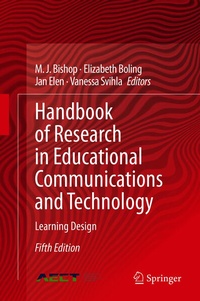
Handbook of Research in Educational Communications and Technology
Description

The 5th edition of the prestigious AECT Handbook continues previous efforts to reach outside the traditional instructional design and technology community to the learning sciences and computer information systems communities toward developing a conceptualization of the field. However, given the pervasive and increasingly complex role technology now plays in education since the 1st edition of the Handbook in 1996, the editors have reorganized the research chapters in this edition to focus on the learning problems we are trying to solve with educational technologies, rather than to focus on the things we are using to solve those problems. Additionally, for the first time this edition of the Handbook reflects our field's growing understanding of the importance of design scholarship to inform practice by including design case chapters. These changes for this edition of the Handbook are intended to bring educational technology research into the broader framework of educational research by elaborating on the role instructional design and technology plays as a scholarly discipline in addressing education's increasingly complex issues.
- Provides comprehensive reviews of new developments in educational technology research and design practice.
- Includes concrete examples to guide future research and practice in the ways emerging technologies can be used to solve educational problems.
- Contains extensive references furnished to guide readers to the most recent research and design practice in the field of instructional design and technology.
More details
Other editions
Additional editions
Persons
MJ Bishop is the Director of the Kirwan Center for Academic Innovation at the University System of Maryland, which researches best practice, disseminates information and offers professional development opportunities for faculty and administrators, all in support of the USM's 12 public campuses. Prior to her current role, Bishop served as Program Director for Teaching, Learning and Technology at Lehigh University, where she was faculty member for 13 years in instructional design and technology.
Jan Elen is Professor in the Department of Educational Sciences of the Katholieke University of Leuven. His research is oriented towards the design and use of computer-supported learning environments in educational settings. He is the coordinator of the newly- founded School of Education of the Association at Katholieke University of Leuven.
Vanessa Svihla is Associate Professor at the University of New Mexico. Her research interests focus on how people learn when they design. She is particularly interested in how people frame problems, how these activities relate to identity, agency and creativity, and ways to assess these complex disciplinary practices.
