

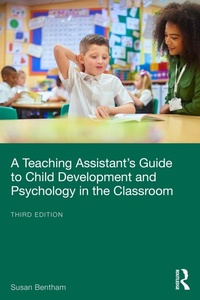
A Teaching Assistant's Guide to Child Development and Psychology in the Classroom
3rd Edition
Published on 16. June 2025
232 pages
978-1-040-36253-2 (ISBN)
Description

How can you help students most effectively in the classroom? As a teaching assistant, you play a vital role in today's schools. This fully updated third edition will help you get to grips with the main issues to do with psychology and its role in the processes of teaching and learning.
This accessible text provides informative, yet down-to-earth commentary with clear examples of how you can apply this knowledge in everyday practice. This book addresses issues such as how to support learning and behaviour, how to create an optimal learning environment for all students, ways to encourage pupil voice, supportive strategies for children with additional needs, and how to help children with their self-esteem and independence. This new edition includes references to up-to-date research in child development and psychology to include information regarding wellbeing, mental health, and learning strategies related to insights from cognitive science. Chapters are complemented with lively case studies, self-assessment questions, and examples of how to apply theory to everyday classroom practice. The reader is encouraged to develop reflective practice to best support children's behaviour and learning.
This reader-friendly book is an invaluable companion for every teaching assistant, HLTA, pastoral support assistant, learning mentor, classroom cover supervisor and anyone working in a supporting role in an educational setting.
This accessible text provides informative, yet down-to-earth commentary with clear examples of how you can apply this knowledge in everyday practice. This book addresses issues such as how to support learning and behaviour, how to create an optimal learning environment for all students, ways to encourage pupil voice, supportive strategies for children with additional needs, and how to help children with their self-esteem and independence. This new edition includes references to up-to-date research in child development and psychology to include information regarding wellbeing, mental health, and learning strategies related to insights from cognitive science. Chapters are complemented with lively case studies, self-assessment questions, and examples of how to apply theory to everyday classroom practice. The reader is encouraged to develop reflective practice to best support children's behaviour and learning.
This reader-friendly book is an invaluable companion for every teaching assistant, HLTA, pastoral support assistant, learning mentor, classroom cover supervisor and anyone working in a supporting role in an educational setting.
More details
Edition
3rd edition
Language
English
Place of publication
London
United Kingdom
Publishing group
Taylor & Francis Ltd
Target group
College/higher education
Professional and scholarly
Illustrations
24 Tables, black and white; 29 Halftones, black and white; 29 Illustrations, black and white
File size
1,87 MB
ISBN-13
978-1-040-36253-2 (9781040362532)
Copyright in bibliographic data and cover images is held by Nielsen Book Services Limited or by the publishers or by their respective licensors: all rights reserved.
Schweitzer Classification
Other editions
Additional editions

Book
07/2025
Routledge
Unfortunately, price unknown
Available (delivery time upon request)
Book
06/2025
3rd Edition
Routledge
€205.20
Shipment within 10-20 days
Book
06/2025
3rd Edition
Routledge
€36.50
Shipment within 10-20 days
Person
Susan Bentham is principal lecturer in Education at the University of Chichester and a chartered psychologist. She has previously published How to Be a Brilliant Teaching Assistant (2018, Routledge), A Teaching Assistant's Guide to Completing NVQ Level 3 (2009, Routledge), and A Teaching Assistant's Guide to Managing Behaviour in the Classroom (2005, Routledge).
Content
Introduction
Definitions of reflection and the reflective practitioner
Ways to reflect: the reflective account
Ways to reflect: the professional dialogue
Final comments
1. Basic principles underlying pupil development and learning
Intellectual and cognitive skills
Language and communication skills
Social and emotional skills
Specific skills and abilities
Summary
2. Learning support strategies
Learning strategies as a way to promote effective learning
Specific skills
Summary
3. Creating an optimal learning environment
Barriers to effective learning
In search of an optimal learning environment
Learning preferences
Summary
4. Pupils with Additional Needs
Inclusion
Terminology
Autism spectrum
Dyslexia
Developmental coordination disorder
Attention-deficit hyperactivity disorder
Speech, language, and communication difficulties
Sensory impairment
English as an additional language
Care experienced children
Mental health and wellbeing
Putting it all together
5. Behaviour for learning
Introduction
Language of behaviour
Strategies to promote good behaviour
Summary
6. Establishing positive relationships with pupils and colleagues
Introduction
Basic principles of effective communication with pupils
Techniques of active listening
Pupil voice, agency, and co-production
Working with groups
Staff wellbeing
What does a collaborative relationship look like?
7. Self-esteem, motivation, and independent learners
Self-esteem and self-concept
Factors that affect the development of self-esteem and self-concept
Strategies that will enhance self-esteem
Praise and self-esteem
The relationship between self-esteem and achievement
Motivation
Factors that promote independence: developing autonomy
Teaching choice
Definitions of reflection and the reflective practitioner
Ways to reflect: the reflective account
Ways to reflect: the professional dialogue
Final comments
1. Basic principles underlying pupil development and learning
Intellectual and cognitive skills
Language and communication skills
Social and emotional skills
Specific skills and abilities
Summary
2. Learning support strategies
Learning strategies as a way to promote effective learning
Specific skills
Summary
3. Creating an optimal learning environment
Barriers to effective learning
In search of an optimal learning environment
Learning preferences
Summary
4. Pupils with Additional Needs
Inclusion
Terminology
Autism spectrum
Dyslexia
Developmental coordination disorder
Attention-deficit hyperactivity disorder
Speech, language, and communication difficulties
Sensory impairment
English as an additional language
Care experienced children
Mental health and wellbeing
Putting it all together
5. Behaviour for learning
Introduction
Language of behaviour
Strategies to promote good behaviour
Summary
6. Establishing positive relationships with pupils and colleagues
Introduction
Basic principles of effective communication with pupils
Techniques of active listening
Pupil voice, agency, and co-production
Working with groups
Staff wellbeing
What does a collaborative relationship look like?
7. Self-esteem, motivation, and independent learners
Self-esteem and self-concept
Factors that affect the development of self-esteem and self-concept
Strategies that will enhance self-esteem
Praise and self-esteem
The relationship between self-esteem and achievement
Motivation
Factors that promote independence: developing autonomy
Teaching choice
