

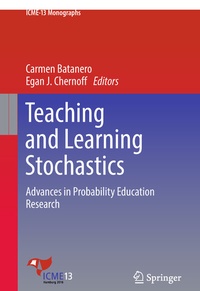
Teaching and Learning Stochastics
Description

In brief, the papers presented here include research dealing with teachers and students at different levels and ages (from primary school to university) and address epistemological and curricular analysis, as well as the role of technology, simulations, language and visualisation in teaching and learning probability. As such, it offers essential information for teachers, researchers and curricular designers alike.
More details
Other editions
Additional editions
Content
Preface.- Section 1. Teaching probability.- Chapter 1. Reasoning with risk: teaching probability and risk as twin concepts.- Chapter 2. Language and lexical ambiguity in the probability register.- Chapter 3. The status of probability in the elementary and lower secondary school mathematics curriculum: the rise and fall of probability in school mathematics in the United States.- Chapter 4. Challenges and opportunities in experimentation-based instruction in probability.- Chapter 5. Visualising conditional probabilities - three perspectives on unit squares and tree diagrams.- Chapter 6. Probability concepts needed for teaching a repeated sampling approach to inference.- Chapter 7. Characterizing the probability problems proposed in university entrance tests in Andalucia.- Chapter 8. Random walks in the didactics of probability: enactive metaphoric learning sprouts .- Chapter 9. The role of statistics anxiety in learning probability.- Section 2. Students' reasoning and learning.- Chapter 10. What 9- and 10-year old pupils already know and what they can learn about randomness.- Chapter 11. Understanding children's meaning of randomness in relation to random generators. .- Chapter 12. Reasoning in decision making under uncertainty and decisions of risi on a game of chance.- Chapter 13. Determinism and empirical commitment in probabilistic reasoning of high school students.- Chapter 14. Students' reasoning on sample space and probabilities of compound events .- Chapter 15. The six loses: risky decisions between probabilistic reasoning and gut feelings.- Section 3. Education of teachers.- Chapter 16. Comparing the relative probabilities of events.- Chapter 17. Preparing teachers for teaching probability through problem solving.- Chapter 18. Exploring teachers' attitudes towards probability and its teaching.- Chapter 19. Students' reflections about a course for learning probability via simulations.- Chapter 20. Prospective teachers reasoning in the context of sampling.- A commentary on teaching and learning stochastics: Advances in probability education research.
