

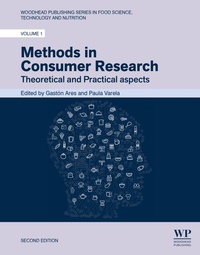
Methods in Consumer Research, Volume 1
Theoretical and Practical aspects
2nd Edition
Published on 3. April 2026
600 pages
978-0-443-22278-8 (ISBN)
Description

Methods in Consumer Research, Volume 1: Theoretical and Practical aspects, Second Edition, brings together the world's leading experts in global consumer research who provide a fully comprehensive state-of-the-art coverage of advances in methods in consumer science.The new edition, thoroughly revised and updated, touches on the latest developments in consumer behavior. It includes a theoretical overview of consumer behavior, followed by a detailed description of qualitative techniques, including coverage of focus groups, projective techniques, ethnography, and social media. Quantitative methods are also addressed from both an explicit and implicit perspective. A section specifically delves into physiological measurements, such as eye-tracking, facial reading, and fMRI.In conjunction with the second volume, which covers specific applications, this book is an invaluable reference for academics working in the fields of sensory and consumer science, psychology, marketing, and nutrition. Through examples of the methodologies being applied throughout, it serves as a practical guide to practitioners in both the public and private sector.
- Provides a comprehensive view of consumer behavior
- Presents a full coverage of methodologies of consumer research
- Includes both qualitative and quantitative methods
- Brings implicit methods for studying consumer perception and behavior
- Covers new chapters on physiological measurements, such as eye-tracking, facial reading and fMRI, and quantitative new methods
More details
Other editions
Additional editions
Book
approx. 02/2026
2nd Edition
Woodhead Publishing
€230.50
Not yet published
Previous edition
E-Book
01/2018
Woodhead Publishing
€210.00
Available for download
Content
Section 1: Theoretical and methodological considerations on consumer research1. Recent advances in consumer research2. Complexity of consumer perception3. Psychographics: Personality variables in consumer research4. Contextual influences on consumer responses to food products5. Ethics in sensory and consumer researchSection 2: Qualitative research6. New approaches to focus groups7. Projective techniques8. Ethnography and observational methods in consumer research9. Application of social media for consumer research10. Text mining11. Design thinking, co-creation and consumer involvement in research and innovationSection 3: Quantitative direct methods12. Conjoint analysis in sensory and consumer science: Principles, applications and future perspectives13. Affect-based discrimination14. Emotional responses to products15. Consumer-based methodologies for sensory characterization16. Measuring the dynamics of consumer perception17. Statistical approaches to consumer segmentation18. Measuring consumer expectations19. Situational appropriateness in food consumer research20. Experimental economics to evaluate consumer preferencesSection 4: Quantitative indirect methods21. Measuring implicit associations in food-related consumer research22. Automatic facial expressions analysis in consumer science23. Eye tracking in consumer research24. Physiological measurements: EEG and fMRI
