

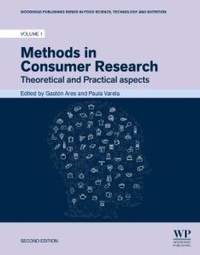
Methods in Consumer Research, Volume 1
Theoretical and Practical aspects
2nd Edition
Will be published approx. on 1. February 2026
Book
Paperback/Softback
600 pages
978-0-443-22279-5 (ISBN)
Description
Methods in Consumer Research, Volume 1: Theoretical and Practical aspects, Second Edition, brings together the world's leading experts in global consumer research who provide a fully comprehensive state-of-the-art coverage of advances in methods in consumer science.
The new edition, thoroughly revised and updated, touches on the latest developments in consumer behavior. It includes a theoretical overview of consumer behavior, followed by a detailed description of qualitative techniques, including coverage of focus groups, projective techniques, ethnography, and social media. Quantitative methods are also addressed from both an explicit and implicit perspective. A section specifically delves into physiological measurements, such as eye-tracking, facial reading, and fMRI.
In conjunction with the second volume, which covers specific applications, this book is an invaluable reference for academics working in the fields of sensory and consumer science, psychology, marketing, and nutrition. Through examples of the methodologies being applied throughout, it serves as a practical guide to practitioners in both the public and private sector.
The new edition, thoroughly revised and updated, touches on the latest developments in consumer behavior. It includes a theoretical overview of consumer behavior, followed by a detailed description of qualitative techniques, including coverage of focus groups, projective techniques, ethnography, and social media. Quantitative methods are also addressed from both an explicit and implicit perspective. A section specifically delves into physiological measurements, such as eye-tracking, facial reading, and fMRI.
In conjunction with the second volume, which covers specific applications, this book is an invaluable reference for academics working in the fields of sensory and consumer science, psychology, marketing, and nutrition. Through examples of the methodologies being applied throughout, it serves as a practical guide to practitioners in both the public and private sector.
More details
Series
Edition
2nd edition
Language
English
Place of publication
United States
Publishing group
Elsevier - Health Sciences Division
Target group
Professional and scholarly
Product notice
Paperback (trade)
Unsewn / adhesive bound
Dimensions
Height: 276 mm
Width: 216 mm
Weight
1000 gr
ISBN-13
978-0-443-22279-5 (9780443222795)
Copyright in bibliographic data and cover images is held by Nielsen Book Services Limited or by the publishers or by their respective licensors: all rights reserved.
Schweitzer Classification
Other editions
Additional editions
E-Book
04/2026
2nd Edition
Woodhead Publishing
€235.00
Available for download
Previous edition
Book
01/2018
Woodhead Publishing Ltd
€222.84
Shipment within 15-20 days
Persons
Gaston Ares works as a professor and researcher in the Department of Food Science and Technology, Faculty of Chemistry, University of the Republic (UdelaR). He works in the area of Sensory and Consumer Science Assessment, working particularly on methodological aspects of new product development and the study of consumer perception. He has extensive experience in research through participation in numerous projects at national and international level. In 2011 he won the prize "Food Quality and Preference Elsevier Award for a Young Researcher". He serves as a reviewer for several journals in the area and is a member of the Editorial Committee of the Journal of Sensory Studies journals and Food Quality and Preference. Paula's research has focused on the exploration of new methodologies to further understanding sensory and consumer perception, in particular sensory descriptive techniques with the use of consumers and the influence of non-sensory parameters in consumer food choice. She is a member of the Editorial Board and Guest Editor of Food Research International and of Current Opinion in Food Science. She also has a part-time associate professor position in in sensory and consumer science at the Norwegian University of Life Sciences (NMBU).
Content
Part I. Introduction
1. Recent Advances in Consumer Science
2. Psychographics
Part II. Qualitative Techniques
3. Contextual Influences on Consumer Responses to Food Products
4. New Approaches to Focus Groups
5. Projective Techniques
6. Using Ethnography in Consumer Research
Part III. Liking and Beyond
7. Application of Social Media for Consumer Research
8. Text mining
9. Co-creation and design thinking
10. Conjoint Analysis in Sensory and Consumer Science: Principles, Applications, and Future Perspectives
11. Emotional Responses to Products
12. Consumer-Based Methodologies for Sensory Characterization
13. Measuring the dynamics of Consumer Perception
Part IV. Consumer Segmentation
14. Consumer Segmentation
15. Conceptual Profiling
16. Measuring consumer expectations
17. Situational appropriateness
Part V. Influence of Extrinsic Product Characteristics
18. Experimental Economics to Evaluate Consumer Preferences
19. Measuring Implicit Associations in Food-Related Consumer Research
20. Automatic Facial Expressions Analysis in Consumer Science
21. Physiological Measurements: EEG and fMRI
22. Eye Tracking in Consumer Research
1. Recent Advances in Consumer Science
2. Psychographics
Part II. Qualitative Techniques
3. Contextual Influences on Consumer Responses to Food Products
4. New Approaches to Focus Groups
5. Projective Techniques
6. Using Ethnography in Consumer Research
Part III. Liking and Beyond
7. Application of Social Media for Consumer Research
8. Text mining
9. Co-creation and design thinking
10. Conjoint Analysis in Sensory and Consumer Science: Principles, Applications, and Future Perspectives
11. Emotional Responses to Products
12. Consumer-Based Methodologies for Sensory Characterization
13. Measuring the dynamics of Consumer Perception
Part IV. Consumer Segmentation
14. Consumer Segmentation
15. Conceptual Profiling
16. Measuring consumer expectations
17. Situational appropriateness
Part V. Influence of Extrinsic Product Characteristics
18. Experimental Economics to Evaluate Consumer Preferences
19. Measuring Implicit Associations in Food-Related Consumer Research
20. Automatic Facial Expressions Analysis in Consumer Science
21. Physiological Measurements: EEG and fMRI
22. Eye Tracking in Consumer Research