

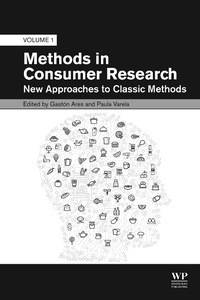
Methods in Consumer Research, Volume 1
New Approaches to Classic Methods
Published on 2. January 2018
582 pages
978-0-08-101258-1 (ISBN)
Description

Methods for Consumer Research, Volume One: New Approaches to Classic Methods brings together world leading experts in global consumer research who provide a fully comprehensive state-of-the-art coverage of advances in the classical methods of consumer science. The book touches on the latest developments in qualitative techniques, including coverage of both focus groups and social media, while also focusing on liking, a fundamental principle of consumer science, consumer segmentation, and the influence of extrinsic product characteristics, such as packaging and presentation on consumer liking.
In conjunction with the second volume, which covers alternative approaches and special applications, this book is an invaluable reference for academics working in the fields of in-sensory and consumer science, psychology, marketing and nutrition. And, with examples of the methodology being applied throughout, it serves as a practical guide to research and development managers in both food and non-food companies.
- Presents a fully comprehensive coverage of the latest developments in the classical methodologies of consumer research
- Provides examples of successful application of the methodologies presented
- Includes focus groups and social media discussions
- Encompasses consumer segmentation, with a focus on psychographics and genetics
More details
Other editions
New editions
E-Book
04/2026
2nd Edition
Woodhead Publishing
€235.00
Available for download
Additional editions
Book
01/2018
Woodhead Publishing Ltd
€222.84
Shipment within 15-20 days
Content
Part One: Introduction1. Recent advances in consumer research2. Complexity of consumer perception
Part Two: Qualitative Techniques3. New approaches to focus groups4. Projective techniques5. Using Ethnography in Consumer Research6. Application of social media for consumer research
Part Three: Liking and Beyond7. Product performance optimization8. Consumer-based methodologies for sensory characterization9. Dynamics of consumer perception10. Repeated exposure11. Affect-based discrimination methods12. Emotional response to products13. Conceptual associations14. Nudging
Part Four: Consumer Segmentation15. Statistical approaches for consumer segmentation16. Including context in consumer segmentation: a literature overview shows the what, why and how17. Oral processing, implications for consumer choice and preferences18. Consumer Segmentation Based on Genetic Variation in Taste and Smell
Part Five: Influence of Extrinsic Product Characteristics19. Expectations- blind/informed testing20. Conjoint analysis in sensory and consumer science: Principles, applications and future perspectives21. Credence22. Information Display Matrix23. Experimental economics to evaluate consumer preferences
