

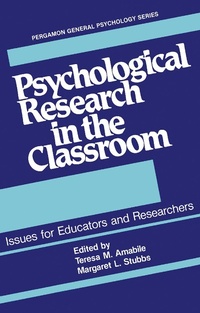
Psychological Research in the Classroom
Issues for Educators and Researchers
Published on 6. June 2016
288 pages
978-1-4831-3687-5 (ISBN)
Description

Psychological Research in the Classroom
More details
Other editions
Additional editions

Teresa M. Amabile | Michael Stubbs
Psychological Research in the Classroom
Issues for Educators and Researchers
Book
06/1982
Pergamon
€69.44
Article exhausted; check different version
Content
- Front Cover
- Psychological Research in the Classroom: Issues for Educators and Researchers
- Copyright Page
- Table of Contents
- Dedication
- Preface
- Acknowledgments
- Part I: The Issues
- Introduction to Part I
- Chapter 1. Psychological Research in the Classroom: An Introduction to the Issues
- Chapter 2. Conversation I: The Gap between Teachers and Researchers
- THE PURPOSE AND USE OF RESEARCH
- METHODOLOGY
- THEORY
- SOME IDEAS FOR CLOSING THE GAP
- Chapter 3. Conversation II: Issues in the Application of Research Results
- RESEARCH AS POLITICAL AMMUNITION
- RESEARCH AS A GUIDE TO PRACTICE
- SUMMARY AND CONCLUSIONS
- Reference
- Chapter 4. A Visit to the Teachers' Lounge: A Dialogue on School Research
- THE UTILITY OF RESEARCH
- VALUES, MOTIVES, AND ETHICS
- PRACTICAL AND POLITICAL PROBLEMS
- SOME NEGATIVE EXPERIENCES
- RESEARCHERS' SUMMARY
- TEACHERS' SUMMARY
- REFERENCES
- Part II: What Research Can Offer
- Introduction to Part II
- Chapter 5. Social Psychologists in the Classroom
- THE SOCIAL PSYCHOLOGIST'S INTEREST IN SCHOOLS
- WHAT DOES THE SOCIAL PSYCHOLOGIST HAVE TO OFFER?
- SOME EXAMPLES
- REFERENCES
- Chapter 6. Developmental Psychologists in the Classroom
- DIFFERENCES IN THE GOALS OF RESEARCH
- DIFFERENCES IN THE METHODS OF RESEARCH
- DIFFERENCES IN VALUE SYSTEMS CONCERNING LOGISTICS AND ETHICS
- A COMMENT ON THE PROBLEMS
- CONTRIBUTIONS OF DEVELOPMENTAL PSYCHOLOGY
- SUGGESTIONS
- REFERENCES
- Chapter 7. The Knowledge Base on Teaching: It's Here, Now
- THE HISTORY
- RECASTING THE LITERATURE
- CURRENT RESEARCH
- THE TREASURE TROVE
- WHY DON'T TEACHERS TALK ABOUT TEACHING
- TEACHERS AS RESEARCHERS: A NEW SELF-IMAGE
- NOTES
- REFERENCES
- Chapter 8. Methodology: Considerations for Classroom Research
- FUNDAMENTAL CONSIDERATIONS: A BRIEF GUIDE FOR TEACHERS
- SPECIAL FEATURES OF EDUCATIONAL RESEARCH: A BRIEF GUIDE FOR RESEARCHERS
- ANNOTATED BIBLIOGRAPHY
- REFERENCES
- Part III: Practitioners' Roles in Research
- Introduction to Part III
- Chapter 9. Personal Research
- REFERENCES
- Chapter 10. Design Criteria for Collaborative Classroom Research
- THE DESIGN CRITERIA
- EXAMPLES OF CLASSROOM RESEARCH AS A COLLABORATION BETWEEN TEACHERS AND RESEARCHERS
- CONCLUSIONS
- REFERENCES
- Chapter 11. Practitioners and Research: A Practitioner's View
- SOME POSITIVE EXAMPLES: ALL TEACHING IS RESEARCH
- INITIATION OF RESEARCH QUESTIONS
- SUMMARY
- REFERENCES
- Chapter 12. How Educators Make Decisions about Research: Research in the Brookline Public Schools
- THE RESEARCH TOPIC
- THE RESEARCH DESIGN
- ETHICAL, LEGAL, AND SOCIAL ISSUES
- HOW THE COMMITTEE FUNCTIONS
- REFERENCES
- APPENDIX: Testing, Research, and Evaluation Committee Questions
- Part IV: Practitioners' Research Needs
- Introduction to Part IV
- Chapter 13. Teacher Talk as a Tool for Effective Research
- THE TEACHER DEVELOPMENT PROJECT
- CHILDREN'S THINKING SEMINARS
- CONCLUSION
- NOTES
- REFERENCES
- Chapter 14. Writing about Practice
- REFERENCES
- Chapter 15. Case Study I: A Program for the Gifted
- GENERAL ISSUES
- A DEFINITION OF GIFTEDNESS
- DEVELOPMENT OF THE PROGRAM
- PROGRAM EVALUATION
- CONCLUSIONS
- REFERENCES
- Chapter 16. Case Study II: A Day Care Center
- SPACE
- CHILDREN
- FUNDING
- PROGRAM
- SUCCESS
- DAY CARE IN THE UNITED STATES
- RESEARCH ON DAY CARE
- UNANSWERED QUESTIONS
- CONCLUSION
- REFERENCES
- Part V: Prospects for Research in the Classroom
- Introduction to Part V
- Chapter 17. Guess Who's Coming to the Classroom
- CROSS-PURPOSES VERSUS DIFFERENT AGENDAS
- WILL THE REAL EXPERTS PLEASE STAND UP
- WHAT TO TELL THE CHILDREN
- THE TEACHER AND THE SCHOOL SETTING AS A SOURCE OF DATA
- FEEDBACK TO SCHOOL PERSONNEL
- ASSISTING TEACHERS IN ASKING QUESTIONS OF THEIR OWN
- REFERENCES
- Chapter 18. Beyond the Ivory Tower
- REFERENCES
- Chapter 19. Some Guidelines for Collaboration between Educators and Researchers
- FIVE GENERAL PRINCIPLES
- GUIDELINES FOR TEACHERS
- GUIDELINES FOR RESEARCHERS
- CONCLUSION
- Author Index
- Subject Index
- About the Editors and Contributors
- Pergamon General Psychology Series
